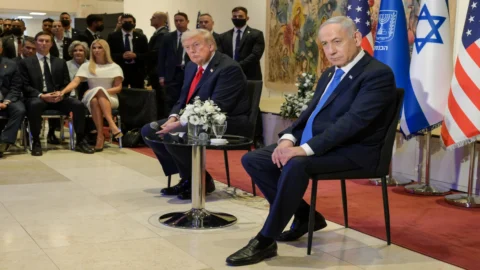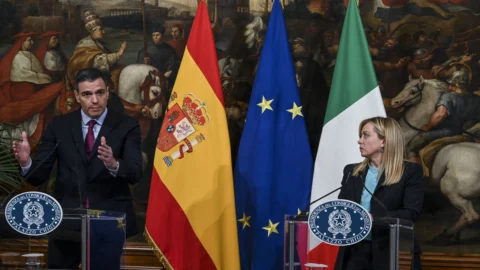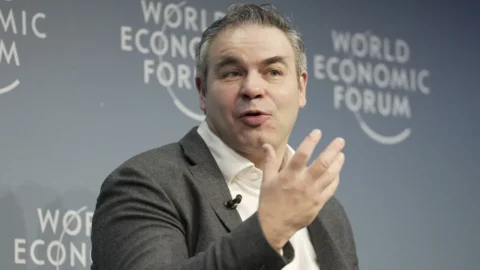
For the political agenda of theEuropean Union It seems like a very long time has passed since the NATO summit in Ankara in early July. A summit that temporarily froze the ongoing friction between the Administration Trump and the European governments but which has not moved by one millimetre the European urgencies to reorganise their own as soon as possible foreign policy and common defense"Ankara has revealed everything there is to know about the trap Europe finds itself in with regard to Trump. The entire summit was orchestrated down to the smallest detail precisely to avoid any unscheduled moments, because European leaders were terrified of what Trump might say or do. And, to please him, they accepted a completely arbitrary 5% spending target, which does not reflect our real needs in terms of military capabilities," he comments coolly. Mark Leonard, co-founder and director of the European Council on Foreign Relations, and author of Surviving Chaos: Geopolitics When the Rules Fail (published April 2026).
Director Leonard, the unpredictability of US President Donald Trump makes it almost impossible to use the categories of traditional diplomacy.
"Regarding the outcome of Ankara, we can say that in the short term, the European strategy worked: Trump did not announce the withdrawal of troops from Europe, he did not declare that the United States would leave the Alliance, and he even expressed positive words about Ukraine, also signing a final communiqué that reaffirmed Article 5. In the long term, however, this strategy is unsustainable. Managing Trump cannot replace building the independent capabilities Europe needs to protect itself from Russia, China, and potentially even the United States itself."
Energy shocks via Hormuz, American tariffs, and the rise of Chinese imports. Older European Union members in particular are struggling to cope with the effects of the acceleration of new international relations.
The Union has done a truly remarkable job over the past fifteen years, managing one crisis after another: from the euro crisis to Brexit, from the migration crisis to the war in Ukraine, and even the Covid pandemic. Since then, no other Member State has followed the United Kingdom outside the Union, and we have even witnessed a further deepening of European integration, as demonstrated by the issuance of common debt for post-Covid recovery funds or defense funding. In many of these cases, Brussels and the Member States have acted more quickly than most expected. But the world we are entering is entirely different and far more dangerous. It will become increasingly difficult for the European Union to simply muddle through in the future if it cannot adapt to this new reality.
Is the European spirit holding up better than expected?
“In many respects, Europeans instinctively continue to want to be what I call architects, that is, designers of large, comprehensive frameworks, often overly legalized. In this new, more fragmented environment, however, the most realistic strategy is that of the "artisan": working pragmatically within existing constraints, adapting existing tools and institutions rather than designing entirely new ones, and adapting quickly rather than planning everything exhaustively.
Even in a global context of chaos and the failure of rules, the main challenge to the EU's stability is economic. If the European economy holds up, so does the social model and the community architecture, with the potential for further integration steps. Do you agree?
First of all, I would say that there is no longer a global order. And the rules-based system is not simply under pressure: it is dead. This means that Europe can no longer rely on the predictable mechanisms of that order to guarantee its security. There have been some encouraging signs from Brussels regarding defense investments, but what is needed is a much more ambitious effort, one that takes into account the Draghi-Niinistö reports. Only then will Europe be able to survive.
Given that China is demonstrating its intention to continue to monopolize global production of both high-value-added and low-cost goods, isn't the time come for European industry to impose new tariff policies?
The truly positive aspect is that Europeans, with some notable exceptions, are finally recognizing the challenge posed by China. Just a few years ago, this was far from a given. That said, the European response must be much broader than simply resorting to defensive tariffs. Europe should establish conditions for access to its single market based on transparency, fair competition, and reciprocity. At the same time, it must reduce its supply chain dependencies on China.
Investments in AI are the new driver of global economic demand. Realistically, how long does Europe have to try to move beyond being just a precise regulator?
Europe has already lost the race for artificial intelligence. Its goal cannot be to compete with the United States and China in developing the most advanced models. Rather than accepting dependence on American technology or betting everything on building fully autonomous technological ecosystems, Europe should use the leverage it already has to minimize the risk of hostile actions against it and leverage its natural advantages.
In concrete terms?
This means imposing open standards and common data formats in public procurement, so that a healthcare company or a police force can switch providers without having to rebuild their entire data architecture from scratch. It also means moving toward modularity, that is, systems in which different vendors offer interchangeable components, rather than depending on a single company selling a single platform. all or nothing (all-or-nothing platform). Europe's goal should not be to reject American technology, but to prevent current relationships from evolving into forms of dependence similar to those we observe in other sectors, such as defense."
Germany, Europe's leading economy, is in the midst of its industrial transition, with devastating economic consequences. Does the future of European integration still hinge on holding Europe's fate to Germany's economic fate?
"Germany will likely become less of an economic powerhouse, as its export-driven growth model faces increasing challenges. But as it invests billions in defense, it will become much more influential on strategic issues."
Another risk to EU integration is the progressive polarization of countries like Germany, France, and Italy (but not only) toward the right and toward anti-European movements. If "systemic" Europeanism collapses in one of these countries, will the Union come to a standstill? Or worse...
I've spent a lot of time studying the new right in the countries you mentioned, and I've spoken with politicians and strategists from the AfD, the National Rally, and various right-wing Italian parties. Following the Brexit failures, these parties have abandoned many of their explicitly anti-EU positions. Today, they mostly advocate reforming the Union rather than leaving it. For this reason, I don't expect their eventual rise to power to spell the end of the Union. However, it will certainly have negative consequences for enlargement, the Multiannual Financial Framework (MFF), and common debt programs. This would certainly be the case if Marine Le Pen were to win the French presidential election, as a recurring criticism of the National Rally is that the European Union is a tool serving German interests.
Another crucial chapter for European politics in the coming months. Are relations between Europe and the US destined to normalize?
I believe Europeans are making a grave mistake in assuming that transatlantic relations will return to their pre-Trump normalcy once Trump leaves the White House, even if a Democratic president succeeds him. The trend toward progressive US disengagement is, in fact, structural, bipartisan, and began well before Trump's arrival in office, with the so-called pivot to Asia Obama. That said, Trump's presidency has been marked by a certain schizophrenic nature, which is less likely to distinguish his successor's administration…”.
But…
The key to building a good relationship with the United States in the future is to invest more in our defense, our resilience, and our autonomy. We can only have a stable relationship with the United States from a position of trust and strength, regardless of whether a Democratic or Republican administration is in the White House. Only then can the United States and Europe settle into a "new normal," beneficial to both sides.