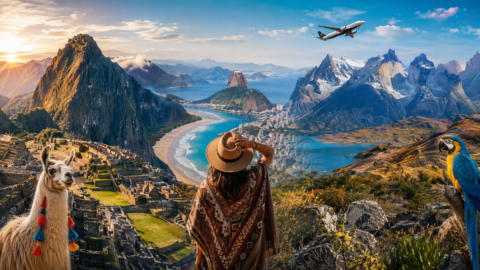
South American tourism enters 2026 with a transforming market. Brazil, Chile, Colombia, Peru, and Argentina are investing in air connections, hotel facilities, and new experiences, while governments and operators are trying to intercept international demand increasingly oriented towards nature, adventure, gastronomy and high-end tourism.
Growth, however, is not proceeding at the same speed everywhere. Brazil continues to break records, Chile is conquering new markets Colombia, on the other hand, benefits from an increasingly extensive long-distance air network, while Peru struggles to balance growing visitor numbers with protecting Machu Picchu. Argentina, on the other hand, is focusing primarily on attracting international investment to its Patagonian destinations.
The result is a new tourist geography of the continentAlongside established destinations such as Rio de Janeiro, Buenos Aires, Cartagena, and Machu Picchu, places such as Atacama, Torres del Paine, the Carretera Austral, El Calafate, Santa Marta, and the Amazon regions are gaining increasing importance.
Brazil sets a new record for international tourism
Brazil is the main protagonist of the South American tourism recovery. In 2025 the country recorded 9.287.196 foreign tourist arrivals, the highest figure ever recorded in the national historical series. This result represented an increase of approximately 37 percent over the previous year and allowed Brazil to significantly surpass the previous record.
2026 started on the same lines. In the first five months of the year, Brazilian destinations recorded 4.819.685 international arrivals, with a particularly significant growth in European visitors, up 17,21 percent compared to the same period the previous year. The United Kingdom also showed significant growth, with May marking the best result for that month since 2017.
This data doesn't just concern international tourism. Domestic air traffic continues to grow and helps distribute visitors across a vast territory. Sao Paulo and Rio de Janeiro remain the main gateways, but Bahia, Pernambuco, Ceará, Alagoas and Amazon destinations are benefiting from increased connectivity.
Brazil is also seeking to increase the economic value of tourism through a new season of hotel investmentsLarge international groups are focusing primarily on the luxury segment and resorts, while interest is growing in destinations where natural products can be combined with high-end accommodations.
On the visa front, however, the country maintains a more selective policy compared to other regional marketsCitizens of the United States, Canada, and Australia are required to obtain an electronic visa for tourist entry. The eVisa system is operational and is now one of the factors to consider when planning trips from these markets.
Brazil, therefore, presents itself in 2026 as the South American tourism market with the most evident growth. The challenge will be to transform new arrivals into longer stays and a greater geographical distribution of tourist spending.
Chile, betting on Australian travellers
If Brazil is growing mainly thanks to the size of its market, Chile is showing how important air connections and visa policies can be in the conquest of new tourist basins.
The most significant case is that of AustraliaIn the first six months of 2026, Australian tourist arrivals in Chile increased by 80,1 percent compared to the same period in 2025. This increase was driven by the elimination of visa requirements for tourist stays of up to 90 days and the increase in direct air connections, from seven to eleven flights per week compared to 2024.
The data is particularly interesting because Australian tourists tend to stay longer and spend more than averageThe average length of stay is about fifteen nights, and the daily expenditure exceeds that of the average visitor. Nature is also one of the main motivations for travel.
It is precisely on this element that Chile is building its strategy. The country is increasingly promoting the Atacama Desert, Torres del Paine, the Carretera Austral, the national parks and the ski resorts of the Andes.
Visa policy has thus become a tool for promoting tourism. The official Chilean tourism website confirms that citizens of the European Union, the United States, Canada, Australia, and South American countries: they do not need a visa to enter as tourists, according to the conditions established for each nationality.
However, there are critical issues. Australian authorities continue to recommend a high degree of caution in Chile due to the risk of violent crime and civil disorderThe paradox of 2026 is therefore evident: Chile is rapidly conquering distant markets, but must simultaneously manage a security situation that could influence the international perception of the country.
Peru, the big game at Chinchero airport
Peru, on the other hand, faces a very different issue: how increase tourist capacity without putting further pressure on Machu PicchuThe Chinchero International Airport project in the Cusco region represents one of the most important infrastructure projects on the entire continent. The airport is expected to significantly reduce access times to the region and transform the way international visitors reach the Sacred Valley and Machu Picchu.
The project, however, is also a source of concern for archaeologists, environmentalists, and local communities. Estimates of the infrastructure's future capacity have fueled fears of a sharp increase in visitors. an area already subjected to environmental and cultural pressuresHowever, the opening is not expected to take place in 2026. The most recent timelines indicate 2027 as the new operational horizon, after further delays in the project's implementation.
The issue is therefore destined to become central in the coming years. Machu Picchu is one of Latin America's strongest tourism products, but its very success risks representing the main obstacle to growth. Peru is therefore trying to expand the offer through Lima, Arequipa, the Sacred Valley, the Amazon and gastronomic tourism. The goal is to convince international visitors to spend more time in the country rather than concentrating their entire trip on the Lima-Cusco-Machu Picchu route.
Important signs are also being observed on the hotel front, especially in the luxury segment and in small, experience-oriented facilities. Lima and the Cusco region remain the main investment hubs, while the Sacred Valley continues to attract international operators.
Colombia, airports and tourism become inseparable
Colombia represents one of the most evident examples of how air connectivity can determine tourism growth. Bogotá, Medellín and Cartagena continue to be the main gateways, but the growth in connections is progressively expanding the geography of Colombian tourism. The greater availability of domestic and international flights makes it easier to connect Caribbean and natural destinations with major urban centers.
The national strategy is also attempting to shift some of the demand to lesser-known destinations. Santa Marta is one of the most interesting examples. The city is investing in maritime and tourism infrastructure with a program of new piers designed to improve connections with various coastal destinations. This is important because: Colombian tourism is no longer considered only as urban or seaside tourismThe new offering includes natural parks, mountains, local communities, coffee tourism, hiking, and cultural heritage.
However, the question of safety remainsColombia has made significant progress in building its international tourism image, but some regions continue to present significantly higher risks than the main destinations visited by foreigners.
The Colombian market in 2026 therefore appears to be characterised by strong potential, but future growth will also depend on the ability to ensure homogeneous safety conditions in the new tourist areas.
Argentina, Patagonia becomes a luxury destination
Argentina is experiencing a unique phase. On the one hand, international tourism continues to be an important component of the economy; on the other, the market is influenced by the currency situation and Argentines' strong propensity to travel abroad. The real news for 2026, however, comes from hotel investments. Patagonia is attracting the interest of large international groups and is progressively transforming from a predominantly naturalistic destination to a high-end tourism product.
El Calafate, Bariloche, Ushuaia and Mendoza are at the center of a new investment season. The presence of new international operators aims to tap into a demand willing to pay more for experiences related to nature, wine, gastronomy, and adventure. El Calafate is particularly significant. The destination represents one of the main gateways to the glaciers and landscapes of Patagonia and is becoming increasingly attractive to the premium segment.
Buenos Aires naturally continues to represent the main urban hub, while Mendoza maintains a strong position in food and wine tourism. Iguazú, finally, retains its role as a major international naturalistic attractionArgentina, however, faces a different challenge than Brazil and Colombia: transforming current tourist interest into stable growth in investment and international demand.
Ecuador: Security concerns weigh heavily on the Galápagos Islands.
Ecuador has one of the continent's most impressive tourism products, but security is the main obstacle to growth in 2026. The Galápagos Islands continue to attract high international demand and represent a special case because tourism is closely linked to environmental conservationThe rising costs of access to the archipelago reflect precisely this need.
The Ecuadorian tourism product is also expanding towards Quito, the Andes, the Amazon, and community tourismThe problem is that news about crime and national security can shape perceptions of the entire country, even when the main tourist areas aren't the most problematic ones.
US authorities continue to recommend greater caution when traveling to Ecuador due to crime, terrorism, unrest and risk of kidnapping. The challenge for the country will therefore be twofold: to protect tourist destinations and at the same time effectively communicate the difference between the areas most affected by crime and the main tourist circuits.
Uruguay, the strategy for quality tourism
Uruguay follows a different path. Much smaller than Brazil, Argentina or Colombia, the country does not focus on quantity but on ability to attract visitors with a greater propensity to spendMontevideo, Punta del Este, and the Atlantic coast remain the main hubs, but interest in rural tourism, wine, gastronomy, and local heritage experiences is also growing.
The proximity to Buenos Aires also represents a strategic advantage. The connection between Argentina and Uruguay It allows for the creation of binational itineraries where both sides of the Río de la Plata become part of the same journey. Uruguay can therefore indirectly benefit from the growth of Patagonia and high-end Argentine tourism, capturing part of the demand for longer stays in the Southern Cone.
The new role of airports
The great transformation of South American tourism in 2026 will therefore involve airports. São Paulo and Rio de Janeiro remain the major Brazilian gateways, while Bogotá has become one of the main regional hubs. Santiago plays a key role in the Southern Cone and Lima remains the main gateway to Peru's Andean destinations.
But the real news is represented by the infrastructures that are trying to bring visitors closer to their final destinationsChinchero is the most obvious example, but the same logic can be found in the development of connections to Patagonia, Atacama, the Colombian Caribbean, and the Amazon regions.
South American tourism can no longer be thought of solely in terms of large international airports. The new phase of the competition concerns the final stretch of the journeyHow long does it take to reach a national park, resort, mountain resort, or archaeological site once you land?
Visas and connections, the new frontier of competition
The Chilean case demonstrates that visa policy can become a real tourism policy. Visa abolition for Australians, combined with the increase in direct connections, coincided with an 80,1 percent growth in arrivals from that market in the first half of 2026.
This is a fact that other countries are watching closely. Competition is no longer just about the price of the flight or the quality of the hotel. It's about the overall ease with which a tourist can decide, book, and reach a destination. In this scenario, an expensive or complicated visa can become a business obstacle, while a simple digital process can become a promotional tool.
The new geography of South American tourism
The 2026 photograph therefore shows a continent that is trying to overcome the old model based on a few large tourist icons. Rio de Janeiro remains Rio de JaneiroBuenos Aires maintains its international status, and Machu Picchu remains one of the planet's most powerful attractions. But a much broader network is emerging around these destinations.
Argentine and Chilean Patagonia is transformed into an international luxury and adventure product. The Atacama Desert is becoming increasingly accessible to distant markets. Colombia is seeking to expand tourism beyond Cartagena and Medellín. Brazil is promoting the Amazon, Pantanal, and the Northeast. Peru is attempting to distribute tourism beyond Machu Picchu. Ecuador is focusing on nature and responsible tourism, while Uruguay is building its competitiveness on quality.
The central point of the new phase is therefore the infrastructure. Without flights, tourists don't arrive; without efficient airports, secondary destinations don't develop; without hotels, stays don't increase; without security, demand doesn't consolidate; without visa policies, distant markets aren't easily conquered.
South America in 2026 is therefore entering a new phase in its tourism history. The challenge is no longer just to convince the world to visit, but to build the conditions for the visitor to stay longer and spend more and discover new territories without compromising the natural and cultural heritage that makes the continent so competitive.