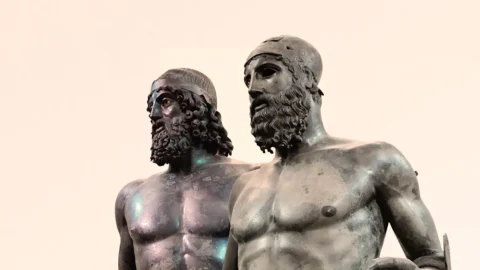
On August 16, 1972, the Mediterranean performed one of the most extraordinary feats in the history of archaeology. A few meters off the Ionian coast of Calabria, in the waters of Riace Marina, a young Roman diver, Stefano Mariottini, saw what he initially thought was the arm of a human body emerging from the sand. It was, however, the arm of a bronze statue from the 5th century BC. Not far away lay a second figure. After over two thousand years of silence, the sea yielded two masterpieces destined to become the universal symbol of Magna Graecia: the Riace Bronzes.
An Italian summer, a discovery that changed history
Italy in 1972 was experiencing a period of profound contradictions. Those were the years of the now-concluded economic boom, of social tensions, and of the strategy of tension, while the Mediterranean continued to be a political and cultural crossroads. A few days after that August bank holiday, the Munich Olympics would open, destined to be remembered for one of the most tragic episodes of the twentieth century. In that uneasy climate, the discovery of Riace seemed to focus attention on a different dimension of history: that of beauty capable of spanning millennia. Mariottini immediately reported the find to the Superintendency. In the official report, he described two perfectly preserved nude male figures lying on the sandy seabed approximately 230 meters from the shore and eight meters deep. It is one of the most moving documents of Italian archaeology because it recounts, in bureaucratic language, the moment when myth enters the news.
The legacy of Magna Graecia
To understand the significance of the Bronzes, we must go back to the 5th century BC, when the Greek colonies of southern Italy constituted one of the most advanced centers of Mediterranean civilization. Cities like Locri Epizephyrii, Kaulon, Crotone, Sybaris, and Reggio were not peripheries of Greece, but laboratories of philosophy, mathematics, medicine, and art. It was in this context that bronze works of extraordinary quality were born. The two statues, nearly two meters tall, were created using the sophisticated lost-wax casting technique, which allowed for unprecedented anatomical rendering: pulsating veins, tense muscles, red copper lips, silver teeth and eyelashes, eyes embellished with various materials. They were not simple sculptures; they were idealized men, a perfect synthesis of naturalism and classical harmony. The attribution remains a matter of debate even today. Some scholars have linked them to Ageladas of Argos, others to Phidias, and still others to the school of Polykleitos. Rather than identifying their author with certainty, contemporary research tends to consider them part of a large Greek monumental group later transported by sea, likely during the Roman era.
Why were they at the bottom of the sea?
This is the question that continues to fascinate archaeologists and historians. No shipwreck has been identified with certainty at the site where they were discovered. The traditional hypothesis holds that a ship, caught in a storm, lightened its load by throwing the statues into the sea. Other scholars believe, however, that the Bronzes belonged to a shipwreck further away and that currents or subsequent events altered their original context. Archaeological campaigns conducted in the years that followed recovered only a few metal rings and fragments, insufficient to definitively resolve the mystery. And perhaps it is precisely this lack of a definitive answer that makes them even more powerful: the Bronzes are not just works of art, they pose an open question about the circulation of cultures in the ancient Mediterranean.
Bronze against time
Most Greek bronze statues were melted down in subsequent centuries to recover the metal. For this reason, surviving originals are extremely rare. The Riace Bronzes are one of the most important surviving examples of great Greek sculpture, while many of the works celebrated today in museums around the world are Roman marble copies of lost originals. Paradoxically, it was the sea, often the destroyer of civilizations, that became their guardian. Covered in sand and protected by the lack of oxygen, the two warriors survived twenty-three centuries almost intact, until a chance dive brought them back to light.
A heritage that belongs to Italy
After their recovery in 1972, the statues underwent extensive restoration work in Reggio Calabria and Florence, culminating in their final location at the National Archaeological Museum of Reggio Calabria, where they are preserved in a climate-controlled room on earthquake-proof platforms. Today, they represent not only the emblem of Calabria, but one of the undisputed symbols of Italy's cultural heritage. More than half a century later, August 16th does not simply commemorate an archaeological discovery. It commemorates the moment when the Mediterranean returned two nameless heroes to humanity, reminding us that beauty does not belong to the past: it simply awaits recognition.