You will certainly remember the great ones sea creatures in the film by James Cameron Avatar The way of water. Are the tulkun. Empathic beings capable of feeling complex emotions such as joy, pain and anger. They are sacred to the indigenous Na'vi people. The Tulkun, in fact, are part of their culture and way of life. Symbolically they represent the hope and identity of the Na'vi people in the face of external threats and exploitation of the planet. Their presence is fundamental in the conservation of thePandora ecosystem.
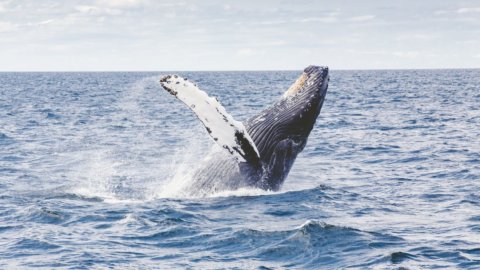
It is the same feeling that some indigenous populations of Polynesia and the Pacific area have towards whale. For the Maori, whales (tohorā) have first of all an ancestral meaning. In tradition the Maori people descend directly from them. Furthermore, whales embody a spirit that connects all that exists: they were fundamental to the development of the island-hopping navigation system of the Maori in the Pacific. This system was built precisely on the migrations of cetaceans.
Even today, the Maori and other Polynesian peoples consider whales are the guardians of the sea. The idea of a single, general and pervasive connective spirit is also part of Western philosophy and led Giordano Bruno on the Campo dei Fiori fire.
Habeas corpus
The awareness of the personality and role of whales and other cetaceans has found legal codification. It is thehabeas corpus recognized in a treaty signed by the indigenous leaders of the Cook Islands, French Polynesia, Aotearoa (New Zealand) and Tonga.
Pacific whales and dolphins are now officially considered “legal persons” in a landmark treaty of indigenous communities. It is enshrined in “He Whakaputanga Moana”, in the Maori language. It can be rendered with “Declaration of the Ocean”. The treaty was signed on February 7th Rarotonga, the largest island of the Cook Islands, during a ceremony attended by Tūheitia Potatau te Wherowhero VII, Maori king, and 15 paramount chiefs of the indigenous peoples of Tahiti and the Cook Islands.
La threat to large cetaceans is enormous. It comes not only from climate change, but above all from impacts with the large ships that are increasingly plying the waters where these creatures live. A collision with a ship can be lethal: it is estimated that 10.000 whales lose their lives every year for such causes. Another huge threat is the fishing equipment. Nets, lines, harpoons and other fishing tools can cause serious injury, suffocation and even death to these marine mammals.
Symbolic treaty up to a certain point
Although symbolic, the treaty is considered a crucial act for the conservation of the Pacific ecosystem. For example, conservationists see it as an effective and significant way to put pressure on national governments to offer greater protection to large mammals, even without going as far ashabeas corpus.
The trust of conservationists is not so misplaced and naïve after all. In 2017 the Parliament of New Zealand passed a groundbreaking law that granted legal entity status to the Whanganui River, given its importance to the Maori, the indigenous people of New Zealand. The Whanganui River is considered by Maori to be a deity, a living entity with its own spirit and the power to protect and guide them in the world.
Furthermore, the growing importance of tikanga Māori (Māori customary law), within the general legal system of New Zealand, could lead to the application of some principles contained in the treaty.
Of course in New Zealand there is no longer a Labor government open to the requests of the Maori groups, but a conservative government that is much less sensitive towards them. However, on these issues, we need to look at the long term rather than the immediate. The road is long, but the direction is the right one.
The protection of marine species
Animal rights have been widely discussed at a legal, academic and political level since the 60s.
In 2010, the Declaration of Cetacean Rights he outlawed captivity. In 2013, India even declared dolphins “non-human persons” to prevent their importation and use for commercial entertainment in water parks.
Despite these important steps, there is still no international standard on this type of protection. In the past, there have been attempts to establish general principles, such as those contained in the UNESCO Universal Declaration of Animal Rights of 1978. Lack of political will and disagreements on how to articulate these principles for each species have hindered their process of application.
In the absence of a global standard, countries have adopted different policies with significant variations in the degree of protection wild marine fauna. This state of affairs, together with the migratory nature of cetaceans, represents an obstacle to standardizing efforts for the conservation and protection of these species. In fact, long-distance migrations can expose cetaceans to threats from the jurisdictions they pass through, jurisdictions that may have low or non-existent levels of protection.
One in five species of those covered by the UN convention for migratory species is at risk of extinction. The protection of cetaceans requires international cooperation and scope to address these global risks.
It should also be added that for some indigenous communities, cetacean hunting represents an important cultural practice as a ritual and as a source of livelihood.
The potential of the Ocean Declaration
If the Ocean Declaration or part of it were adopted by the States, similar to what happened for the Whanganui River, governments could sanction violators through criminal justice or customary law. Even without giving cetaceans thehabeas corpus Parliaments could put it into law speed limits for boats, introduce alternative navigation routes, ban fishing activities for these cetaceans and underwater extraction in certain areas of the Pacific.
Furthermore, the legal implementation of new technologies, such as remote sensors and acoustic techniques, would help monitor the movements of animals, helping boats to locate them underwater.
It is estimated that a whale has an insurance value of 2 million euros and that, therefore, a "whale Insurance" can be introduced to be applied in the event that a cetacean is damaged during navigation or fishing activities. Which could force companies to equip themselves with anti-collision equipment and stringent fishing rules.
However, conservationists are uncertain to what extent granting legal personality to whales and dolphins can protect the area's most vulnerable species such as Hector's dolphin. However, the declaration is a big step for whales and dolphins and for the recognition of the rights of indigenous peoples.
Sources
Remy Tumin, In Move to Protect Whales, Polynesian Indigenous Groups Give Them 'Personhood,' “The New York Times,” March 29, 201
Bryant Rousseau, In New Zealand, Lands and Rivers Can Be People (Legally Speaking), “The New York Times,” July 13, 2016
Whales and dolphins now have legal personhood in the Pacific – but one treaty won't be enough to protect them, The Conservation, 15 April 2024.