OpenAI e Google have made available advanced services of artificial intelligence of companies controlled by Alibaba, Baidu e Tencent based in Singapore, although the three Chinese technology groups are included in the Pentagon blacklist dedicated to companies suspected of having ties to Beijing's military apparatus.
The news, reported by Financial Times and confirmed by US companies, reignites the debate in Washington over the rules governing China's access to the most advanced AI models. The operations are now legal, but they highlight a potential flaw in the American strategy, which is much more rigid when it comes to semiconductors than when it comes to AI software.
Services available through Singapore and Hong Kong
OpenAI and Google enable the use of their models through companies located in countries where services are regularly available, including Singapore and Hong Kong. The corporate structure therefore allows the subsidiaries of Chinese groups to access American technology even if their respective parent companies are listed in the so-called list “1260H” of the U.S. Department of Defense. The list includes companies that, according to Washington, have ties or collaborations with the People's Liberation Army. The inclusion on the list, however, does not automatically imply a general ban to purchase software or use American artificial intelligence models.
OpenAI has specified that do not offer direct access to its systems from mainland China. However, the company allows "certain companies" in China or controlled by Chinese entities to use its tools in countries where it believes it can implement security measures, verify compliance with contractual terms, and monitor for potential abuse.
Google has taken a similar positionIts AI services remain available in Singapore and Hong Kong in accordance with company policies, which expressly prohibit the use of models for unauthorized activities.
OpenAI blocks users linked to Alibaba
The availability of services has not prevented OpenAI from take action against some users linked to Alibaba. As reported to the FT, last month the company suspended access to its APIs after detecting possible attempts to “distillation”.
La distillation is a technique through which the outputs generated by an advanced model are used to train or improve a competing system. This process can allow for replication of some of the capabilities of a proprietary model while reducing the time and cost required to develop a new one.
OpenAI also reported the case to the U.S. government. Google acknowledged that geographic restrictions alone are insufficient to prevent this type of behavior, especially when users have the technical expertise to circumvent the controls.
The incident takes place in a context already marked by similar accusations. anthropic has already DeepSeek, Moonshot and MiniMax are listed among the Chinese laboratories suspected of having used distillation techniques. The company also informed the U.S. Congress that it believes that Alibaba may have created around 25 fraudulent accounts, through which more than 28,8 million interactions with the Claude model would have been generated.
Alibaba has not commented on the allegations. The group has, however, asked a US court to be removed from the 1260H list, deeming the Pentagon's decision "arbitrary and capricious."
The flaw in American restrictions
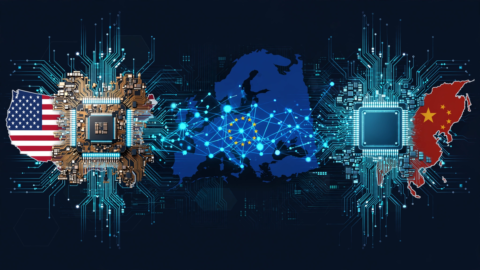
US law already limits access to some border models, but does not establish a blanket ban to the supply of artificial intelligence software to Chinese companies blacklisted by the Pentagon. This very difference fuels concerns among national security experts. In recent years, Washington has introduced very strict controls on the export of advanced chips and the technologies needed to produce them to China. However, similarly extensive rules have not been applied to AI models, which can be used through the cloud and by companies registered in third countries.
The fear is that access to American systems could accelerate the development of competing models, reduce the United States' technological advantage, and indirectly support activities considered strategic or military.
Anthropic chooses a more severe line
Compared to OpenAI and Google, Anthropic has adopted a more restrictive policyThe company prohibits the use of its advanced models not only by companies based in China, but also by foreign subsidiaries attributable to Chinese groups. Anthropic has, however, admitted that Enforcing the bans is complexBusinesses may use intermediary companies, accounts registered in other countries, or corporate structures that are difficult to reconstruct. For this reason, the company has announced new measures aimed at closing the loopholes used to circumvent the restrictions.
Artificial intelligence is becoming one of the main areas of strategic competition between the United States and China. After semiconductors, the next front could directly concern access to the models, to the APIs and cloud services through which the most advanced technologies are distributed. Washington will now have to decide whether to maintain a system based on the terms of use set by individual companies or introduce binding controls for the foreign subsidiaries of groups included on the Pentagon's list.