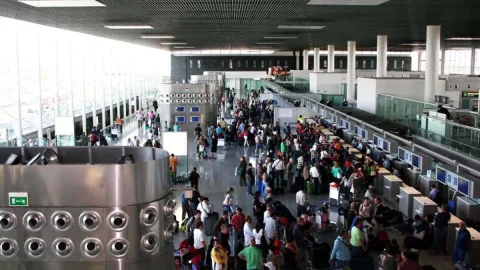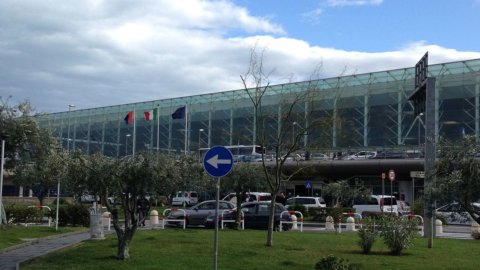
Continue the eruptive activity of Etna, the emission of ash continues and, consequently, they continue the inconveniences at Catania airportAfter the partial return to normality yesterday, the closure of flight areas corresponding to sectors B1 and B2 was ordered again on the morning of Monday, August 17. "Incoming flight activity is limited to five aircraft per hour until 5:14 PM today," communicates SAC, the company that manages the Catania airport. There are no restrictions on departures, but airport authorities warn that there could be repercussions on punctuality due to the failure to reposition crews and aircraft. "Passengers are asked to check the status of their flights with their airlines before traveling to the airport. Updates will follow in the coming hours," concludes SAC.
Etna: New Eruption in the Valle del Bove
On Etna, explosive activity in the Voragine crater remains intense. Volcanic tremor, which signals the energy present in the internal magma conduits, is increasing and remains at very high levels.
The National Institute of Geophysics and Volcanology, Etneo Observatory, reports that "from the images of the video surveillance cameras, at 06:09 UTC an earthquake was recorded the opening of an effusive mouth in Valle del Bove, at an altitude between 2200 and 2350 m; this activity produced a lava flow. Field surveys are underway by INGV-Oe personnel, while ash emission from the Voragine crater continues, with ash dispersal in a south-east direction.
“From the point of view seismic – continues the INGV – after yesterday afternoon's increase, the average amplitude of the volcanic tremor reached a maximum value around 17:40 UTC last night and subsequently, up to the current state, decreased slightly with weak oscillations, always remaining within the high value range. The centroids of the tremor sources appear to be located in the Voragine crater area, at an altitude of approximately 3000 m above sea level.
“Since yesterday afternoon, infrasonic activity It has been quite variable at low and medium levels. Infrasonic events, of low to medium amplitude, have been localized and are still being produced mainly by the Voragine crater; to a lesser extent, infrasonic sources have also been located at the Northeast Crater. Clinometric network signals show small variations of the order of 0.5 microradians, consistent with an ongoing deflationary process. A greater variation is observed at the Cratere del Piano station, which, starting at 16:30 PM on August 16, has accumulated approximately 2 microradians. The high-frequency GNSS network signals do not currently show significant variations outside of measurement uncertainty,” concludes the National Institute of Geophysics and Volcanology.
Etna's activity is not "exceptional", a plan is needed
In the meantime, we're already thinking about what happens next. About the next eruption, the next ash emission. About Sicily and Catania. a structural plan is needed to address a phenomenon that is becoming more frequent year after year. A reality that now manifests itself 3-4 times a year cannot be dismissed by talking about “emergency” or “exceptional situation”. The only exceptional aspect is the spectacle that Mount Etna offers residents and visitors, while the inconvenience is now an expected factor for anyone planning a trip to or from Sicily's main airport, which handled 12,5 million passengers in 2025 and, according to development plans, is expected to reach 20 million in the coming years. Not to mention the economic repercussions: according to initial calculations, the airport's prolonged closure, precisely during peak tourism days, would have caused Prevention for the tourism sector, equal to at least 24 million euros.
“It is not the volcano that is out of place, but the airport,” said the Minister of Civil Protection, Catania, a few days ago. Nello Musumeci, who already in 1999, when he was president of the province of Catania, had promoted a document which highlighted the risks deriving from the proximity between the volcano and the Fontanarossa airport and proposed the construction of a new “central” airport in the plain between Catania and Enna. Recently, however, the institutions of Trinacria have focused on strengthening the current port, with the burial of the Acquicella-Bicocca railway line, preparatory to'runway extension from the current 2.436 to 3.100 meters. However, this project neither addresses nor resolves the problems arising from its proximity to the volcano.
The hypotheses, all in a preliminary state, speak of a greater involvement of the airport of Comiso, of the extraordinary civil use of the military base of Sigonella, which is located in a more protected position from the prevailing winds, or on the recovery of theformer disused military runway of Gerbini, in the Catania Plain. We'll have to see which of these options (or even more than one) proves to be the most viable. What's certain is that we can't continue to wait. Because Etna doesn't respect bureaucracy, much less the laxity of authorities and institutions.