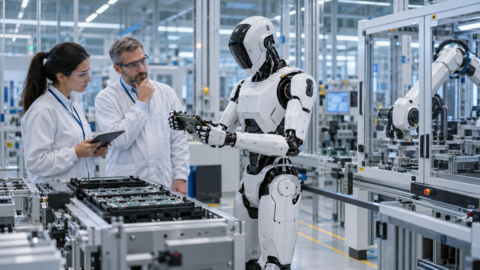
La new frontier of artificial intelligence comes out of the screens and enters the factories. Moving on this terrain are Dry, an Italian technology company based in Arezzo specializing in miniaturized computers, embedded systems, the Internet of Things and edge artificial intelligence, and Neura Robotics, a German company founded in 2019 in Metzingen by David Reger and active in the development of cognitive robots and Physical AI. The two companies have signed a strategic partnership to develop and industrialize in Europe artificial intelligence solutions applied to the physical world, combining cognitive robotics, embedded systems and advanced computing platforms.
The Courtauld Commitment agreement XNUMX also involves Qualcomm Technologies and aims to large-scale produce electronic modules for the German company's robots, including the humanoid 4NE1. The collaboration will also extend to semiconductor and electronics manufacturing processes, with the aim of transforming data collected in the factories into new automation solutions that can be deployed globally.
Seco enters the heart of cognitive robots
The Italian group will collaborate with Neura on the design, engineering and production of the processing modules installed in its cognitive robotsThese components will integrate Qualcomm Dragonwing processors and will be included in the distributed architecture developed by the German company. The partnership brings together different but complementary skillsNeura brings its expertise in Physical AI and robotics, Qualcomm provides edge computing platforms, and Seco intervenes in the crucial phase leading from design to industrial production.
Neura develops robots capable of seeing, hearing, sensing the environment, and learning. The company aims to make physical work more scalable, also addressing structural phenomena such as the aging population and the shortage of skilled labor. For Seco, the agreement represents a further step forward. advancements in the fields of Edge AI and Physical AIThe Arezzo-based company is already part of the Qualcomm Technologies ecosystem and has developed several computing platforms for industrial applications based on Dragonwing processors.
“We are proud to collaborate with Neura both on the industrialization of its cognitive robotics platforms and on the application of Physical AI to our industrial environment,” said Seco CEO, Massimo MauriAccording to the manager, combining their respective skills will allow them to create solutions with "value that goes far beyond a single factory or application."
Artificial intelligence is distributed throughout the robot
One of the central aspects of the project is theBrain + Nervous System architecture designed by NeuraThe model assumes that processing and perception capabilities are not concentrated in a single point, but distributed throughout the entire machine. From this approach comes the concept of Smart LimbArms, legs, and other parts of the robot are equipped with autonomous computing capabilities, bringing intelligence closer to the joints, sensors, and areas where interaction with the real world occurs. Processing data directly at the edge allows for reduced response times and becomes essential when machines must work safely alongside people.
Qualcomm Technologies' Dragonwing Robotics processors will power AI functions directly onboard, ensuring energy efficiency and low-latency control. Seco will instead be tasked with transforming this architecture into reliable modules suitable for large-scale production. "Physical AI will not be built by a single company," emphasized David Reger, founder and CEO of Neura Robotics. He believes it will require an ecosystem capable of bringing together sensing, computing, cloud, and industrialization, connecting Qualcomm's technology with Seco's European manufacturing and engineering expertise.
The Qualcomm sees collaboration as a a step towards the concrete use of cognitive robotics. Nakul Duggal, head of the company’s Automotive, Industrial and Embedded IoT and Robotics sectors, highlighted how intelligent and scalable computing platforms are essential to achieving “more responsive, capable and adaptable” robots in industrial and commercial environments.
The factory becomes a training ground for Physical AI
The The alliance is not limited to the components installed in the robotsSeco and Neura intend to use data from real industrial processes to sdevelop automation systems mainly intended for the production of semiconductors and electronics.
The goal is teach the machines progressively more complex activities and transform acquired knowledge into reusable skills. The factory thus takes on a dual function. It remains a place of production, but it also becomes an environment in which robots collect data, learn, and refine their skills. The solutions developed in Europe can subsequently be adapted and implemented in other plants around the world. This is the principle behind the Neuraverse, the ecosystem conceived by Neura to enable robots to continuously learn and share new skills, preventing the knowledge acquired in a single project from remaining confined within that specific application.
The collaboration will also have a physical presence in ItalyThe two companies are working on the creation of a Neura Gym, set to become the German company's first training center in Southern Europe. The hub will be able to support the joint collection of production data and testing of machines in real industrial environments. Finally, the European production of computing modules adds a piece to the puzzle of building a regional Physical AI supply chain. The strategy does not aim to isolate the continent from international technologies, but to combine European engineering and manufacturing capabilities with the most advanced global platforms.
The announcement comes one day before the publication of Seco's final results for the second quarter of 2026, scheduled for September 8. In July, the company had already reported preliminary figures showing revenue of €50,3 million, down 2% from the same period the previous year, and a gross margin that rose 2% to €28 million, equal to 55,6% of revenue. Over the past three months, Seco shares have gained approximately 11% on the Milan Stock Exchange.