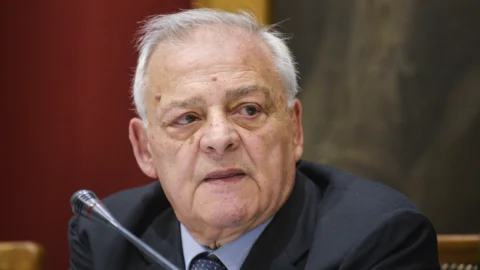
È Massimiliano Cencelli died in Rome, a historic official of the Christian Democracy whose name has become, over the decades, one of the most recognisable expressions of the Italian political languageHe was 90 years old and passed away on Saturday afternoon in the capital.
Cencelli is known to history above all for the famous "Cencelli Manual", a formula used to indicate the distribution of political and government positions based on the weight of the different factions or parties. More than a true written manual, it was a method of allocating charges which ended up becoming a definition that entered permanently into the lexicon of Italian politics.
From 12% of "bridge builders" to the birth of the Cencelli Manual
L'origin of the expression dates back to the Christian Democracy of the sixtiesIt was Cencelli himself, in an interview with Avvenire in 2003, who reconstructed the moment in which the system that would later bear his name took shape. In 1967, during the DC congress in Milan, Adolfo Sarti, together with Francesco Cossiga and Paolo Emilio Taviani, founded the "bridge builders" faction, created with the aim of creating a link between the party's majority and its left wing. This faction won 12% of the vote, and the question arose of how many positions the faction should hold. Cencelli suggested applying a principle similar to that used in joint-stock companies to politics. "If we have 12%, just as positions on a company's board of directors are divided based on share ownership, the same should apply to party and government positions based on membership," he said in the interview.
The criterion was then used to distribute the available positions. Taviani retained the Interior Ministry, Gaspari became undersecretary of the Post Office, Cossiga received a post in Defense, and Sarti was assigned to Tourism and Entertainment.
That name has become synonymous with political division
A quip by Sarti himself also contributed to making the "Cencelli Manual" famous. During government crises, when journalists sought advance information on the composition of executives, he would often reply: "Ask Cencelli!".
From that moment on, the name of the former Christian Democrat official was definitively linked to the mechanism of distributing tasks according to power relations, percentages, and internal balances. A formula born in the First Republic but survived the DC era and still used today when politics must find a balance in the distribution of ministries, presidencies, and other positions of responsibility. Cencelli himself, many years later, ironically observed how that method was often invoked without being truly understood.My manual? They don't know how to use it..There is too much political ignorance around,” he had stated.
Nearly sixty years after its birth, the "Cencelli Manual" continues to be cited in public debate and even in university textbooks. A term that has outlasted the political era in which it was conceived and has ultimately cemented the name of its creator in the history of Italian politics.