The Hera Group and Fabbri 1905 announce the start-up of a photovoltaic system at the Anzola production site A new generation product, the result of an agreement between two major companies: the historic Bolognese confectionery company renowned worldwide for its specialties, first and foremost the iconic Amarena, and one of Italy's leading multi-utilities.
La collaboration between the Hera Group and Fabbri 1905 It stems from a shared desire to promote local development and reduce the impact of industrial production. The new plant will allow Fabbri 1905 to reduce its environmental footprint, confirming the Hera Group's role as an enabler of the transition thanks to its integrated energy and plant solutions.
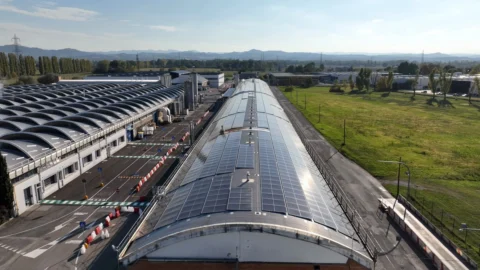
The 900 kWp system, which covers a large area of the roof of the Fabbri 1905 factory and did not require additional land consumption, will allow us to reach an annual quota of self-produced energy from renewable sources equal to 1 GWh, 95% of which will be used for self-consumption and the remaining 5% for grid feed-in. The installation will generate clean energy, significantly reducing polluting emissions. Specifically, it will avoid 280 tons of carbon dioxide per year and 8.400 tons over the plant's estimated 30-year lifespan, equivalent to the emissions of a forest of 21.000 trees.
Thanks to self-production, the plant It will also guarantee savings on the company's energy costs at the same time, which operates in 100 countries worldwide and is firmly led by the Fabbri family, now in its fifth generation. Thanks in part to the speed with which it was completed and put into operation, the project also guaranteed access to the tax credit provided by the Transition 5.0 plan, further reducing the company's payback period, which was already estimated at five years.
The plant was built by F.lli Franchini, a subsidiary of the Hera Group specializing in the construction of energy efficiency systems and solutions for the industrial sector. As part of the Hera Business Solutions multi-service offering, the multi-utility will also analyze wastewater from purification processes, which involve Fabbri 1905's various production lines. The goal of this additional project is to improve overall management of the purification process and identify potential opportunities for optimizing plant flows by integrating the diverse expertise in integrated waste management, water cycle management, and energy services present within the Group's various companies.
This initiative is in line with one of the strategic pillars of Fabbri 1905's latest Sustainability Report which pays special attention to the circular economy, a crucial issue in the ecological transition process. One of the most concrete examples concerns the reuse of production waste, particularly that resulting from the processing of the iconic Amarena Fabbri cherry. In recent years, this has led to a reduction in the production process of the sour cherry by approximately 50 tons, reducing waste and creating new sustainable business opportunities through industrial upcycling.
The project, moreover, is consistent with the Hera Group's long-term strategy for climate neutrality, which includes targeted actions not only on its own direct emissions, but also on indirect emissions resulting from customers' energy consumption. With integrated on-site renewable energy and consumption management solutions, the multi-utility, one of the most sustainability-focused companies globally, supports businesses in the areas it serves towards a more circular and low-impact management of production cycles and energy needs, while also strengthening its own path to Net Zero. Photovoltaic systems at customers' industrial sites, in fact, become a lever that reduces emissions along the energy value chain and contributes to widespread decarbonization, in line with the Group's Climate Transition Plan.
"The photovoltaic system built on the roof of the Anzola Emilia plant demonstrates how sustainability can translate into an industrial choice capable of generating environmental value, energy efficiency, and greater competitiveness for a historic company like Fabbri 1905, which is now growing and called upon to meet increasingly significant energy needs," stated Isabella Malagoli, CEO of Hera Comm. 95% of the renewable energy produced will be used for self-consumption, with an immediate and measurable economic benefit. Thanks in part to the speed with which the plant was completed, the project was able to access the benefits of the Transition 5.0 plan, further reducing the payback period, already estimated at five years. Sharing these results today with the community and local stakeholders highlights the project's solidity: the numbers, timelines, and benefits demonstrate an energy transition that is not theoretical, but already operational.