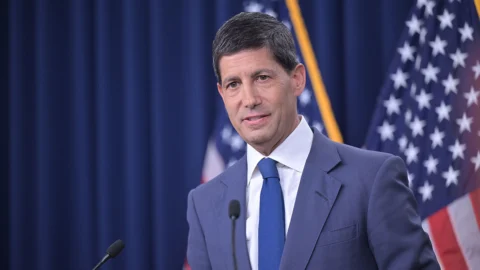
The Federal Reserve left the Fed Funds corridor unchanged at 3,50%-3,75%, but Chairman Kevin Warsh's message was anything but dovish. In the press conference following the FOMC meeting, the central bank's new head insisted that fighting inflation remains the primary objective and that the Fed will continue to evaluate the data without making any prior commitments on its next steps.
The maintenance of rates was widely expected by the markets, but attention was focused above all on the tone of the press conference, considered the main communication tool after Warsh's choice to reduce the traditional forward guidance.
Warsh: “Price stability and employment are not in conflict”
One of the most significant passages of the speech concerned the Fed's dual mandate. Warsh stated that price stability and full employment “are not in conflict”, rejecting the idea that the central bank must choose between economic growth and inflation control.
The Fed Chairman stressed that it is precisely high and unpredictable inflation represents the main risk for households, businesses, and investments. For this reason, the central bank will continue to maintain a focus on returning inflation to the 2% target, avoiding automatic reactions to individual economic data: "Our commitment to returning inflation to 2% is firm. There is no 'softer' inflation target, nor a different implicit target: our target is 2%," he said.
"The American economy," Warsh added, "is showing remarkable resilience. Despite the shocks of recent months, the underlying trend remains positive. What's really hurting the markets is... it's not just high inflation, but high and unpredictable inflation".
No indication on upcoming rates
Warsh confirmed the strategy already outlined in recent weeks: no advance indications on the path of the ratesAccording to Reuters, the new president is trying to move beyond the communication model of recent years, minimizing anticipation of future decisions and reiterating that each FOMC meeting remains "live," meaning open to any outcome based on available economic data.
This setting increases short-term uncertainty, but according to Warsh it restores greater flexibility to monetary policy in a phase characterized by geopolitical shocks, rising energy prices and possible new inflationary effects linked to trade tariffs.
The internal debate remains heated
During the press conference, Warsh defined the confrontation within the FOMC a “good family discussion”, downplaying the differences that have emerged among the governors. Tensions, however, remain evident.
Reuters had already highlighted in the previous days how several members of the Committee were in favor of an even more restrictive line, in light of persistent inflation and the risks posed by rising energy prices. "A large majority of the Committee supported the decision to keep rates unchanged," the president assured.
Markets focused on next moves
For investors, the meeting does not change the underlying picture. The Fed has not opened the door to an imminent rate cut and continues to prioritize credibility in the fight against inflation.
Bloomberg had already described Warsh as a president increasingly oriented towards a "hawkish" posture, intent on demonstrating that the new course of the central bank will not tolerate prolonged deviations from the 2% target. Even the Financial Times had underlined how, since Warsh took office, the Fed's centre of gravity has progressively shifted shifted towards greater attention to inflationary risks.
The message from the meeting is therefore consistent with this approach: no automatic decisions on the next steps, maximum dependence on data, and a priority that remains unchanged. For the Federal Reserve, the lasting return of price stability continues to represent the essential condition for supporting economic growth in the medium term.