Cremona stages one of its most famous gastronomic glories: His Majesty the Mostarda. From 6 October to 19 November the city will become a great theater for the Mustard Festival with a range of events between gastronomic tradition and innovation.
At the center of the event will be “The Mustard Village” the exhibition space in the Gardens of Piazza Roma which will host from 6 to 8 October, in collaboration with the Salami Festival, the mustard producers who will exhibit and present their products. The objective is to strengthen and spread knowledge of mustard and its versatility in the kitchen through tastings and insights into the history and tradition of this gastronomic specialty.
Specifically, on the morning of Friday 6 October "Salame and Mostarda: two typical products linked to the history and traditions of Cremona and its territory" will be held. During the meeting, Carla Bertinelli Spotti, scholar of the history of Cremona, will illustrate the characteristics that make Cremona PGI salami unique and the interesting combinations with Cremona mustard.
As happened in previous editions, this year too it will be possible to delve deeper into the history of this food, its origins and the importance it had in the past.
Also at “Il Villaggio della mostarda” it will be held on the morning of Saturday 7 October “Mustard and quince jelly in a 1800th century recipe book”: following the discovery of notebooks and recipe books from the 1800th century from a book collection left at the Cremona State Library, Carla Bertinelli Spotti will present the part dedicated to mustard and quince jelly recipes from which a publication was taken which will be distributed on the occasion of the event .
It will be on the morning of Sunday 8 October with the event "Which mustard for which cured meat" that participants in the event will have the opportunity to get to know local producers, taste the various combinations and vote for the most popular one.
For the occasion it will be possible to download with a QR code the cookbook of mustard-based recipes created for the last eight editions of the Mostarda festival.
From 6 October to 19 November a calendar of events and initiatives to taste the product in its most sought-after forms
The Festival will also propose a extensive calendar of events and initiatives in the area to taste the product in its most sought-after forms thanks to the participation of food and wine companies, restaurants and the collaboration and contamination with other important local food and wine events, such as the Salami Festival and the Nougat Festival scheduled from 11 to 19 November.
Furthermore, for those who want to fully enjoy the specialties of Cremonese cuisine featuring mustard, during the Festival, the participating restaurants will offer special menus designed for the event.
Also '2023 edition will be available in digital and widespread version, on the official event website and on the event's social accounts with a rich schedule of events and initiatives. Among these, social collaboration with important local and non-local chefs, to discover recipes and new ways of interpreting this gastronomic delicacy.
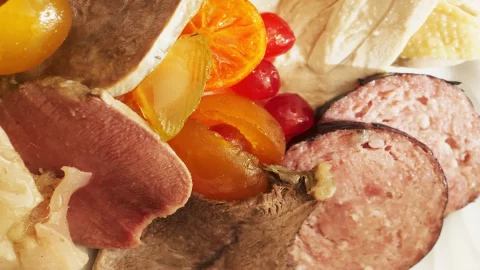
La Traditional mustard from Cremona based on candied fruit, with the addition of mustard, which is served with meats and cheeses, to give them a sweetly spicy taste It has very ancient origins.
According to what we read in a note from the municipality of Cremona on the first document that associates mustard with Cremona is a recipe "Pour faire moutarde de Cremone", not too dissimilar to today's in terms of ingredients, contained in a book “Ouverture de cousine par maistre Lancelot de Casteau”, printed in Liège in 1604. Other historical recipes were written in 1666 and 1866.
Cremonese mustard with fruit and mustard is widely spoken of also in documents from the eighteenth and nineteenth centuries.
Agostino Cavalcabò writes that in 1774 there were 20 nougat and mustard factories active in Cremona, which employed a total of 40 workers.
These were probably family-run artisan businesses, which however were able to establish themselves for the quality of the product, so much so that Francesco Cherubini in his Milanese-Italian dictionary (1839-1843), regarding mustard, states that "the packaging which is manufactured in Cremona, according to the Cremonese method... we have for the most exquisite".
The reports of the Chamber of Commerce in various years, starting from 1854, report the importance of the production of mustard in the Cremonese economy and this is confirmed by historians such as Angelo Grandi (1856) and Francesco Robolotti (1859).
In Giuseppe Gorrini's "Cook's Manual" (1884) the recipe for Cremona Mostarda is reported, made with "apples, pears, pumpkins, ripe figs, dried peaches, pieces of citron fruit, ... honey, sugar and mustard".
The product is also known outside Lombardy and is associated with the name of Cremona. In a detailed report from the Chamber of Commerce, in the statistical notes on the Cremonese industries of 1907, we read that mustard is a local specialty, processed by numerous companies operating in the city area, that there are two qualities: a cheaper one which is used as a sweetener honey and a more expensive one with sugar, and which in addition to sales in Italy and Europe "also has an active export trade in the Americas (main centers New York and Buenos Aires)".