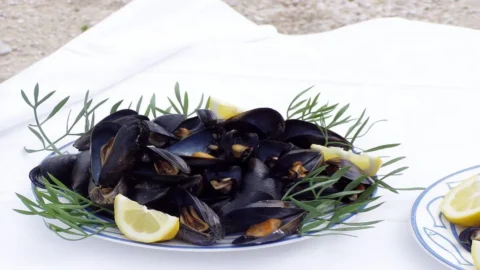
There are mussels, then there are - in Ancona - the wild Moscioli, or mussels (Mytilus galloprovincialis), "wild" which release an intense aroma and flavor of algae and sea, and which in local cuisine are truly memorable opened on a plate placed on the fire, without any seasoning, or marinara style, opened in a pan with garlic, parsley, oil and pepper. But they are also excellent as a sauce in first courses, or Tarantina-style, or even stuffed with minced meat and parmesan, if not roasted. Why wild? Because these mussels reproduce naturally and live attached to the submerged rocks of the Conero coast.
An identifying dish of Ancona seafood cuisine risks disappearing
The presence of mussels in these seas has been precisely demonstrated since the beginning of the twentieth century; fishing, however, was very limited and the mollusc colonies were concentrated on the Trave rock and on a few other rocks and shallows between Pietralacroce and Sirolo. Until the Second World War, fishing was carried out with rowing boats, the batana, and represented an income supplement for the farmers of the hamlets of Poggio, Varano, Massignano and Pietralacroce and of the Municipality of Sirolo, and for the workers of the port of Ancona .
The tool that was used to tear the mussels from the rocks, similar to a pitchfork, was not particularly harmful: more harmful was, as time went by, the adoption of the "moscioliniera", a long pole with curved iron teeth at the bottom with which the rocks are scraped from the boat. In this way, both large and very small mussels were torn away: paradoxically, however, this type of fishing contributed to the proliferation of mussels in almost all the other submerged rocks of the Conero. In fact, some of the smaller mussels, thrown back into the sea, managed to survive and colonize new areas.
The Slow Food presidia are delaying fishing by a month after bringing forward the closure of the 2023 season by two months
Traditionally the mosciolo fishing period runs from mid-May to mid-October. But alas, now we risk having to say goodbye to this identifying delicacy of a marine territory and a centuries-old culinary tradition.
Illegal fishing and the effects of drought and sea warming have in fact put the Portonovo wild mussel Slow Food Presidia in crisis. Thus, to responsibly save this precious biodiversity resource, the principals have decided this year to postpone the collection of shellfish for a month and if this is not enough, a one-year fishing ban is looming.
«For Ancona, says Roberto Rubegni, Slow Food manager of the Portonovo Wild Mosciolo Presidium, it is not just an important economy and a tradition in the kitchen: it is a question of identity. There is no one from Ancona who hasn't dived into the wild fishing for wild mussels at least once in their life... And even the fans of the football team, when they go away, remind everyone by singing that we 'had the mussels'".
«For two years, fishermen have been reporting the presence of few mussels – continues Rubegni –. In 2022 they closed the season at the end of August, rather than the end of October as required by the regulations, and last summer even before. They did it to try to save the following season, that is, the one that should have opened on May 15th." But the measure adopted was not sufficient: the molluscs are few again this year, and so the two main fishing cooperatives active in the area (including the three boats belonging to the Slow Food Presidium) have chosen to postpone the start of the harvest as of June 15th. «We are worried and for this reason already in recent months, as a Slow Food Convivium, we have urged the mayor of Ancona to open a table, with scientific partners such as the Polytechnic University of Marche, the Experimental Zooprophylactic Institute of Umbria and Marche , the Cnr and Arpa, to investigate the causes of the decline in the mussel population. But in addition to the scientific aspects - concludes Rubegni - illegal fishing weighs heavily, i.e. those who immerse themselves in the waters of the promontory, take tens of kilos if not quintals of molluscs, and resell them through unclear channels.
Even in Torre Guaceto in Puglia the Slow Food Presidia have decided to stop fishing for one year
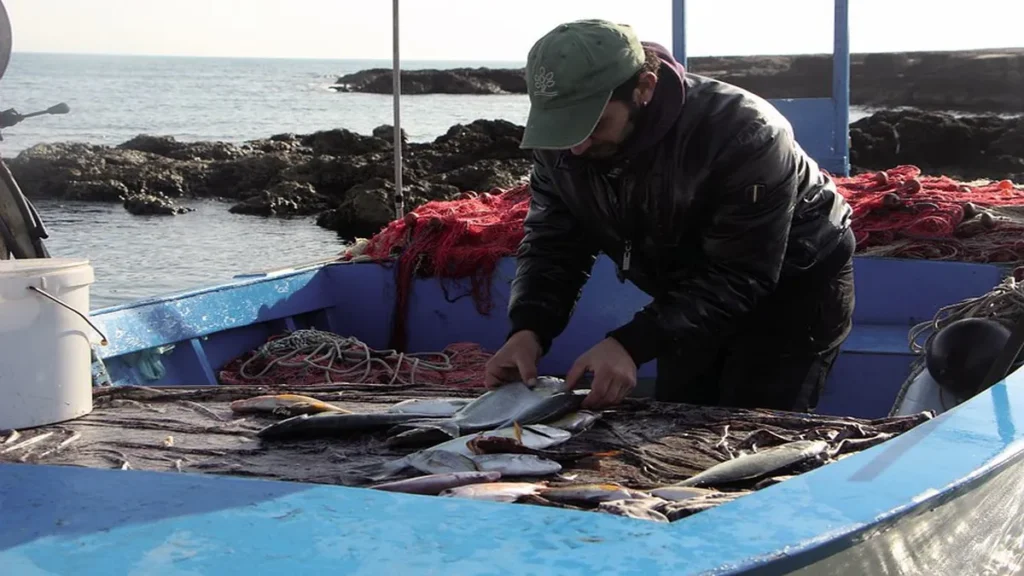
Illegal fishing and the effects of drought and warming of the waters have put the fishermen of Torre Guaceto in crisis five hundred kilometers further south, who are experiencing the same dramatic situation as the Mosciolo Presidia: the sea, rich in resources until a few years ago, is presenting the bill. There are no more fish or molluscs and so, to try to save their sea and their work, they decided to stop but within the Apulian marine protected area the measure was much more drastic and the stop will last an entire year.
A specter with serious economic consequences for the fishing sector recurs in Torre Guaceto almost twenty years later, when fishing was suspended for five: «It happened between 2000 and 2005 – recalls Marcello Longo, president of Slow Food Puglia –, a period in which we observed an increase in the fish population of 400%", a figure which would later settle at around 250% with the resumption of fishermen's activity. Strictly regulated fishing: Torre Guaceto is a protected marine area, within which only a limited number of authorized boats can operate (seven, i.e. those that join the Torre Guaceto Slow Food Presidium for small-scale fishing), a only one day a week and only in the outermost area. Yet, the situation has become critical again. The Torre Guaceto Management Consortium, the body that manages the protected area, put the reason in black and white: illegal fishing. “Poachers have damaged the important work carried out by the management body and professional fishermen” we read on the Reserve's website. Thus, scientific studies in hand, it was decided to stop the activity for a year, until May 2025.
A video surveillance service has been installed to combat poaching in the protected area
«It was the fishermen of the Slow Food Presidium themselves, with an act of responsibility, who wanted to stop fishing» concludes Longo. In the meantime, to combat the scourge of poaching, the Torre Guaceto Management Consortium has installed a video surveillance system that will quickly alert the police if unauthorized boats enter the protected area. . Artisanal fishermen, who will not be able to fish for twelve months, will instead be involved in a (paid) monitoring project to verify the effectiveness of the fishing ban.
The protected area of the Brindisi area is not only a fishing basin to be protected, but also an interesting area for its nature, history, architecture and culture, where the Apulian culture of hospitality resonates. And for those who want to experience slow tourism, Torre Guaceto is one of the Slow Food Travel itineraries, where you can meet communities of chefs, innkeepers, expert guides, farmers, fishermen, shepherds, cheesemakers and artisans who work every day safeguarding local biodiversity and offering hospitality in the shops, laboratories, fields and places of their daily life.