Kering sinks, lvmh resists but is not convincing, Hermès fly. The first quarter of the giants can be summed up like this french luxury. A contrasting trend that reflects the forecasts of analysts, who have long predicted a weak start to the year for the entire high-end goods sector and who are now focusing on the performance of the various brands and markets to understand whether in the second half the long-awaited rebound will arrive in 2024. Everyone's eyes are focused on the China, fundamental variable that has weighed heavily on the accounts of the big names in the sector, but also on North America which, after the weakness of 2023, could reserve positive surprises in the coming months.
The French luxury quarterlies: Kering the worst with Gucci
Let's open the dance with Kering, which has been under special surveillance for some time, which after a disappointing fourth quarter and the revenue alarm launched in March, announced on April 23rd that it had closed the first quarter with revenue down 11% (by 10% on comparable bases), to 4,5 billion euros. It was above all that weighed Gucci's performance which in the first three months of the year recorded revenues of 2,1 billion euros, down 21% or 18% on comparable bases. Yves Saint Laurent's revenues fell by 8%, while those of Bottega Veneta fell by 2%. Both at the level of the parent company and for the individual brands, it was the negative performance in Asia-Pacific to impact the results, while the performance in Western Europe, North America and Japan was in line with that of the fourth quarter of 2023.
The comment from the president and CEO is self-evident François-Henri Pinault: “Kering's performance deteriorated significantly in the first quarter. While we anticipated a difficult start to the year, stagnant market conditions, particularly in China, and the strategic repositioning of some of our maisons, starting with Gucci, have exacerbated the downward pressure on our topline", said the Kering number one, adding that "In light of this decline in revenues and our firm determination to continue to invest selectively in the long-term attractiveness and distinctiveness of our brands, we now plan to register a significantly lower operating profit in the first half of the year of this year. We are all working tirelessly to help Kering overcome its current challenges and rebuild a solid platform for lasting growth." Taking into account the worsening revenue trend, the group now expects a decline of 40-45% in the current operating profit of the first half of 2024 compared to the first half of 2023.
LVMH penalized by alcohol
The world's number one luxury giant, LVMH, closed the first quarter with revenue down 2% compared to the same period of 2023 at 20,694 billion euros against 21,035 billion in the same quarter of last year, underlining however that the start of the year was favorable despite "a geopolitical and economic context that remains uncertain". Sales went well in Europe (+2%), in the United States (+2%) and above all in Japan (+32%), while the rest of theAsia fell 6%. The fashion and leather goods division closed the first three months with a turnover of 10,490 billion, down 2% (+2% at constant exchange rates), with good performances from Louis Vuitton and Dior, but what penalized the group was especially the double-digit decline (-16% or -12% at organic level) of Wine and Spirits division. Watches and Jewelery recorded a decline of 5% in the first quarter to 2,466 billion (-2% at constant exchange rates), while the revenues of Perfumes and Cosmetics and Selective Retailing recorded respectively +3% (+7% at constant exchange rates) and + 5% (+11% at constant exchange rates.
For the full year 2024 ithe consensus identifies growth of around 7%, with the Fashion & Leather Goods division up by approximately 6%. Equita analysts estimate 2024 turnover at 91,4 billion, up by approximately 6% and a net profit that should go from 15,159 billion to 16,5 billion, the latter level above the consensus of 1% .
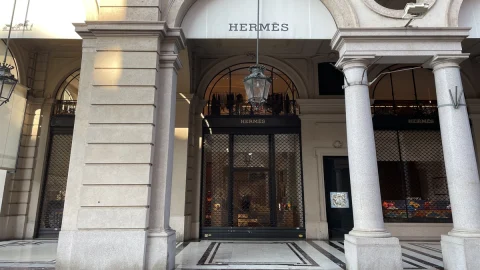
Hermès is flying and growing by double digits in Asia too
The run of Hermès, however, does not stop, closing the first three months of 2024 with a turnover of 3,8 billion euros, up 12,6% compared to the same period of 2023 (+17% at constant exchange rates), confirming "despite the uncertainties of the economic, political and geopolitical context", "the objective of ambitious revenue growth at constant exchange rates” in the medium term. First quarter revenues were mainly driven by sales of leather goods, which represent the most important part of Hermès' turnover, and which recorded an increase of 20% to 1,6 billion euros, "by virtue of a particularly strong demand". Double-digit growth also for revenues from clothing and accessories, +16% to 1 billion, while turnover from silk and fabrics recorded an increase of 8%. Finally, the perfume, beauty and watches division recorded +4%. By virtue of the results achieved, the group decided to increase its production capacity in leather goods, announcing four projects that will be implemented in the coming years: in Riom (Puy-de-Dôme) in 2024, in l'Isle d'Espagnac (Charente) in 2025, in Loupes (Gironde) in 2026 and in Charleville-Mezieres (Ardennes) by 2027.
From a geographical point of view, unlike its competitors Hermès has also managed to achieve excellent results in Asia where, excluding Japan, revenues grew by 14%, equal to 1,0 billion euros, despite a slight decline during the Chinese New Year period. The decline in consumption was however compensated by the increase in average spending. The CFO explained that the number of customers who purchased silk products, which are more accessible, decreased, but the wealthier ones continued to buy. In Japan, sales soared by 25%, in the Americas by 12%, in Europe (excluding France) by 15% and in France by 14%.
A “luxury” budget: everything will depend on China
Wanting to take stock of the first quarter of the French luxury giants, it can be said that the difference between the excellent performance of Hermès, the slowdown of LVMH and the collapse of Kering, lies (almost) entirely in the results obtained in Asia and China in particular. While the giants led by Arnault and Pinault respectively recorded more significant losses (Kering with Gucci) or less (LVMH), Hermès managed to consolidate its position by focusing on extra-luxury products, the cost of which managed to compensate and overcome the general decline in consumption that afflicted the entire sector, achieving solid growth.
What will happen in the near future will therefore depend on Chinese question. Beijing, after the post-Covid rebound recorded in 2023 (+13% compared to 2022 which however was still affected by the consequences of the pandemic and forced closures) should record “limited growth” in 2024. This is what Bain & Company says in the latest "China Luxury report", which talks in particular about a "mid-single digit" advancement.
"I Fundamentals of luxury consumption in China remain solid in the long term, albeit with some uncertainties in the short term linked to the speed of recovery of consumer confidence and the evolution of shopping abroad", explains Claudia D'Arpizio, senior partner and global head of fashion & luxury at Bain & company. “In general, we expect another positive year for Chinese luxury consumption abroad, particularly in Asian destinations, also in light of the different pricing strategies between mainland China and foreign markets, which play a crucial role in this game. Therefore, in this context, it is crucial for brands to implement globally harmonized strategies”. The positive performance recorded in 2023 "characterized all categories of the Chinese luxury market and, after three tumultuous years due to the pandemic, we can believe that 2023 marked the start, for this market, of a normalized growth trajectory”, added Federica Levato, senior partner and EMEA fashion & luxury leader of Bain & company. .
Luxury: the other protagonists of the market
We're almost at the end of the quarterly season (there's still a big shot of the caliber of Richemont which will present its accounts on May 17), the luxury sector appears contrasted, with Italian fashion having however managed to earn its space in a panorama of lights and shadows. Revenues recorded by Moncler (+ 13% to 818 million), BRUNELLO CUCINELLI (+16,5% to 309 million), but also from a top player like Prada (+16 to 1,2 billion) bodes well for the near future.
“Amid uncertainty over Chinese consumer spending, our top picks remain names with high brand desirability and market leadership position, such as LVMH, Brunello Cucinelli and Hermès, while we are more cautious on turnaround stories of Kering, Burberry and Ferragamo” the analysts from explain to Mf BofA-Bank of America, according to which, “although the normalization of the sector is now well understood by the market, we believe that investors should use the first quarter to consider the five-year CAGR as a guide for the rest of the year”.