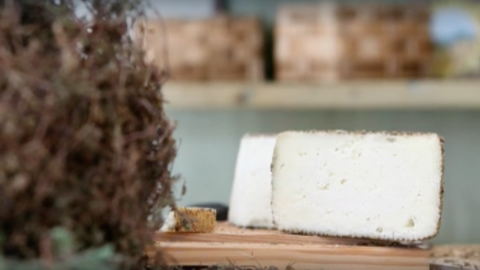
Not all cheeses are the same. It is such a diverse world that sometimes some of these are all but forgotten. It is the case of Tanned of San Vittore, in the lower Lazio area (in the province of Frosinone) on the border with Campania. Yet, this cheese is one of the oldest in the Region, dating back even to the Samnites. Made only of sheep's milk, the tanned is a PAT cheese from Lazio hard paste and is characterized by a very laborious transformation technique but at the time essential for preserving the product and preventing it from being attacked by some external agents that were quite dangerous for humans.
Its production has had some big problems in recent times, due to the economic crisis, consequently this small sheep's cheese, despite being a example of biodiversity it's not that easy to find. But let's take a look at his story.
Conciato di San Vittore, the history: from the Samnites to Mancino up to the prison of Rebibbia
Il Tanned of San Vittore dates back to ancient times Samnite people, which were located in the central southern area of the Peninsula, and their main working activity was precisely that of sheep farming and agriculture. Since the territory in which they lived was mountainous and poor in resources, they needed to process the food products in such a way as to keep them for the entire year and procure a food supply for the whole family. For this reason they had introduced the treatment of caciottas with aromatic herbs, hence the name of tanned.
Going back to more recent times, the tradition of this small cheese was carried on until 2008 by the agronomist Theodore Vadala, the year in which the shepherd decided to retire and stop producing this very rare product, risking "condemning" a product with ancient origins.
And here a young gastronome enters the scene, Vincent Mancino, who manages to convince Vadalà to give the recipe of this unique example of cheese to the Pacitti family, owners of a company about thirty kilometers from the shepherd's house and from San Vittore. Thus, the Pacitti family still continues today to produce the Conciato which is sold - wrapped in its traditional yellow paper - in the shop of typical products of Mancino, together with other cheeses, sausages and other organic specialties of lower Lazio.
But it doesn't end there. The Conciato is also worked in the Rebibbia prison. Again thanks to Mancino who convinced Vadalà to accompany him to Rebibbia, to teach the inmates to produce this precious cheese in sheep's milk, which, depending on the herbs used, acquires a different flavor each time. The prisoners also produce other cheeses, the name of which has never been disclosed.
Processing technique of Roman tanning
Il Tanned of San Vittore o Roman tanned is derived from whole milk from sheep of the Comisana, Camosciata and Massese breeds, autochthonous breeds that are usually brought in transhumance at an altitude of 1200 or 1400 meters.
The raw milk is heated to a temperature of about 38-40° and calf or kid rennet is added. The curd is then broken up to the size of a hazelnut and left to rest in whey for a few minutes. After extraction, the paste is placed in the molds, for a light and soft pressing by hand. Subsequently undergoes a brine salting process. A pre-seasoning of 4-5 days follows, before the cheese is "tanned" with 15 aromatic or medicinal herbs (including wild thyme, laurel, juniper, sage, rosemary, wild fennel, anise, garlic, coriander, black pepper, white pepper and basil) all harvested by hand in the production area. The production period goes from September to June.
After the tanning, the product is left to drain on the tables. The shapes obtained have a structure similar to that of a cylinder, with a weight of 1 to 1,5 kilograms. The latter are placed on wooden shelves for maturation for a period of time ranging from 45 days to a maximum of three months.
Conciato di San Vittore PAT: the characteristics
The conciato di San Vittore PAT has a very thin if not almost non-existent crust. Inside it has a white paste (possibly mottled with herbs), soft and crumbly. Through curing, this cheese develops hints of herbs and a floral aroma. The paste is slightly sweet and sour but very aromatic, with a good persistence.