Corruption is, above all, a cultural problem that arises from the lack of trust in the work of institutions. The main problem of the phenomenon is represented by the underestimation and the inability to understand the potential damages.
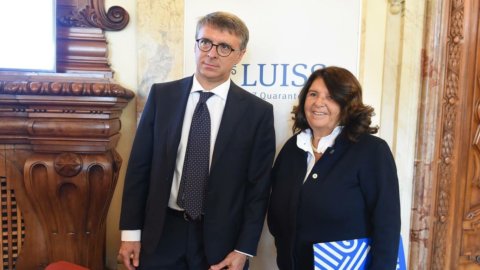
So Raphael Canton, President of Anac (National Anti-Corruption Authority), opened the conference to present the first master's degree in Compliance and Corruption Prevention in the public and private sectors, jointly organized by the University's School of Law and Government Luis Guido Carli of Rome and by the Anac.
The main objective of the course, which will start in December, is to build the foundations for the creation of acommon ethics, based on transparency and legality. These two tools, alongside the means of judicial repression, must be the guidelines for combating a phenomenon strongly present in Italy. There is a need for a common front, prepared and dynamic, capable of punishing cases of economic favoritism and conflict of interest. In fact, the new corruptor, declared Cantone, “is a facilitator: it gives you something lawful in a reasonable time, no longer something illegal”.
Paola Severino, Luiss rector, will lead the course alongside Cantone. The former justice minister of the Monti government wanted to underline the importance of the collaboration between the university and the Anac: "Italian universities must work as a system and not compete, each must bring a specific contribution due to its own peculiarities". Luiss, continued Paola Severino, "is very close to the world of institutions and will provide its experience to train future company lawyers and board of directors members".
Unfortunately to date, in Italy, the perception of the phenomenon is still very low. It is necessary to grow it popular sensibility so that corruption can be defeated. The ruling class and private citizens tend to consider corruption a marginal problem and, looking at the judicial data, this view would seem to be confirmed. In fact, only 1% of criminal trials for corruption reach the Supreme Court. However, the sentences that have become final are thousands, and the underground is enormous. It is not alarmism and indignation that help prevent the phenomenon, but the awareness that a country with this level of corruption certainly does not attract investments.
On the other hand, corruption is a bilateral crime, which requires the participation of private and public officials. The formation of a culture of prevention will represent a multiplier of possibilities and experiences. It is, and must be possible, to be able to make a profit through fair competition. This is the message launched in chorus by Raffaele Cantone and Paola Severino.
The master, structured in six different theoretical modules, will also include laboratories related to the discussion and analysis of real cases, specifically chosen by the Anac, such as the judicial events of EXPO Milano and San Raffaele, up to the organized crime phenomena of the Mafia Capital.
Another objective of the course organized by Luiss is the dissemination of knowledge of anti-corruption regulations. Indeed, as Cantone underlined, “too often the rules are imposed from above without the adequate preparation of those who are called to put them into practice. Precisely to make up for these shortcomings, Anac is working hard with universities to provide the necessary skills, in the belief of the irreplaceable role played by training”.
The need, therefore, is to overturn the paradigm used up to now. Businesses and the public administration are not objects of the fight against corruption, but must become its subjects, active parties. The logic of the past, in fact, was based on the idea that administrations were the enemy to be defeated.
One of the most evident limitations linked to the phenomenon of corruption in Italy is that of the poor perception of the phenomenon. Cantone and Severino have in fact repeatedly pointed out that the private citizen sees corruption as a crime of little interest, without however realizing the enormous consequences that this has on common life, just think of the very low level of services (such as health care) and the rules of the competition. Corruption, to date, is an evil of society, which blocks economic growth and upsets the internal economy.