For the first time, the Exhibition features over 750 participantsi: architects and engineers, mathematicians and climate scientists, philosophers and artists, chefs and programmers, writers and woodcarvers, farmers and fashion designers, and many more. The resulting group of participants spans generations: from seasoned professionals who are still innovating at ninety to recent graduates who are just starting their careers. Pritzker Prize winners, former Curators of the Venice Biennale, Nobel Prize winners, and Professors Emeritus appear alongside emerging architects and researchers. This inclusive process reflects our commitment to a wide range of diverse perspectives. “Intelligens” is the title of this edition curated by Carlo Ratti it challenges the tradition of the architect as the sole creator, with other professionals relegated to supporting roles. A more inclusive authorship model, inspired by scientific research. The Venice Biennale must collaborate with other institutions. Intelligens has thus established connections with other global institutions, with the United Nations COP30 in Belem, with the C40, with the Baukultur Alliance in Davos, with the Soft Power Club and many others. Its public program, GENS, will host a series of meetings and conversations, engaging audiences of all sizes..
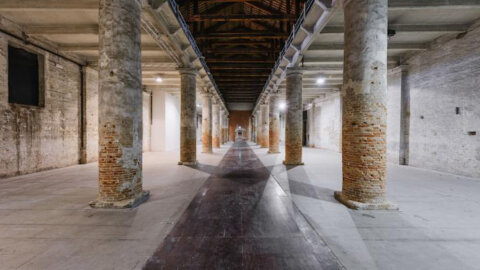
The Ropeways
“The Corderie opens with a stark fact: while global temperatures rise, the world population decreases. This is the reality that architects must face in the age of adaptation. Starting from here – explains Ratti – visitors will pass through three thematic worlds: Natural Intelligence, Artificial Intelligence and Collective Intelligence. The exhibition then culminates in the Out section with a question: can we look to space as a solution to the crises we face on Earth? Our answer is no: space exploration is not an escape route, but a means to improve life here, in the only home we know.” “Each section is conceived as a modular and fractal space, an organism that connects large- and small-scale projects creating a network of dialogue. The exhibition design by the architecture and design studio Sub directed by Niklas Bildstein Zaar, and the graphic design by Bänziger Hug Kasper Florio reflect the interconnectedness we need to survive. Additional digital layers amplify and expand the conversations, adding a new dimension to the Exhibition.”
Venice living laboratory
With the Central Pavilion undergoing renovations throughout 2025, Venice will not only host the Architecture Biennale, but will become a living laboratory. The city itself – one of the most exposed and vulnerable to climate change – will be the backdrop to a new kind of Exhibition, in which installations, prototypes and experiments will be spread across the Giardini, the Arsenale and other neighborhoods.
College Architecture
8 projects selected for the 2nd edition of Biennale College Architettura 2024-2025: Joelle Deeb (Syrian Arab Republic), Jia Wei Huang (Malaysia), Caterina Miralles Tagliabue (Spain), Agnes Thomasina Parker (England), Lucia Rebolino (Italy), Tanvi Khurmi (Canada), Rita Espinha Dos Santos Abreu Morais (Portugal), Florian Kilian Jaritz (Germany), Franziska Gödicke (Germany), Jaakko Julius Heikkilä (Finland), Emil Oscar Lyytikkä (Finland). The aim of the College Architecture 2025 is to 19th International Architecture Exhibition. Over 200 people from 49 countries around the world responded to the call for participation. The eight projects will be eligible for a contribution of 20.000 euros for the creation of the final work. The works created will be presented, out of competition, as part of the 19th International Architecture Exhibition of the Venice Biennale, Intelligens. Natural. Artificial. Collective., curated by Carlo Ratti.
Participating countries
66 national participations will organize their exhibitions in the Pavilions at the Gardens (26), at the Arsenale (25) and in the historic centre of Venice (15). The new participations are 4: Republic of Azerbaijan, Sultanate of Oman, Qatar, Togo.
Italy Pavilion
Il Italy Pavilion at the Tese delle Vergini in the Arsenale, supported and promoted by the General Directorate of Contemporary Creativity of the Ministry of Culture, is edited by Guendalina Salimei TERRÆ AQUÆ project. Italy and the intelligence of the sea.
Santa Thirst
Il Pavilion of the Holy See, promoted by the Prefect of the Dicastery for Culture and Education of the Holy See, Cardinal José Tolentino de Mendonça, will take place this year in the Santa Maria Ausiliatrice Complex (Fondamenta S. Gioacchin, Castello 450The exhibition is entitled “Opera aperta” and is curated by Marina Otero Verzier and Giovanna Zabotti.
Venice Pavilion
Il The Municipality of Venice participates with the historic Venice Pavilion at the Giardini, with the setting up of the exhibition titled Libraries. Building Venetian Intelligence. The City Pavilion will have its own emanation in other institutional spaces and in the offices of the Iuav University of Venice.
All other events and commitment to the climate
Furthermore, throughout the period there will be collateral events, special projects, the Biennale sessions project with Universities and Higher Education Institutes, without forgetting the commitment to climate change, a path that the Biennale has already started in 2021 and which this year once again sees the goal of obtaining the certification of "carbon neutrality". The Circular Economy Manifesto launched by Carlo Ratti, with the guidance of Arup and the contribution of the Ellen MacArthur Foundation, strengthens the Biennale's commitment to this goal, promoting an increasingly sustainable model for the design, installation and operation of all its activities and events. The challenge is to create pavilions and spaces that are examples of bold circular thinking that generates a lasting legacy in terms of sustainability. The goal is to eliminate waste, circulating materials and regenerating natural systems, thus demonstrating that architecture and the built environment can coexist in harmony with our planet.