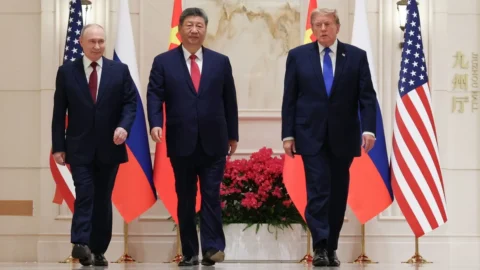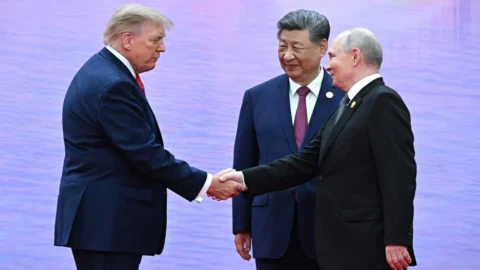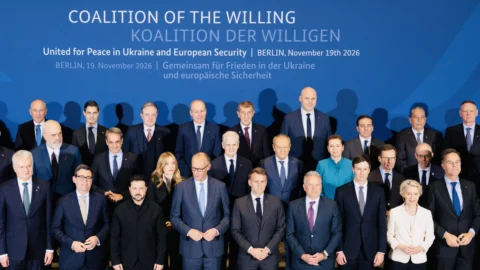
As we are now getting closer to the fifth year of the Russian invasion of Ukraine the modalities of the subjects directly involved in the peace negotiations between Moscow and Kiev are being redefined, a table from which the voice of the European Union will no longer be missingThe meeting of the coalition of the willing convened yesterday in Berlin by Chancellor Friedrich Merz together with Ukrainian President Zelensky and American envoys Witkoff and Kuchner set the priorities of political and military support to Kiev for the new year. A meeting almost simultaneously with the three-way summit between Trump, Putin and Xi in Shenzhen,
The German Chancellor was very direct, according to whom summits such as the one in Shenzhen “is a format that cannot bring peace to Ukraine"If peace negotiations come to pass, we will be involved," Merz said, explaining that the talks "can only be successful with the participation of Ukraine and Europe to bring peace." Merz confirmed that European countries will support Kiev As long as it takes to achieve "a just and lasting peace." In Berlin, the willing took stock of the aid plan for Ukraine. Merz recalled that yesterday the EU Commission presented a proposal providing an additional €45 billion for 2027, and today other members have proposed further commitments, including the United Kingdom, which announced another €11 billion in aid.
Trump's phone call to the Willing
Trump then phoned the Volunteers gathered in Berlin from Air Force One to confirm that the summit had been a success, even though according to some sources he would have criticized the excessive level of aid to Kiev and reported Putin's anger over the Ukrainian attack on the Russian bridge to Crimea. However, the two US Presidential envoys, Steve Witkoff and Jared Kushner, did not fly to China, but were in Berlin. According to Kremlin economic cooperation adviser Kirill Dmitriev, "they are working with their European partners, illustrating a possible European security structure."
In the German capital the two diplomatic formats – E3 and E5 making its debut with Italy admitted after the EU summit in Dublin – will coexist but with separate tasks: Germany, France, the United Kingdom, will carry on their specific sub-format focused on military security and planning of a multinational deterrent force on the ground in Ukraine once the ceasefire is achieved, a prospect that has been in the pipeline for some time now. the Italian government has made it clear that it does not share announcing that it will not contribute to the deployment of troops. At the same time, the E3 will integrate with Italy and Poland (forming the E5 quintet, or "Berlin Format") to manage the political strategy and common diplomatic line ahead of future peace negotiations with the United States and Russia.
Tables that they will interface with the two Americans and with Volodymyr ZelenskyFriedrich Merz, Emmanuel Macron, and Andy Burnham (the E3), who led the 37 coalition countries to the Chancellor's office, will meet with NATO Secretary General Mark Rutte, who recently reiterated the importance, in parallel with the work to bring peace to Ukraine, of "ensuring" that Kiev "has what it needs to overcome the winter and be as strong as possible in the negotiations." "Security guarantees for Ukraine must be closely coordinated with the US, and among these must be a Multinational Force Ukraine (MNF-U), intended, among other things, to support the reconstruction of the Ukrainian armed forces." the German government has made it clear on the eve of the meeting of the volunteers.
NATO Secretary General Rutte and Prime Minister Meloni address the meeting.
NATO Secretary General Mark Rutte He also emphasized the need to continue militarily supporting Kiev as long as the conflict continues. "We must ensure it has everything it needs in terms of weapons and other support," he said, recalling the meeting two days ago in Brussels, during which Allies and partners agreed to provide Ukraine, including during the coming winter and beyond, with the necessary weapons and assistance to maintain its resilience and prepare for possible peace negotiations. Responding to a question about the meeting between Donald Trump, Xi Jinping, and Vladimir Putin in China, Rutte dismissed concerns: "It's important that the leaders meet. It's normal, and I'm not worried."
Italian Prime Minister Giorgia in Berlin Meloni insisted on the need to maintain high pressure on MoscowIn Shenzhen, the prime minister said, three leaders "reiterated the importance of stable energy flows. Let's take them at their word, starting with the Ukrainian power grid. This is an issue that concerns us all: the safety of nuclear power plants on our continent, millions of civilians facing winter, energy markets already under pressure. If Moscow were to oppose it, the world will clearly see who wants peace and who doesn't. In the meantime, We continue to support Ukraine and to keep up the pressure on Russia."