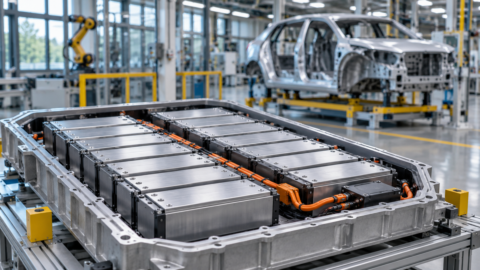
In 2030 the rules proposed by France and Germany would guarantee European factories orders for cells to equip approximately 900 thousand electric carsWith incentives linked to more rigorous criteria on the European origin of batteries, we would arrive at 4,6 million cars. It is the comparison at the centre of the analysis of Transport & Environment (T&E) on the agreement between Paris and Berlin. According to the organization, the agreement would ensure an outlet for just the 13% of European cell production expected for 2030.
For the factories currently starting up lines, the difference lies in the contracts they can rely on. Most of the cells Europe plans to produce by the end of the decade are expected to come from factories that are currently idle. Among the most exposed projects, T&E lists Lyten, the former Northvolt plant in Sweden, PowerCo in Salzgitter, Germany, and Verkor in Dunkirk, France.
Car incentives and Made in Europe thresholds
The comparison concerns theIndustrial Accelerator Act (IAA), the European Commission's proposal currently being discussed by Parliament and member states. The text ties access to public aid and tax incentives to the share of components produced in Europe. The question for manufacturers is therefore how many of the cars eligible for incentives will have to have cells manufactured in the Union.
The Franco-German agreement would set the quota at 10% in 2028-2029 and 20% in 2030-2031, to bring it to the 70% since 2032For T&E, the first two thresholds would offer manufacturers little additional certainty. Already today, the organization notes, more than half of the cells installed in electric cars sold in the EU are manufactured in Europe.
Where would the orders for cells and cathodes end up?
The destination of the investments will also be decided by the definition of European productIf components manufactured in the EU were equally eligible for incentives as those from all countries with which Brussels has free trade agreements, manufacturers would be better off sourcing from countries where production costs are lower. Compared to incentives reserved for European production, T&E estimates that in 2030, orders for 100 GWh of cells, enough for approximately 1,5 million electric cars, and 250 GWh of active cathode material could end up outside the EU.
Il cathode It is one of the highest value-added battery components. To increase volumes, producers need long-term contracts with cell factories and automakers. According to T&E, with more stringent origin criteria, European plants could meet the entire cathode material needs of subsidized electric cars by 2032. The IAA would generate 323 GWh of additional demand for European cathodes, bringing the total to 407 GWh. 94% of the expected production would thus have a guaranteed buyer.
The vote on emissions also weighs on factories
A second risk arises from the rules on CO2 emissions from new cars. In December, the European Parliament is due to vote on the position approved by parliamentary committees, which softens emissions reduction targets. According to T&E, the resulting decline in electric car sales would reduce European demand for cells by a total of 247 GWh between 2027 and 2032. This is equivalent to the batteries of approximately 3,7 million vehicles, nearly three times the annual production capacity of the LG Energy Solutions plant in Poland, the largest in Europe.
"L 'Franco-German agreement is a disaster for the European battery industry", he has declared Andrea BoraschI, director of T&E Italia, said: "European leaders should prioritize a complete, Made in EU battery supply chain, with the skilled jobs it would bring. Instead, they are debating how much to weaken the very rules that would guarantee domestic production. Weak incentives for local content criteria for batteries in the IAA would send a bad political signal about the future of this industry in Europe. European companies, struggling to scale up their production, should instead be able to count on the boost to demand that the IAA can provide."
T&E therefore calls on the Union to reject the agreement, maintain the deadlines and requirements proposed by the Commission and maintain emissions targetsRegarding the origin of components, the organization proposes limiting production incentives for the Twenty-seven, allowing at most other European Economic Area countries and the United Kingdom. The precedent it fears is that of solar panels, for which Europe has lost production capacity and technology to China.