“One morning I woke up, Bella ciao (rip.) and I found Durigon“. The Lega Nord undersecretary for labor spends much of his time locked in a think tank with the task of getting to the opening of the budget session with the development of some proposals that will enable its leader to tell that the “overcoming” the Fornero reform.
This year, at the League event 'In Your Defense – Towards the 2027 Budget', a diabolical idea has been pulled out of the hat: to overcome this reform by extrapolating a piece of the reform itself. The 2011 rules allow for retirement at 64 years old and 20 years of actual contributions, provided that a requirement of adequacy of treatment commensurate with the 2,8 times the social security benefit or at least equal in 2026 to the amount of 1.638 euros gross per month. Durigon on behalf of the Alloy proposes to apply this additional early exit route also to those who are in mixed regime, as long as they accept the fully contributory recalculation.
The League's new proposal on pensions
Durigon has done some research: the beneficiaries of the provision could be, according to the forecasts attributed to INPS, approximately 80 thousand more pensionsThen – like the murderer who always returns to the scene of the crime – the undersecretary proposes a three-year trial, the same time frame used for share 100, with an impact of 1,5 billion a year".
The objectives of this onerous measure are also the same as those advertised in 2019 when the yellow/green government shared the two great disasters of the CBI and share 100 for a three-year trial period. "I believe it's an initiative to give the labor market some breathing space and make it more efficient if we partner with the young people who are entering with the 5 percent tax rate," Durigon emphasized. We're still there; the Quota 100 initiative and its aftermath were supposed to provide employment for at least three young people to replace an older worker who was retiring early, but everyone—including the League—had to realize that things turned out differently.
Since then, the reality of the job marketToday, companies are reporting a supply-side crisis; those who leave are not replaced simply because available staff cannot be found, not only because they refuse a certain type of work or are unable to perform it, but, much more simply, because they were not born and therefore do not exist. There are also a series of other aspects that should be taken into account. Currently, the League is debating a return to its origins as a party representing a territorial Productive North who feels neglected by Salvini's stance. So, what are the problems facing this part of Italy?
We have already mentioned an elaboration of the CGIA of Mestre from which – through the synthesis of numerous official sources – it resulted that within a few years there will be in Italy 3 million new retirees, without it being possible to replace them as a result of the falling birth rate. The CGIA had distributed the exoduses according to economic sectors: just over 1,6 million they will be private sector employees, 768.200 public employees e 665.500 self-employed workers.
The regions most affected by retirements and replacements will be the Lombardia where the incidence will touch the 64,6 %, the Emilia Romagna and Lombardy with 58,6 % and Veneto with 56,5 %These are the three regions with the highest manufacturing density, where private sector employment accounts for the largest share of total employment and where, according to the CGIA, replacement falls almost entirely on businesses.
The mere possibility of a short-term replacement calls into question the work of foreigners, despite all the limitations and problems this solution poses. The League must realize that emptying factories of workers still capable of working with the necessary experience and professionalism will inevitably lead to a short circuit with immigration.
The cost knot and accounting alchemy
Then there is the problem of the charges on which the minister is also very cautious Giorgetti, despite having hinted at some openness during the debate. It is on this aspect that Durigon is running for the noble prize for the merchant's accounting at the fair, a family board game before the invention of PlayStations.
" pension expenditure is 326 billion – we comment – while the revenues are equal to 296 billion, a historic record with contributions. With these numbers, Fornero is right, there is no stability. But who is the employer of pensioners? It's the State. Are those 326 billion gross or net? They are gross. How much is that gross? It's 76 billion, taken away from the 326 billion, make it clear that the sustainability of the pension system in Italy is strong, it is in force and we can say that it exists".
In essence theaccounting alchemy It consists of removing the tax burden from spending. This isn't the first time the undersecretary has indulged in this economic theory, which unfortunately is entirely his own work. Because if we could reason like this for the entire world, public spending We would have solved all the problems: it would be enough to only take into account net spending, subtracting the tax revenue from the total expenditure. Why do this only with pensions and not with public employee salaries, with contract specifications, and with all the income and cash flows that sooner or later end up under the taxman's thumb? How come no one has ever thought of a solution as simple as Columbus's egg?
It is the same logic, also shared by the League, of those who think they can solve the problem of sustainability of the system through accounting operations, such as – it is the most widespread cliché – the separation between pension expenditure e welfareIt would seem that up to now the Italian authorities have purposely provided incorrect data to the European level when a few subtractions would be enough to get things in order: deleting the part of the expenditure covered by the State budget as assistance and, lastly, also the share of Irpef paid by pensioners.
There's a problem, though: statistics in Europe – and elsewhere – are compiled based on common, agreed-upon, and predefined criteria. The aim is to avoid what Durigon calls “a round trip”But when you belong to a community that has established its own rules, you can't unilaterally change them or interpret them as you please.
Is it intended to eliminate pension income tax across Europe? Italy's net income tax will remain higher than other countries' net income tax rates, as confirmed by the select group established by the minister. Andrea Orlando in 2021: ''the result relating to IVS functions suggests that also for pensions (15,8% of GDP before taxes, +3,1 percentage points compared to the EU average) would remain a net differential.''
It would be a mere propaganda operation, a makeover for its own sake. Then – as if by magic, because the resources would remain the same – according to the League, that accounting trick would allow them to free up resources to cover 64 years>.
Who really benefits from retiring at 64?
It's then worth exploring the actual benefits of these operations for workers. I could be told that it's their business because the options are voluntary; then, if INPS provides... 85 thousand more pensions with a burden of 1,5 billion a year there is no need to raise objections; except to remember that, at the time of share 100, the expected exits in the three-year period were 900mila, but they didn't get to 500mila.
Who may be interested in going out to 64 years with twenty years of effective service, even if subject to a fully contributory calculation. A lot of people, especially women, who have a smaller presence on the labor market are induced to avail themselves of the old-age pension 67 yearsWith the proposed amendment, while the required contribution length remains at 20 years, the age requirement would drop to 64, resulting in a variable but sustainable financial penalty.
One problem remains: the requirement of adequacy equal, in general, to 2,8 the social security allowance or in 2026 1.600 euros and a little moreIf we look at the average amount of the treatment starting in the first half of 2026 for all the managements we find an amount equal to 1.600 euros for men and 941 for women. It follows that in this case too, the exit route will primarily benefit men, even though the majority of members of the baby boomer generation meet the conditions for early retirement.
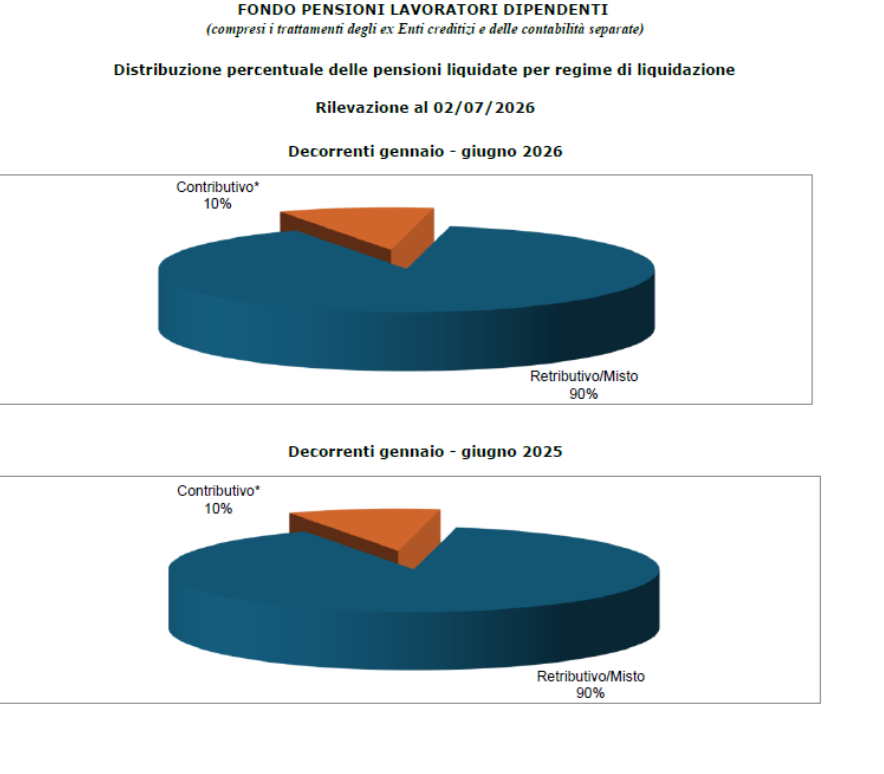
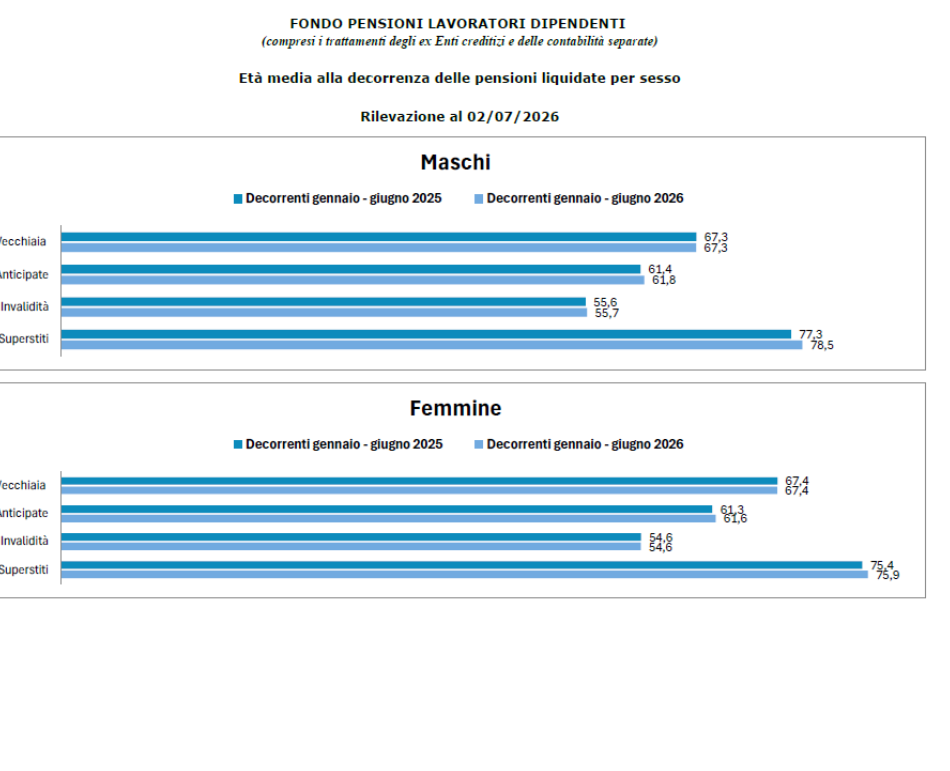
As you can see from the graph, referring to the FPLD, the prevailing severance pay regime is the mixed one and therefore, in theory, many workers would be affected by the change proposed by the League. However, there are other considerations to be made. The generations of baby boom I am able to meet the required contribution requirements, 42 years and 10 months for men and one year less for women regardless of their age, with an average age at the start of the pension in 2026 of 61,4 years old; and their allowance – calculated under the mixed regime – does not suffer any cuts.
Obviously, we've described factual situations that aren't established by law, but which are reflected in reality. The question is: is it worthwhile to devise additional solutions that, ultimately, would prove to be solutions to niche problems? We repeat it for the umpteenth time; the real problem regarding pensions in the next budget law is the same: what to do with the biennial indexation mechanism for pension requirements with respect to increasing life expectancy. Let's not get distracted by secondary issues.