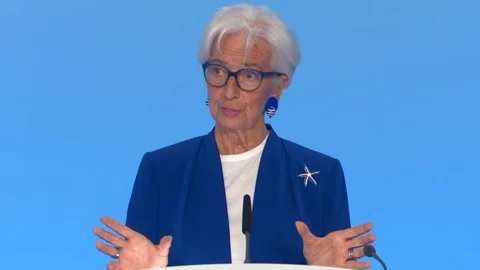
Europe recognizes the risks, but often intervenes only when he can no longer ignore them. This is the limit that Christine Lagarde calls for overcoming in his speech at the 36th Frankfurt European Banking Congress, his last as president of the European Central BankAt the heart of the speech, entitled “Acting in Time”, is the economic sovereignty and financial stability of the Old Continent: a challenge that, according to Lagarde, requires stronger institutions, strategic investments, and political leadership capable of assuming responsibility for decisions before crises become evident.
"Economic sovereignty has become a challenge in itself," she declared, warning that dependencies considered normal in an open economy, from critical raw materials to technology, "can now be used against us." The problem, according to Lagarde, is that Europe is able to react when a crisis erupts, as happened with the pandemic and the war in Ukraine, but struggles to anticipate the risks that slowly unfold. "We can identify the problem from the beginning, but we only act when it can no longer be ignored. And at that point, almost by definition, it is too late," she observed. "Once our dependence has been used against us, our sovereignty is already exposed."
The ECB president recalled a metaphor by Machiavelli, who compared the problems of states to fevers: initially "easy to cure and difficult to understand", but subsequently "easy to understand and difficult to cure".
Lagarde: "Someone must take responsibility for making decisions."
For the ECB president, the greatest challenge is recognizing when waiting becomes riskier than action. "No matter how carefully we weigh our choices, there always remains a certain degree of uncertainty, and someone must take responsibility for deciding," she said. "The most difficult judgment is recognizing when waiting has become riskier than acting, even before the evidence is irrefutable."
This principle applies especially to European strategic decisions, which are often held back by immediate political costs versus long-term benefits. "At that point, leaders must find the courage to make the case for intervention, before the majority is ready to listen," he added. And those who act early must also be prepared to lose recognition, he emphasized, quoting Henry Kissinger: "It is in the nature of successful policies that posterity forgets how easily things could have turned out differently."
From artificial intelligence to defense, investments for European sovereignty
Among the strategic dependencies, Lagarde indicated theartificial intelligence: Increasing Europe's share of global computing capacity from 5% to 15% by 2030 would require €1.300 trillion. "As long as we can purchase computing power from external providers and cutting-edge AI models remain at our disposal, it's difficult to argue why we should pay this price," he noted. But AI also represents a new threat to financial security, because it can make them attacks IT more sophisticated and difficult to counter. "The concern that keeps me awake, and that keeps many of you awake as well, is AI combined with cyber threats," Lagarde warned, emphasizing that policymakers have not paid enough attention to the risk.
The vulnerability also concerns the paymentsInternational circuits handle over 60% of card transactions in the Eurozone, and 14 out of 21 countries do not have a national circuit. Hence the project ofdigital euro, a "digital equivalent of cash" on European infrastructure. "Since a project of this scale takes years to implement, we had to start well before the need became pressing," he explained. The ECB aims for a first issuance in 2029, if the legislation is adopted by the end of the year.
Even the investments in defense and in research, they can strengthen Europe's autonomy. "We should design our response so that it can deliver benefits even if the worst-case scenario never materializes," Lagarde said, highlighting public-private partnerships for semiconductors and data centers as priorities.
Capital markets and the international role of the euro
Oncapital markets union, Lagarde criticized a European supervisory agreement that "weakens the European Supervisory Authority's ability to make effective decisions" and "includes too many exceptions." "We've all agreed for over a decade that Europe needs a capital markets union," she recalled, but achieving it means "challenging vested interests." delay, he warned, it costs a lot: “With every year that passes without Capital Markets Union, a greater share of our savings is invested abroad and more of our growing businesses seek financing elsewhere.”
Il strengthening the international role of the euro It is equally important: "It can support Europe's growth and sovereignty on the world stage." Greater demand for euro-denominated assets, he explained, reduces financing costs: "Financing costs decrease if international investors want to hold our currency." The ECB is also moving in this direction: over 30 central banks have expressed interest in Eurep and Frankfurt is working to expand swap lines and connect European instant payment systems to those of other countries. The goal is to strengthen investor confidence, because "if a reserve manager knows that euro-denominated securities can be converted into euro liquidity without a forced sale, they will be more motivated to hold them under normal conditions."
A review of seven years at the ECB: "I hope to leave a more sovereign Europe."
In her last speech to the congress as president of the ECB, Lagarde outlined a mandate balance sheet"I hope to leave behind an institution that has helped give Europe greater integration and sovereignty than it had when I arrived." In these seven years, she added, "I have seen Europe achieve things that once would have been considered impossible."
The challenge now is to act with the same determination before emergencies become unavoidable. "The question now is whether Europe can act with the same determination before the need becomes impossible to ignore," he observed. "At the ECB, we have tried to do so in our field. It will be up to others, over time, to decide whether we have judged correctly."
His final appeal is addressed to Europe's ruling class: "We should do everything possible to facilitate timely action, strengthening action at the European level and defining policies capable of producing positive results whatever the future scenario." Because, he concluded, "we will also need leaders who believe in Europe and are ready to fight for it."