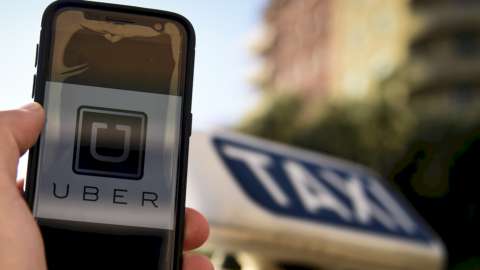
Uber make peace with Rome taxis. Or at least, with some of them. The Californian app has signed an agreement to carve up the streets of the capital with the ItTaxi consortium, whose cars, from June, they will become part of the Uber platform in Rome. However, the agreement is only the first step in a campaign that could extend to 90 cities and 12 cars (these are the numbers of the ItTaxi network in Italy).
According to the Roman agreement, therefore, from the Uber app users will also be able to select the taxis of the ItTaxi consortium to call a ride. “They will be informed that the service is offered by the partner ItTaxi and they will be routed to our circuit,” explains Loreno Bittarelli, president of the consortium and number one of the 3570 cooperative.
Uber-Taxi: the agreement includes changes only for payments
After that, the usual rules apply to the drivers and customers: the call cannot be refused and drivers who are out of shift or outside the area of competence cannot be called. The only difference concerns the bill, which is established on the basis of the municipal tariff, using the taximeter, and is taken from the payment card registered on Uber.
For this reason, with taxis, users cannot receive an indication of the final cost right before the ride, as happens with NCCs, but only a range of prices calculated by the algorithm. “Uber is committed to operating according to the rules of our sector”, underlines Bittarelli again.
Who makes money?
But from an economic point of view, who benefits? The taxi drivers accepted the agreement to have access to the pool of 118 million Uber global users, who in Rome are mainly tourists or foreigners on business trips (with their tips). The American app, on the other hand, collects a commission, which according to Bittarelli accounts for 7% of the value of the rides, including VAT.
“By 2025 we want all the world's taxis on our platform,” Andrew Macdonald, vice president of Uber said recently.
The doubts of taxi drivers
On the part of taxi drivers, however, there is no shortage of doubts. According to Nicola Di Giacobbe, Unica-Filt-Cgil national coordinator, "the risk is to disturb and deregulate non-scheduled public transport, which cannot be left to the free market but must remain a public service, in the user's interest". Massimo Campagnolo, national manager of Federtaxi-Cisal, fears instead another risk: "If we give power to this global giant, including user information - he claims - we will end up at its mercy: we will be taxis/riders".