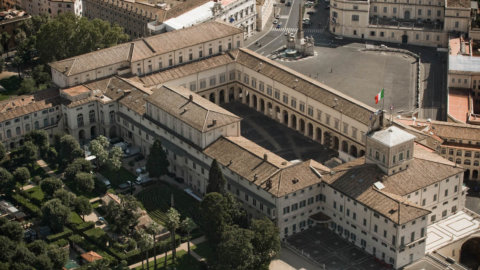
Over the centuries, the Quirinal Palace has changed its "skin" several times but has always remained the heart of Roman power: it has hosted 30 popes, 4 kings and 12 presidents, including Sergio Mattarella and the future Head of State who will be elected starting next January 24th. Waiting to know who will be the thirteenth President, let's take a journey through the history of the Palace located on the "highest hill", the art and cultural heritage of the best Italian genius.
Its name derives from the god Quirino and is located on the homonymous hill overlooking the Tiber river, which in the Renaissance was the place of residence of the Roman aristocracy. Many may not know it but the elevated position made the hill an ideal place to escape from the mosquitoes that infested the Tiber during the summer, or that the Quirinale is the sixth largest palace in the world or, again, that not all the presidents have lived in the palace. The seat of the highest office in the Republic boasts a past full of curiosities to be discovered.
PALAZZO DEL QUIRINALE: THE HISTORY
The Palazzo del Quirinale was built starting from 1583 as the summer residence of Pope Gregory XIII who, at his own expense, wanted a different resting place from the Vatican or the Lateran. In fact, stylistically far from the seat of the pope bishop as it has no visible religious symbols or a church open to the public (the only one among the apostolic palaces). The works were entrusted to the architect Ottavio Mascarino. In 1587 Pope Sixtus V, had the Pontifical State the land where the palace stood and he expanded its construction by entrusting the work to his trusted architect, Domenico Fontana. However, Pope Paul V Borghese was the first who lived and died in the Palace, but above all who built it according to its current appearance thanks to the architect Flaminio Ponzo and later Carlo Maderno.
For over three centuries the popes used the Quirinale first as a summer residence and then as a center of papal power. Illustrious masters of Italian art worked on its construction and decoration such as Peter of Cortona, Alessandro mirrors, Ferdinando Fuga, Gian Lorenzo Bernini, Giovanni Paolo Panini e Guido Reni.
From the 1809th century, the Popes lived permanently in this palace, with the exception of some periods: three times they were evicted from the palace. In XNUMX from Napoleon who renamed the Quirinale "Palazzo Imperiale" and carried out numerous works to his taste by relying on the architect Raffaele Stern. But the French emperor's stay ended even before it began when, five years later, Pius VII regained possession of the Quirinal, erasing the traces of the Napoleonic occupation. Among the most important interventions, the frescoes of the Paolina Chapel and the final arrangement of the Fountain of the Dioscuri in front of the entrance to the building. Their constant presence on the Quirinale has led the hill to assume the name of "Monte Cavallo".
Then in 1848 from Roman Republic led by Mazzini, Armellini and Saffi and then by Vittorio Emanuele II in 1870 with the breach of Porta Pia – which decreed the end of papal temporal power – when Pius IX had to leave his residence and flee to the Vatican, leaving the historic building in the hands of Savoy. Not before – according to a legend – having cast a terrible curse on the usurper king.
After the farewell of the "popes" to the fascinating residence, the Council of Ministers of Kingdom of Italy he established that the Quirinale should be destined for the residence of the King. Thus the "house of priests" became the residence of the Kings for seventy years.
But it was Umberto, son of Vittorio Emanuele, who transformed the Quirinale into a real palace. Although during the First World War it underwent another, but temporary, transformation: from an elegant royal palace to a military hospital, losing part of its political centrality with the coming of Mussolini to power.
After the armistice of 8 September and with the flight of Vittorio Emanuele III towards Brindisi, the palace once again welcomed the Savoys who returned to the center of the political game. But for a short time, until the fall of the monarchy sanctioned by the first democratic vote of 2 June 1946. From there the building definitively became the seat of the republican head of state.
PRESIDENTS WHO LIVED AT THE COLLE
Although formally the Quirinale is the official residence of the president of the Italian Republic, not all presidents chose to live there. For example the first two presidents of the Italian Republic, Enrico De Nicola and Luigi Einaudi. The first to settle in the old building was Giovanni Gronchi (1955-1962), followed by Antonio Segni (1962-1964), Giuseppe Saragat (1964-1971) and Giovanni Leone (1971-1978). Instead, Sandro Pertini (1978-1985) and Francesco Cossiga (1985-1992) refused and used it as an office. Oscar Luigi Scalfaro (1992-1999) was convinced to live in the building only starting from the middle of his mandate, while Carlo Azeglio Ciampi (1999-2006), Giorgio Napolitano (2006-2015) went to live there with his family.
INSIDE THE QUIRINALE: THE ROOMS AND THE GARDEN
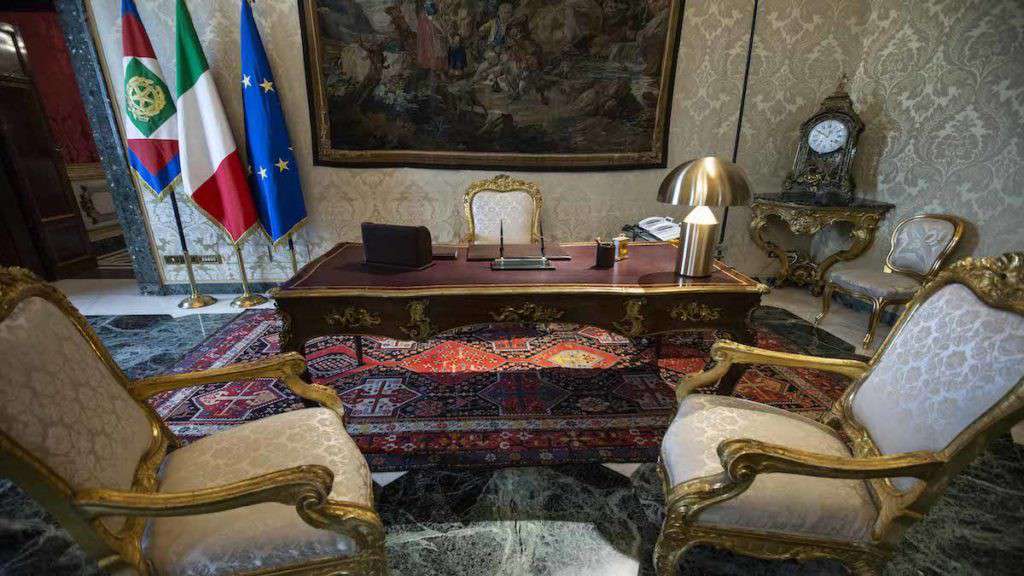
With an area of 110.500 square meters, it therefore seems impossible to describe in detail all the rooms of the historic Roman palace, including imposing halls decorated and embellished with paintings and busts that enclose over four centuries of history. For a total of 1.200 rooms, the Quirinale is made up of the central body, which develops around the majestic Cortile d'Onore, with the most beautiful rooms in the complex that serve as representative places for the Presidency of the Republic. While the offices and apartments of the head of state are located on the opposite side, the so-called "Manica Lunga", the wing adjacent to Via del Quirinale. The Study of the President it is the seat of the official meetings with the Heads of State and with the party secretaries during the consultations for the formation of the Government, but also the place where the President delivers the traditional end-of-year message.
Besides the very famous spiral staircase by Mascarino (it led to the apartments of the popes, which could be accessed directly on horseback), it is worth mentioning the Loggia of Honor where press conferences are held on the occasion of the consultations for the formation of executives.
Cortile d'Onore is a large porticoed square, the result of decades of work. From here you can climb the Scalone d'Onore which allows access to the two main rooms of the building: the Hall of the Cuirassiers and Party Hall. The first is the largest room in the entire complex (37 meters long, 12 wide and 19 high), where hearings and awards are held. In the second, the new Government is sworn in and the official lunches are held (ballroom during the stay of the Savoys).
Jewel of the Palace is the Pauline Chapel by Carlo Maderno, with the same architectural and dimensional characteristics of the Sistine Chapel in the Vatican. In the past it hosted some conclaves, today chamber concerts. Although consecrated, the chapel is not officiated except at Christmas and Easter.
La Bronzino room it owes its name to the sixteenth-century tapestries woven to designs by Agnolo Bronzino, today the place of first meeting between the President of the Republic and the Heads of State guests from the adjacent Loggia of Honour. While the Hall of Mirrors it is used for some official hearings of the Head of State and the oath of the judges of the Constitutional Court.
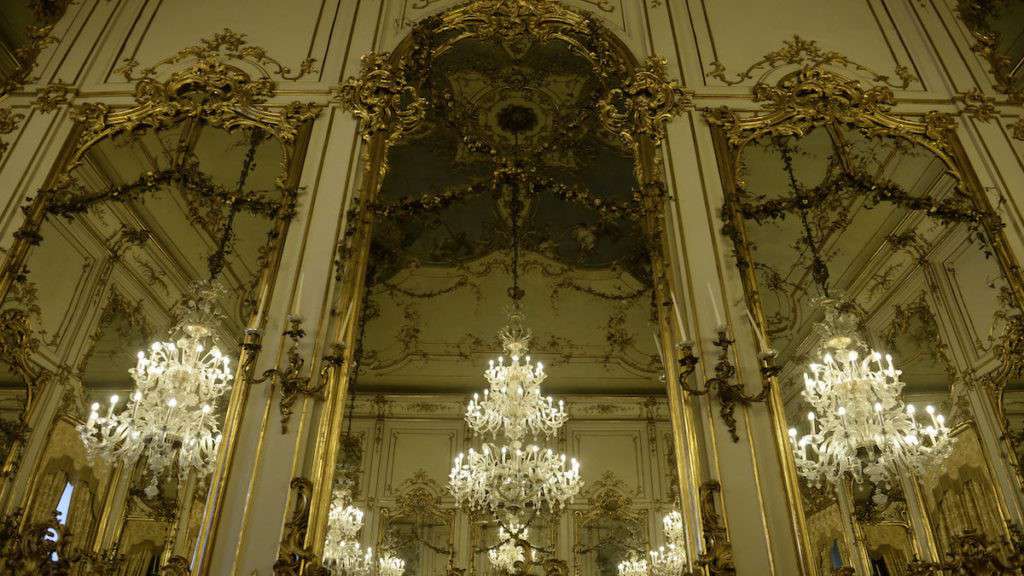
In Hall of the Tapestries meetings of the Supreme Defense Council are held, convened at least twice a year by the President of the Republic. In the Hall of the Ambassadors the accredited diplomatic corps is received on the occasion of official visits of foreign Heads of State in Italy. A peculiarity of the Quirinale is represented by Chapel of the Annunziata, built in the early 600s as a "secret chapel" for Paolo V Borghese.
As for the official dinners, they are usually held in the Tower Hall, the highest part of the building which offers a magnificent view over the city.
Among the most suggestive places is the Piffetti room, which takes its name from the precious library built in the mid-700th century for the villa of Queen Anne of Orleans, near Turin by the Piedmontese cabinetmaker Pietro Piffetti, then transported to the Quirinale by the will of King Umberto I and Queen Margherita.
It flies, i Quirinal Gardens, famous for their "elevated" position over Rome. They extend for 4 hectares, with several fountains, a labyrinth, a grove, the sundial, a long terrace overlooking a breathtaking panorama and an elegant 700th century Coffee House. Modified over the centuries according to the taste and needs of those who settled in the Palace.
PALAZZO DEL QUIRINALE: THE COLLECTIONS
Today, a series of collections are concentrated in the headquarters of the Presidency: 260 tapestries, paintings, statues, carriages (105), clocks (205), furniture and porcelain of great value (38) and an incredible collection of Murano glass chandeliers and crystal. Among these stands out a "rezzonico" style chandelier 6 meters high and with a diameter of about 4 meters. An imposing security service made up of elements of the police and carabinieri watches over this jewel.
During his seven-year term, President Mattarella added to the Palazzo's rich heritage a collection of contemporary Italian and design works that have found space in the courtyard, gardens and halls of the building.
PALAZZO DEL QUIRINALE: CURIOSITIES
- The Tiber made the lower part of Rome unlivable in the summer, due to the mosquitoes. For this reason the hill was favored by the clergy and the ruling class for the hottest season.
- It is the sixth largest building in the world in terms of area (20 times the White House) and is the second largest residence of a head of state (first is the Turkish President Erdogan's Ak Saray in Ankara).
- The Quirinale is a colossal institution that costs almost over 200 million euros a year (the ceiling imposed by President Mattarella is 240 thousand euros).
- In the Salone delle Feste there is the second largest carpet in the world which extends for about 300 square meters.
- In the Savoy era, the Salone dei Corazzieri was used as a tennis court, a thesis supported by the discovery of a ball during some restoration operations in more recent times.
- The 200 watches (all signed) are cared for by Stefano Valbonesi and Fabrizio Geronimo, official watchmakers capable of manually reconstructing the deteriorated parts and gears of the precious watches.
- If we also consider the police forces who operate permanently at the Quirinale, the amount of the workforce involved in supporting the presidency of the Republic reaches 1720.
- The Corazzieri are the honor guard of the President, a specialized force of the Carabinieri. Strict requirements, both physical and moral, are required to enter: excellent service references, a minimum of one meter and 90 in height and an "adequately harmonious" physical structure.
- The flagship of the Quirinale garage is a dark blue Flaminia 335 from 1961, with seven seats. Now, after 44 years of honorable service, it is used only for the inauguration and for the parade on June 2nd.
- To enhance and share this rich heritage, President Sergio Mattarella reopened the Palazzo to the public in 2015. Furthermore, it is possible to visit the "House of Italians" - as defined several times by Mattarella - not only in person but also from the comfort of home thanks to the virtual tour created by Google Arts and Culture.