When nothing was thrown away, in the countryside of Sappada, the mountain resort at 1.250 meters above sea level al extreme border of Friuli Venezia Giulia, excess milk from milkings was left for 4 days in cast iron containers on the edge of wood stoves. Then the curd that was formed was dripped into linen sacks and mixed with the tarragon, a herb widely used in French cuisine to flavor fish, eggs and other dishes, the main component of Béarnaise sauce used to accompany grilled meat. In Italy it is difficult to find it in nature, it is found only cultivated and has antiseptic and digestive properties, moreover the leaves contain mineral salts and vitamins A and C.
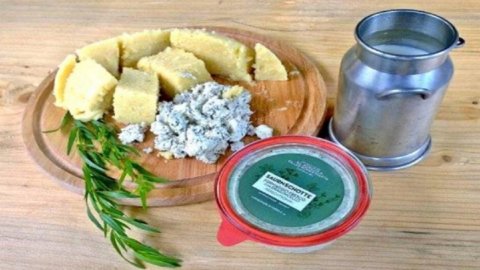
It is not customary to find it in our country except in Friuli and Piedmont and even more unusual and difficult to pronounce is the name of this rare fresh cheese, Saurnschotte, Whose aromaticity given by tarragon with pleasant hints of mint and wild fennel. it is supported by the acidity of the curd.
In the local language, Saurnschotte means "sour cottage cheese". The appearance is that of fresh ricotta, a little shapeless, white in colour but it shouldn't be confused with ricotta. It is in fact a fresh cheese, obtained from the acid coagulation of whole raw cow's milk, to which are added minced fresh or dried mountain tarragon leaves, which in the parts of Sappada they call perschtroum, and a little salt and pepper.
Saurnschotte, aromatic tarragon cheese with pleasant hints of mint and wild fennel. supported by the acidity of the curd.
Spontaneous plant on the edge of pastures and woods Sappadini, the inhabitants of Sappada collect it in the summer before it begins to flowerand, traditionally between August 15, the feast of the Assumption and September 8, the Nativity of Mary. Once pruned, the leaves are shredded and preserved in salt for the production of Saurnschotte.
Acid coagulation takes a long time, even a few hours, due to the slow acidification of the milk triggered by the addition of lacto-graft self-produced by the cheesemaker. During this process the lactose is transformed into lactic acid, the increase in acidity causes the precipitation of the caseins and the formation of the clot. The increase in temperature, within certain limits, favors the acidification process, therefore the milk inside the boiler is kept at a temperature of about 37° C.
Once the coagulation process is complete, the curd is left to drain in cotton cloths for 24 hours and then mixed with tarragon, salt and pepper. It keeps up to about 15 days in the refrigerator.
Saurnschotte is a unique dairy product in the Alps and represents the piece of a delicate puzzle, which is the mountain environment, fragile and in need of continuous care and maintenance. THECow's milk comes from local farms, whose cows graze in the summer months and are fed hay during the winter months.
Slow food presidium was disappearing, saved after having collected ancient testimonies in families today it has a production disciplinary
Today Slow Food presidium of Friuli Venezia Giulia the saurnschotte had all but disappeared, just as the harvesting of wild tarragon had all but been abandoned. His salvation and its rebirth are due to the sisters Marta and Sara Piller Roner who manage the Plodar Kelder dairy in Sappada.
“It all started a few years ago, when Marta and I decided to produce it in the dairy” declares Sara Piller Roner, who explains how they arrived at the prestigious garrison: “With the help of numerous people from Sappadia, including Marcella Benedetti, provided detailed descriptions of how it was once made in homes, we started building the recipe to produce a cheese similar to the "homemade" one. There have been various attempts and today we have a production "disciplinary" and a supervisor. While we were working to produce it, a group of fellow villagers, including Max Pachner and Roberto Brovedani moved so that the saurnschotte also became a tool for the protection of identity and for the promotion of the territory. After various attempts, today we have reached a disciplinary and a supervision". And today Sappada can finally boast of producing a cheese of exceptional flavor with a long history.