The XXV was presented in recent days INPS report in the presence of Minister Elvira Calderone who drew the conclusions after the explanatory report by the President of the Institute, Gabriele Fava. The INPS Annual Report is a sort of check-up of Italian society and economy in the international context and the organization is a friendly Big Brother who enters all the homes of Italians and foreign residents and all the workplaces, providing that overall vision which should guide social protection policies.
As the president stated in the report: “INPS does not replace employment policies, but plays an essential and distinctive role. Thanks to the information heritage At its disposal, it can interpret the evolution of the labor market, identify changes before they become critical, and highlight the connection between today's employment dynamics and the sustainability of tomorrow's pensions." He then added: "Sustainability is not just a matter of balancing the books. It is a responsibility between generations. It means ensuring that those who retire today receive what they are entitled to, but also that those who work today do not inherit an unsustainable system. The true way to protect pensions is not to separate them from the rest, but to rebuild their connection with work, with young people, with women, with businesses, and with growth."
The general statement shows a surplus in accruals and cash in 2025
The first dimension of analysis of the Institute's activity, therefore, is that economic-financial and patrimonial, which is illustrated through a simplified reading of the main results of the data General financial statement for 2025. The financial management of competence offinancial year 2025 closes with a surplus of 16.818 million euros, as the difference between 571.210 million euros for assessments and 554.392 million euros for commitments, as a result of the current account balances (13.813 million euros) and capital account balances (3.004 million euros).
La cash financial management, with collections of 561.375 million euros and payments of 554.916 million euros presents a positive differential of 6.458 million which, added to the initial fund, determines a surplus of 48.411 million euros. The administration surplus is equal to 136.759 million euros, as can be seen from the algebraic sum of the final cash fund, the active residues and the passive residues. From an economic-financial point of view, the year 2025 closes with a positive operating result equal to 4.525 million euros, an improvement of 3.496 million compared to 2024, when it amounted to 1.029 million euros. This result, net of the allocations to riserve legali and to the reserve fund of the Solidarity funds, determines a economic deficit of 1.130 million euros. As a result of the operating result achieved and the reduction in debt for treasury advances, the net assets It goes from 35.313 million euros at the beginning of the financial year to 42.838 million at 31 December 2025.
The wage bill is growing, bringing contribution revenues to +3,6%.
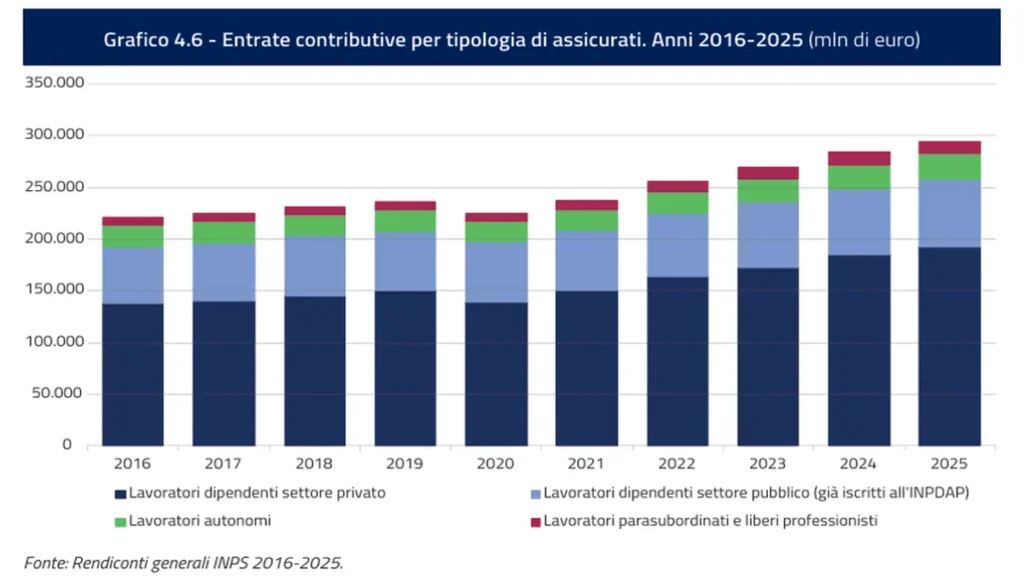
Le contributory revenue amounted to 294.194 million, with an increase of 10.147 million (+3,6%) compared to the figure recorded in the previous financial year's report (284.047 million), with a positive deviation of 1,5% compared to the forecasts set at 289.734 million. The increase in contribution revenues, equal to 10.147 million, is largely attributable to the trend of the macroeconomic framework which presents a increase in the payroll This represents a 3,7% increase for the entire economy, a combined effect of employment trends among dependent workers and the growth of individual wages. The dependent labor market, in fact, recorded an increase in overall employment and a rise in gross wages per employee.
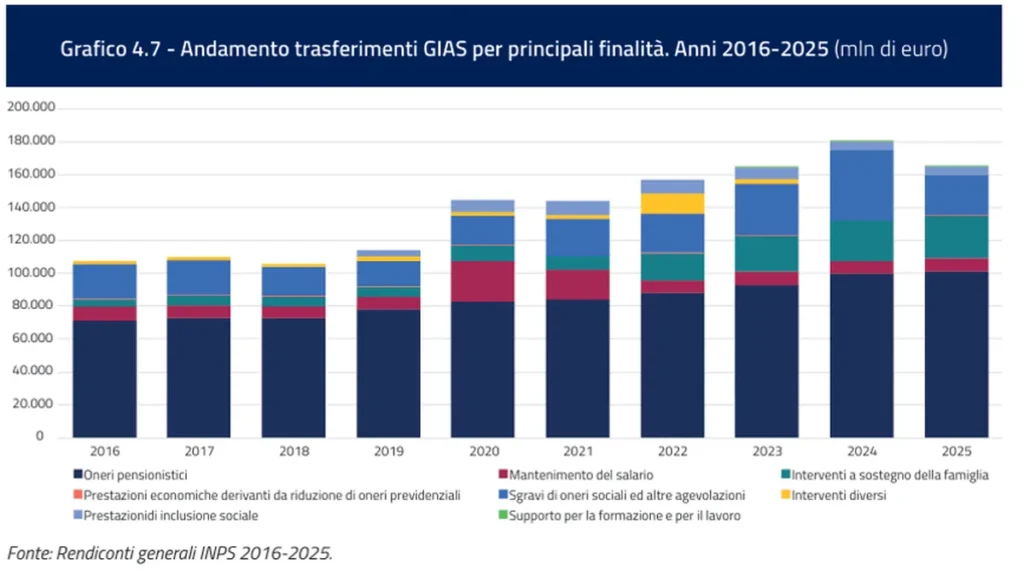
I transfers of the current portion from the State budget and from the regions, definitively allocated to Gias, amount to a total of 165.252 million, of which 20 million attributable to the regions (in 2024 180.544 million, of which 6 million from the regions), to cover welfare costs or which are financed by general taxation, based on the purpose from which the relative transfer arises by law. The overall value of the investigations (165.252 million) therefore shows a reduction of 15.292 million compared to the previous financial year, due in particular to the following measures: a significant reduction in transfers to cover contribution exemptions, in particular the elimination of the costs deriving from the reduction in the contribution wedge, following the transformation of the relief on the employee's share of contributions into a tax benefit (through bonuses and tax deductions); a decrease in expenditure for the early retirement pension called "Quota 100", now at the end of its operation.
The number of workers covered by INPS has risen to a record 27,2 million.
The increase in contribution revenues brings us to the data of theoccupationSince this is a topic of debate and political controversy, INPS presents itself as a reliable and impartial arbiter. A summary of this is provided in President Fava's report: "Today, Italy is experiencing high employment levels”. According to Istat data, the employment rate has steadily exceeded 63%. In 2025, the audience of workers insured by Insp According to the Report's data, it reaches approximately 27,2 million, marking a new record. This number, Fava continues, "doesn't just reflect an administrative dimension."
It captures the real foundation upon which our social security pact rests. Permanent employment has undergone a significant consolidation phase. But it would be a mistake to stop at the surface of the numbers. The Italian workforce is growing, changing in nature, and aging in its demographic composition. increasingly depends on the contribution of foreign workers and sees the decline of some historical forms of self-employment while The number of professionals, collaborators and members of the Separate Management is growing.
Strong contribution of foreign workers increased by 35%
According to the data contained in the Report, between 2019 and 2025 “the non-EU workers have grown by more than 35% and today one in seven employees is a foreigner“. The Report then contains more specific references. Let's start with dependent work. In 2025 the employees exceeded the 21 million threshold for the first time. Compared to 2024, the increase was approximately 250, equal to 1,2%, a value however lower than the average for the entire 2019-2025 period (+1,6%). The increase in employees was accompanied by a very modest increase in the average number of paid days (+0,2%). These are 255,2, equal to 81,8% of the 312 theoretically payable days in a year. They were 254,6 in 2024 and 252,8 in 2019. The share of workers, has grown almost imperceptibly: it will be equal to 45,18% in 2025, compared to 45,16% in 2024 and 44,92% in 2019. The increase in terms of employment intensity is more significant: in 2025, the average number of paid days for women was equal to 253 compared to 251,8 in 2024 and 249,7 in 2019. While feminization is proceeding albeit very slowly, two other demographic trends are decidedly more intense: the growth of foreigners and the importance of aging.
Taking into consideration, the job market It is highlighted that employment has reached new historical highs, driven by the permanent employment. However, structural weaknesses remain: the employment rate remains below the European average and is characterized by strong gender gaps, despite a progressive narrowing of the gender gap, and territorial. INPS insured people are growing, especially young people and non-EU workers. On the demand side, the services they become the main driver of employment and the average size of companies grows, albeit too gradually.
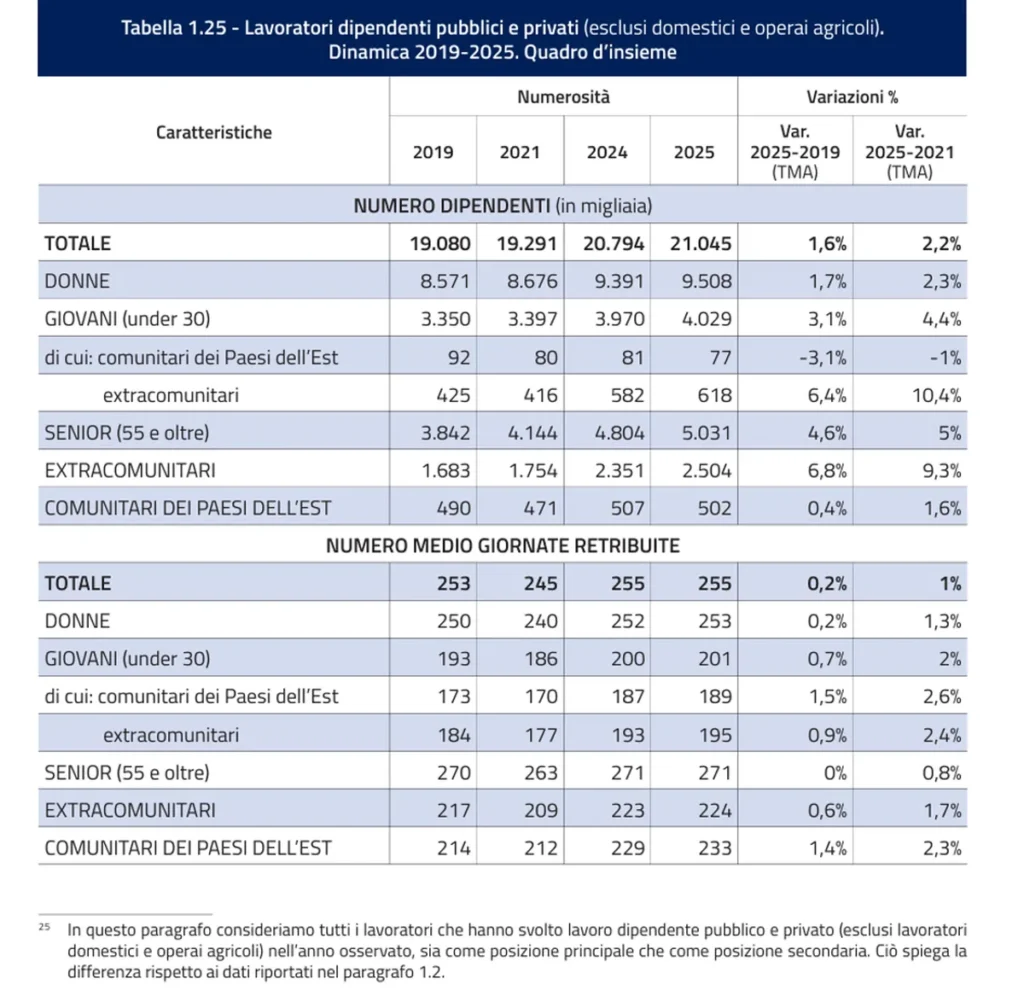
Based on the graph, the Report highlights the following aspects:
young people between 18 and 34 years old: they have significantly increased as employees (850 thousand) despite a continuous reduction in the population of the same age groups (-230 thousand): the two movements are reflected in the employee/population ratio, which has risen significantly, with variations even above ten points; • adults between 35 and 54 years old: here there has been the most intense negative variation in the reference population (-1,8 million) while at the same time the number of employees has decreased but to a much lesser extent (-100 thousand): also in this case it is important to underline the trend of the ratio, which has grown, which is significant given that this is the age group with the highest employment rate; • Seniors aged 55 to 70: this is the only group for which both the reference population (+1,32 million) and the corresponding number of employees (+1,16 million) have significantly increased, with a peak in the employee-to-population ratio around the age of 61-62. The recent growth in dependent employment is therefore largely due to the increased weight of the youth component (including, but not limited to, immigrants), which has accompanied the increase due to the senior component, stemming the contraction of the adult component.
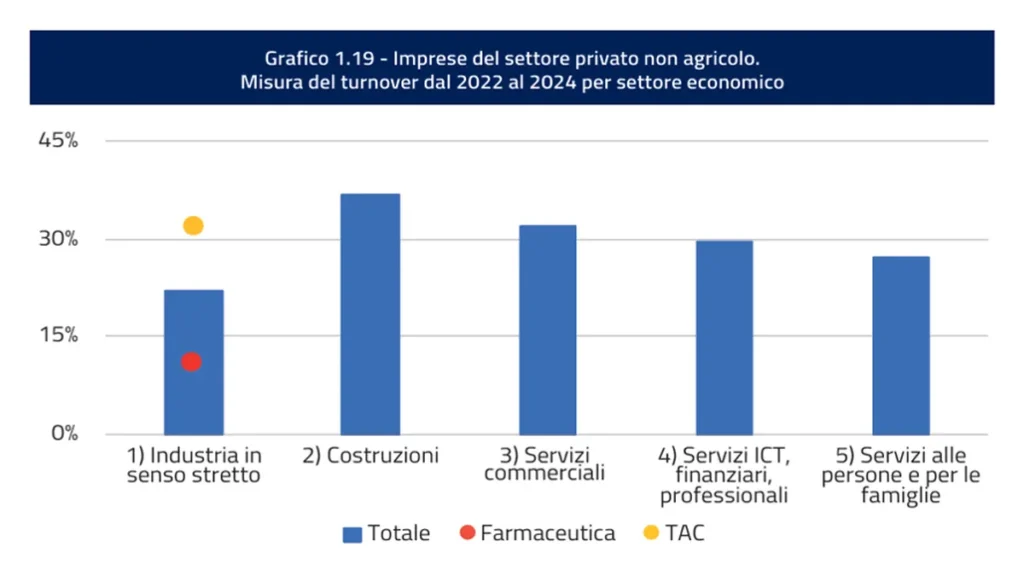
Among the many interesting aspects (the INPS Report should be included in journalists' training and refresher courses), there is a focus on turnover trends, which reveals appreciable labor market dynamics. Business demographics are a useful additional indicator for labor market analysis, as they provide insights into the productive fabric's ability to regenerate, innovate, and adapt to changing demand and the competitive environment. The analyses are conducted over the three-year period 2022-2024, providing consolidated data and thus providing a stable estimate of turnover. The choice to analyze three years, rather than two, allows for amplifying the magnitude of the rates and thus brings out certain findings more clearly. In the three-year period considered, there were just over 1,97 million active businesses, grouped as follows: • 1,38 million "stable" businesses (70%), meaning they were present in all three years. These companies employ an average of 92% of the workforce and are expected to experience significant growth of 832 employees between 2022 and 2024. The average size of these companies is between 10 and 11 employees; • 280 “exited” companies (14%), i.e., present in 2022 but not in 2024. Approximately 4% of the total employees worked in these companies. The average size is very small, just over 2 employees; • 279 “incoming” companies (14%), i.e., absent in 2022 but present in 2024. These companies employ approximately 4% of the workforce, the average size is just over 2 employees. Overall, this is clearly a segment that mirrors the previous one; • 35 companies (2%) defined as “entries-exits” as they show both movements. There are two cases: (a) companies active only in 2023; (b) companies present in 2022, absent in 2023, and present again in 2024. The average annual size is less than one: these are companies that have only one employee for a limited number of months. In terms of workload, they are completely negligible.