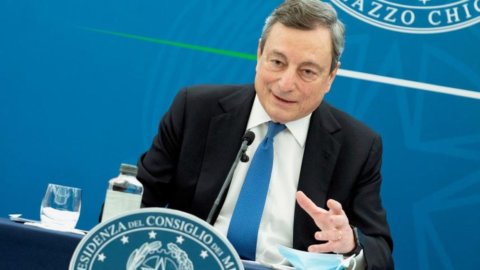
Reform of the citizen's income and other social safety nets, first reduction of the Irpef, cut of the tax wedge, new flexibility on pensions and extension of the 110% superbonus. These should be the fundamental chapters of the first budget law by Mario Draghi. Today the government is sending the European Commission the Draft Budgetary Document, i.e. the outline of the 2022 maneuver. A package of interventions which, in the Premier's intentions, should be worth around 25 billion euros, focusing on growth and social protection. In theory, the actual budget should be approved by Wednesday, but everything suggests that there will be a postponement, given that the October 20 deadline is not peremptory.
BASIC INCOME
As far as the basic income is concerned, the priority remains the re-foundation of the employment centres. It is a titanic undertaking cherished by several legislatures, but nonetheless indispensable for relaunching active employment policies, which have failed so far.
The other major objective is to reduce the number of people who receive checks illegally because they work illegally. The aim is therefore to improve the checks, which today take place ex post, on a sample basis, and are entrusted entirely to INPS.
Then there is the idea of introducing a form of "décalage", that is, to reduce the amount of the check after a certain period of time, in order to encourage people to accept even those jobs they currently refuse.
Finally, it is necessary to ensure that the income gives greater support to large families and foreigners, who at the moment must meet the requirement of having been resident in Italy for 10 years.
OTHER SOCIAL SHOCK ABSORBERS
In all, the reform of the social safety nets could cost up to 6 billion euros, in the event that the Cig is extended to companies with fewer than 5 employees. There is also discussion of a possible strengthening of Naspi and the extension of the expansion contract.
TAX: IN THE 2022 MANEUVER POSSIBLE ADVANCE OF THE IRPEF CUT
Up to 8-9 billion could be reserved for cutting the tax wedge to free up resources for corporate investments and encourage the recovery of domestic consumption. This is the only chapter on which convergence among all the parties seems possible.
It cannot be excluded that the government decides to anticipate some interventions envisaged by the law tax delegation, for example a first cut of the Irpef (requested by Lega, Forza Italia and Italia Viva).
PENSIONS
The budget law will not contain a real pension reform, but an intervention to mitigate the "staircase" for the end of Quota 100. There are several options on the table: from strengthening theSocial Bee to the expansion of the categories of strenuous work.
SUPERBONUS 110%
As for the Superbonus 110% (which includes ecobonus 110% and sismabonus), we are moving towards an extension to the whole of 2023. In addition, other incentives could also be extended, from the bonus for renovating buildings to the energy one.