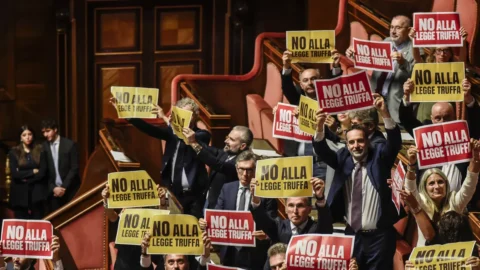
With 113 votes in favor, 71 against and 2 abstentions, the Senate approved the reform of the lawelectoral law among the strong opposition protests who shortly before the vote displayed signs reading “No to the fraudulent law”.
The text, which arrived from the Chamber of Deputies, was amended by the Senate and is now back in Montecitorio for a third reading, where it should likely receive final approval by the end of September.
What the electoral law provides, in brief
Lo Stabilicum, as the reform has been renamed, it is a pure proportional with a majority bonusThe coalition that surpasses 42% of the vote gains 35 additional senators and 70 additional deputies. The measure also establishes a partial return of preferences, despite the blocked list leaders remaining.
As for the changes, the minimum number of people increases from 1.500 to 6. signatures per college that those not in Parliament must collect to run in the elections. However, as provided for in the current law, those with two groups in Parliament are exempt, as is, under an amendment introduced in the Chamber of Deputies and confirmed in the Senate, those with at least one group formed by December 31, 2025, such as, for example, Italia Viva and Azione. For those, like +Europa or FnV, with a member in at least one of the two houses of Parliament, the number of signatures required remains as current, between 1.500 and 2,000 per constituency (112.500 in total if you want to run in all constituencies). Exempt from collecting signatures for the Overseas constituency (between 500 and 1,000 residents in the relevant constituency, as provided for by the current law) are parties or political groups that formed a parliamentary group, even in just one of the two Houses, at the time the elections were called, or that presented candidacies under their own symbol in the last election and obtained at least one seat in one of the two Houses. The Senate instead rejected an amendment from the opposition which proposed the collection of signatures in digital mode, while the text establishes that in the event of early voting the number of signatures to be collected should be halved.
The opposition protests
"You predicted that 42% could trigger a bonus of up to 70 deputies and 35 senators, but what idea of democracy is that? You take almost everything and hope to elect the President of the Republic by yourselves, but what idea of democracy is yours? Perhaps the fact that you get to the Quirinal and appoint the five judges of the Constitutional Court is because you have never liked this formation, so extraordinarily desired by the Constituent Assembly, just as you don't like the Constitution, which you can't feel is yours; in fact, you struggle to call yourselves anti-fascists," said the Democratic Party group leader. Francesco Boccia, speaking in the chamber on the electoral law.
The leader of Italia Viva is also very critical Matteo RenziYou decide to change the electoral law in September 2026 to ensure greater government stability, and in the same month you make a fuss about it just to celebrate the longest-serving government in Italian history. So one of two things: either stability comes from the electoral law, or the existing one is fine. The one you're changing is the only one that has allowed for stability. You're not changing it for stability, but because you're convinced that next time you're seriously in danger of losing. Last time, you didn't win because of the Rosatellum (a special law on the right to vote), but because the left didn't unite. Referring to the center-left, Renzi added: "Whoever takes it upon themselves to break this unity for ideological or personal reasons will go down in history as those who give another five years to Meloni, Vannacci, and company." He then announced his rejection of the reform.
Azione also voted no to the electoral reform. Because "this law aims to perpetuate a constant and ongoing conflict that in this country should be ended by putting bipolarism on the back burner," the party leader stated. Carlo Calenda Speaking in the Senate during the final vote on the electoral law, he said: "We know that this system constantly generates new forms of populism, extremism, ever new noise and propaganda. We know this because we've seen it in recent days," he continued. "Now it's created General Vannacci, who will be next? Will Grillo return? Will we then have other influencers? Do you really think this won't happen? At each election, the coalition that fails to deliver on its campaign promises will generate even more extreme demand. This is a dynamic that needs to be remedied. The majority bonus could have been awarded at 50% plus one, with a proportional system and binding government programs for coalitions."
The majority's comments
“Without taking sides, I propose a reflection. Is there anyone who can't reach 42%? No. Is there anyone who is sure of reaching it? No. So it's a fair law,” stated the President of the Senate. Ignazio La Russa, speaking to journalists at the end of the session.
“I don't see any obstacles, so I'm optimistic that it will pass the Chamber,” said the Minister for Institutional Reforms, Elisabetta Casellati, Speaking to reporters after the Senate approved the electoral law, he added, regarding the possibility of the government raising a vote of confidence: "Let's take it one step at a time: now the electoral law has been approved here" in the Senate, "and then there's the next step in the Chamber."