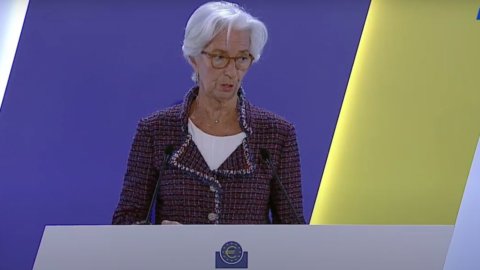
Anti-spread shield and rate hike they are not at odds with each other, but rather one favors the other. The president of the ECB reiterated this, Christine Lagarde, in his opening speech at the annual Sintra Forum, launching yet another reassuring message to the markets which, not surprisingly, increased earnings after his words.
Lagarde: 'Undesirably high inflation, we will act quickly'
On the occasion of his introductory speech at the Sintra Annual Forum on central banks, the president of the ECB, Christine Lagarde reiterated that inflation in the Eurozone “is undesirably high, and is expected to remain so for some time to come. This is a major challenge for our monetary policy." In this context, “net asset purchases under our various programs will end this week. In July we intend to raise the reference rates for the first time in 11 years. We provided some indications for the September meeting and for the path of rates that we expect to follow thereafter", said Lagarde, underlining that the ECB will continue "to follow this path of normalization and will do what is necessary to ensure that inflation stabilize at our target of 2% over the medium term”.
The president of the ECB, quoting Victor Hugo, said that "perseverance is the secret of all triumphs, so we will continue to be persevering".
So what will happen in the coming months? “The process of normalizing our monetary policy will continue in a determined and sustained way”, confirmed Lagarde, adding however that “given the uncertainty we face, the rate normalization step cannot be defined ex ante”, but will be carried out with “gradualness and optionality“. “This conditional approach should not be confused with a deferment of normalization,” she added. “This means moving gradually if there is uncertainty about the outlook, but with the option to act decisively if there is a deterioration and de-anchoring of inflation expectations”. According to Lagarde, in the light of all this, "it must be emphasized that flexibility is an integral part of the process of normalizing monetary policy and it is essential to implement the necessary policies and protect price stability".
Lagarde: "The anti-spread shield will be effective and proportionate"
“Preserving the transmission of monetary policy across the euro area will allow us to raise rates to the extent necessary. In this sense, there is no compromise between launching this new instrument and adopting the necessary policy stance to stabilize inflation at our target. Effectively, one favors the other", said the president of the European Central Bank speaking of the anti-fragmentation tool that the technicians in Frankfurt are developing.
Precisely to avoid the risks of fragmentation that would block the transmission of monetary policy choices, the ECB has decided "to speed up the completion of the design of a new instrument": one anti-spread shield that "must be effective and proportionate" but also "providing sufficient guarantees to maintain the momentum of the member states towards sound fiscal policies", underlined Lagarde in her speech, once again highlighting the Eurotower's determination to prevent "explosions" in differentials but at the same time reassuring against policies fiscal 'merry' thanks to the shield provided by Frankfurt. Words that remember those pronounced a week ago in front of the European Parliament, when the number one of the Eurotower had warned: "those who have doubts about our determination are wrong".
Returning to today, Lagarde recalled how in this fight against fragmentation the ECB “will also use the flexibility to reinvest maturing securities” in bonds of countries “where an orderly transmission is at risk. This dual approach – he continued – “falls exactly within the tradition of the ECB” which “in the past, made use of separate tools to manage inflation and preserve the functioning of the monetary policy transmission mechanism. Measures to preserve transmission can be used at any interest rate level as long as they are designed not to interfere with the monetary policy stance."
Growth forecasts
In a difficult global context, between the impact of the war, high inflation and problems with supply chains, "we have clearly revised our growth forecasts downwards for the next two years" for the Eurozone "but we still expect positive growth rates despite the loss of momentum” of the recovery thanks to the “cushions” linked to household savings and domestic demand, said the president of the ECB Christine Lagarde.
"Numerous shocks have hit the economy of the Eurozone,” he stressed, citing imbalances in global demand and the energy crisis, amplified by the conflict in Ukraine, which is also driving up food prices. “Given its energy dependency, the Eurozone is experiencing these shocks acutely,” with a sharp rise in inflation. “The size and complexity of these shocks also creates uncertainty about how persistent these inflation levels will be,” Lagarde said, stressing that “an end to the conflict between Russia and Ukraine is still not in sight and there is still the risk of a supply cut which could keep energy prices high”.
European stocks up sharply after Lagarde
After Lagarde's words, the European stock exchanges expanded their increases, with Piazza Affari which gains 1,4% in the mid-morning at 22.238 points. Similar increases also for Madrid and Paris, while Frankfurt rises by 0,98%.
In Milan, investors' attention is focused on Saipem that two hours after the opening is still unable to make a price, marking a theoretical +20% for shares and -20% for rights. The oil company is facing the second day of the 2 billion euro capital increase. In the meantime, however, it has been awarded several contracts, both onshore and offshore, in the Middle East for a value of approximately 1,25 billion dollars.
Eyes up too Mediobanca (+1,99%) and Generali (+0,97%) in the aftermath of disappearance of Leonardo Del Vecchio. Leonardo (+3,8%), Moncler (+2,68%), Stellantis (+2,59%) and Unicredit (+2,58%) are also among the best stocks of the Ftse Mib.
Sales hit instead: Diasorin and Amplifon, both down by 0,9%, but also Inwit (-0,6%) and Recordati (-0,4%).
The voltage on the secondary is deflated, with the spread between ten-year BTPs and their German counterparts at 204 basis points (-2,48%). The yield on the 10-year BTP is 3,686%.