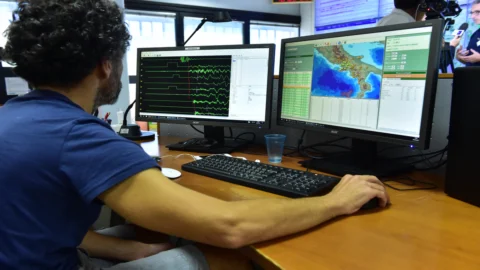
La digital network largest and most widespread in Italy is transformed into a environmental surveillance platform. National Institute of Geophysics and Volcanology (Ingv) and FiberCop have Memorandum of Understanding signed to use the Fiber optics as a distributed sensor in seismic and volcanic monitoringNot just connectivity, therefore, but a new infrastructure to serve the country's security.
The agreement opens a study and experimentation phase which aims to integrate geophysical monitoring with existing digital infrastructures, strengthening the commitment of the INGV to make observation techniques increasingly effective of natural phenomena through innovative methodologies to be used alongside traditional tools.
Das technology: from data to prevention
The heart of the project is the Distributed acoustic sensing technology (Das), already successfully tested on the island of Vulcano. Thanks to this system Fiber optic cables are converted into a widespread sensor network capable of detecting vibrations and intercepting seismic-volcanic events even in underwater or difficult-to-access environments.
During the experiment conducted Over 1.400 seismic events were detected by the INGV with international partners in just one month.analysis of more than 20 Terabytes of data, made possible by the use of artificial intelligence and high-performance computing, has allowed for a detailed study of the state of the island's hydrothermal system, opening up new perspectives in volcanic surveillance and emergency management.
Phlegraean Fields: Fiber passes through the most sensitive area
The experimentation is already operational in one of the most delicate areas of the country: the Campi FlegreiDAS signals are being acquired and analyzed along a fiber optic cable that crosses the active seismic area for approximately 20 kilometers, from Bagnoli to Bacoli.
The distributed nature of the measures allows for a detection point every five meters, increasing virtual sensors and facilitating the identification of minor events, especially in seismic swarms. The INGV has developed an application for real-time data analysis and automatic event detection using artificial intelligence techniques.
An infrastructure that changes function
Under the agreement, FiberCop makes available dark fiber optic sections to enhance geophysical observation activities in the most sensitive areas. The goal is to build a distributed, permanent, and high-precision monitoring system capable of complementing and strengthening traditional sensor networks in seismic and volcanic risk zones.
“The FiberCop network is a capillary system that enables digital connectivity, designed to ensure reliable and high-performance communications, and capable of taking on an even broader role by becoming an advanced platform for seismic and geophysical monitoring,” he declared. Massimo Sarmi, president and managing director of FiberCop"The agreement with INGV represents a strategic step in leveraging our infrastructure as a resource for protecting the territory and reinforces our vision of a digital ecosystem that combines innovation, sustainability, and responsibility, positioning fiber optics as a key element for the country's resilience and progress."
Along the same lines Fabio Florindo, president of the INGV: “The signing of the memorandum of understanding between our Institute and FiberCop represents aimportant opportunity To strengthen and increasingly improve the effectiveness of geophysical observation techniques. Ensuring a comprehensive, integrated, and efficient monitoring system, particularly in areas at greatest seismic and volcanic risk, is a priority for us, including through the adoption of innovative methodologies alongside traditional observation tools.
Fiber optics, from a data transmission infrastructure, also becomes a monitoring tool thanks to Fiber Optic Sensing. As part of collaborations with universities, research institutions and European projects, FiberCop is studying new applications to detect temperatures and mechanical variations along the network, consolidating a model that combines technology, sustainability, and safety.
The agreement is included in research and experimentation activities dedicated to the evaluation and the implementation of innovative technologies to support risk prevention, marking a further step towards an increasingly integrated and advanced territorial surveillance system.