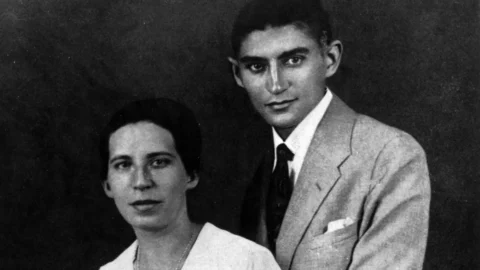
Kafka everywhere. I think it's not an exaggeration to say that Franz Kafka, with Orwell and a few others, can find a place in the small group of the most loved, most cited and most influential writers of the twentieth century.
Hanna Arendt considers him the greatest writer of the last century.
On TikTok the hashtag #kafka has totaled over one and a half billion views. The teenagers exchange passages and quotes taken from letters written to Milena such as: "Love is the fact that for me you are the knife with which I search inside myself." Powerful and true words.
Kafka's universality is astounding. Kafka himself, who wanted to see all his writings destroyed and published very little during his lifetime, would have been dumbfounded by this celebrity.
Korean rapper Kim Nam-Joon, frontman of the very famous group BTS, recommends his fans to read The Metamorphosis.
There is a manga adaptation of Kafka's stories by the Japanese brothers Nishioka Kyodai.
In a 2023 interview, the Hindi writer and translator Ashutosh Bharadwaj explained why Kafka belongs to everyone, everywhere and at the same time. He refers to the Prague native as a “writer of multiple, contradictory and disconcerting identities”.
The letters to Milena
To remember the centennial of the disappearance of Kafka, which occurred on June 3, 1924, we asked Claudia Sonino, a well-known Germanist, an unpublished contribution on the Prague writer.
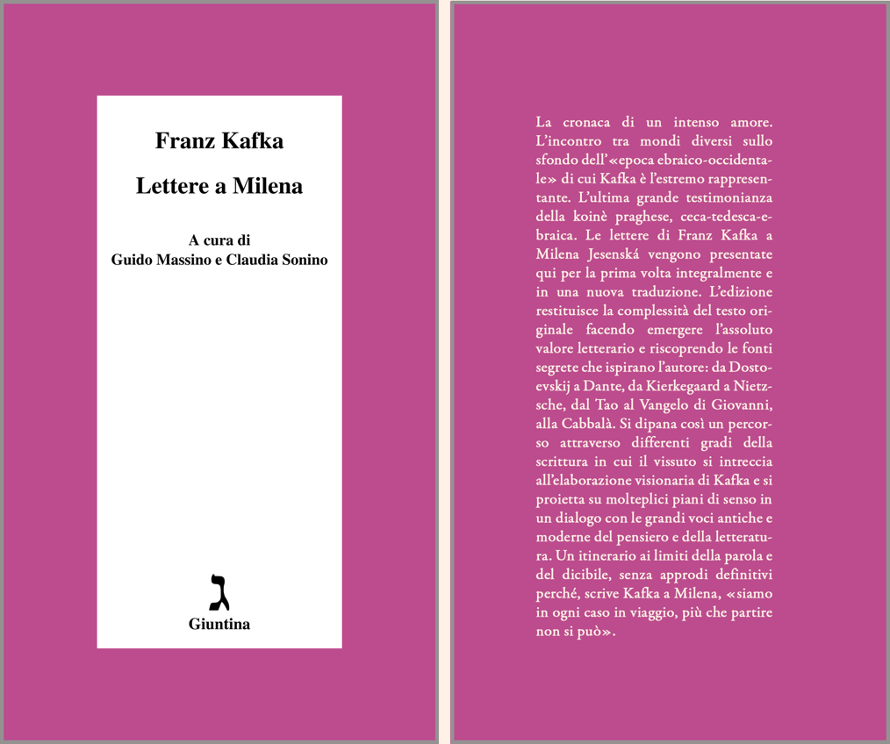
Claudia Sonino has edited together with Guido Massimo an important critical edition of one of Franz Kafka's most fascinating texts, the Letters to Milena in a new translation by Isabella Bellingacci. It is a 440-page book published in 2019 by the Giuntina publishing house of Florence.
Finally in our language, we can now have a complete edition of the Letters to Milena. The research and critical work of Guido Massimo and Claudia Sonino has highlighted the connections and sources that fueled and inspired her. Sources that account for the breadth of Kafka's readings and his eclecticism which ranges between different cultures and traditions of thought and spirituality.
Given the extent of Claudia Sonino's contribution, whom we thank, we thought we would offer it to our readers in two parts. The first in a row, the second next Sunday.
Happy reading.
Food in Kafka's world (Claudia Sonino)
Part one
Hunger and asceticism
In a note from diaries from 1922 Kafka compares himself to a hungry animal «if the path leads to edible food, to breathable air, to free life, even if it is behind life».
Kafka often talks about food, which is certainly not strange, in fact, food is talked about in many works of literature. What appears singular is rather the fact that Kafka talks about food to underline a position of marginality, of extraneousness, of personal diversity or of other subjects and individuals.
Other authors often talk about the food as a moment of celebration, of sharing, in which a community, through the ritual consumption of food, recognizes and strengthens itself, in which the individual, through the shared meal, integrates into a group and takes root in life.
The case of Kafka and his characters is different, men who seem to come from nowhere, without community, without belonging, without past and without future, for whom the normal instinct to eat appears powerfully repressed or even disappeared, and for whom the food is part of a complicated system of symbolic, intellectual and spiritual, emotional values, it is rather something that is sought but not found, something - which is even "behind life".
The appetite
In Faster, a story written in 1922, the protagonist is condemned, as he will reveal at the end, to being hungry. His asceticism, his art of fasting is actually a deception, the truth is that he was forced to fast «because I couldn't find food that I liked. If I had found it – he murmurs on his deathbed – I wouldn't have made such a fuss and I would have started eating like you and the others."
I Kafka texts they are populated by figures like these, hungry beasts in a vain search, hunting for food that can be eaten. Gregor Samsa in Metamorphosis he aspires to a food that is not that of other men but which he would feed on and without which he is condemned to be hungry.
Other figures of the different, of the marginalized are characterized by a lack of appetite, where food is confirmed as a problem, as an element of separation rather than sharing. Thus Karl Rossmann, the young protagonist of America, abandoned to himself, does not eat the salami that his mother gave him for the long sea voyage, and when he reaches his destination he finds himself at the table with Pollunder and Green, imposing and massive men whose corpulence and stature signify strength and vitality, but also social success and integration, dinner turns out to be torture for him.
«Mr Green was carving up a pigeon with great blows of the knife…and brought to his mouth a large piece of meat which, as Karl happened to see, was grabbed and pulled in by his tongue. This sight made him feel nauseous."
Kafka's eating habits and vegetarianism
Other figures of Kafka lead, driven by an internal necessity, one ascetic life. By fasting they alienate themselves from others, the eaters, acquire distance and assume the position of critical spectators. They seem to be looking for something which, as it is said in the diaries of the 22nd, is perhaps "behind life".
There has often been an attempt to identify these voluntary and involuntary fasters with Kafka himself. The complex and complicated relationship that Kafka had towards food is very well documented.
He chose food carefully, avoided certain foods, became a vegetarian - already undermined by tuberculosis he came to praise the high nutritional value of half a lemon - and gave importance to a very conscious and thoughtful way of eating, which in his opinion was beneficial to his health.
For example, he experimented with «Fletchern», a chewing method developed by the American Horace Fletcher which required each morsel to be chewed for a long time and carefully, breaking it into pieces with all the teeth before swallowing it. Furthermore, it was very clear to him that with these eating habits he confined himself to the role of the extravagant, and with great irony in a letter to Felice Bauer, his never-married girlfriend, he recounts how his father would put a newspaper in front of his face so as not to see him. eat.
That's his difficulty with food, the one eaten by everyone, was evidently demonstrated by the memories of his contemporaries which gave rise to a real anecdote.
When he worked in Prague at the Institute for Insurance against Accidents at Work, he subsisted on bread, milk and yogurt, while the others had the succulent dishes of Bohemian cuisine delivered to them. A waitress of his time told of the "health dessert" that Kafka loved to eat.
The interest in this aspect of Kafka's life is certainly due to desire, and the need to better decipher the enigmas of his work. Some critics have seen this relationship with food as a sort of self-punishment, tracing it back to psychopathological disorders.
Others have rather interpreted it as a secularized form of Kashrut, that is, a secularization of Jewish dietetics and prescriptions regarding food. Still others highlight the psychosomatic aspects – office stress as the cause of his frequent stomach aches.
Kafka explicitly and implicitly linked the refusal of certain foods to his family. «My paternal grandfather was a butcher» he says in a letter to Milena "It's not like this means I have to eat as much meat as he slaughtered."
Sitting at the family table
But it is in the Letter to his father in which Kafka refers to the behavior of the father table to point out to him his tyrannical way of behaving with his children and the consequences this had on him. The rules that Hermann Kafka dictated were valid for everyone except him: «When, as a child, I was with you, especially during meals, you instructed me above all on how to behave at the table. What appeared on the table had to be eaten, it was not allowed to talk about the goodness of the foods - However, you often found them inedible and called them "good for beasts"... While you, thanks to your vigorous appetite and your love for speed, you ate everything hot and in big bites, the child had to hurry; and meanwhile a gloomy silence loomed over the table, interrupted by warnings, "Eat first, you'll talk later"; “sooner, sooner!” or: “look, I've already finished a while ago”. Gnawing on bones was not allowed, but You did. You were not supposed to taste the vinegar, but You were allowed to. The most important thing was to cut the bread straight; but it didn't matter whether you did it with a knife covered in sauce. You had to be careful not to let crumbs fall on the floor, but there were tons of them under your chair. At the table you only had to pay attention to eating, while you cut and cleaned your nails, sharpened pencils, searched your ears with a toothpick...I always lived in shame...whether I rebelled...or whether it wasn't possible for me to obey you because I wasn't I had, let's say, neither your strength nor your appetite...".
Fasting condition for writing
Kafka thus reveals how he had missed that approach to food as a fundamental need at home, a lot aestheticas organically grown products e affective, which in the family is generally expressed through a discipline that is also initiation, learning about life.
At the table with the father there is no food socialization, banquet, assimilation of affections through the dishes, construction of future positive memories in the food enjoyed together, linked to this or that occasion, to a party, or to habit. Supervision and punishment seem to be in force at the table, at least in the son's memories.
He is certainly not wrong in relating Kafka's tendency not to eat to his protest towards his father and his way of being, his satiated bourgeois being. In Hermann's scale of values - who had made himself from nothing - material possession occupied a very high place while everything spiritual was looked at with distrust.
Chopping vegetables instead of eating the roast pork with appetite was an act of demonstration, you were different, you were better than him.
Primitive and almost animalistic èlan vital of his father, Kafka contrasted another impulse or instinct: he stated several times that his interest, all his interest went to spiritual things, to literature. And in one step of the Journals he will confess that he has lost weight in all other directions.
For Kafka, not eating was therefore a prerequisite for being able to write, just as sexual abstinence was. «I need a room, a vegetarian pension, for the rest almost nothing», he wrote, and addressing Milena in 1920, he compared the robust and imposing writer Franz Werfel to a living space capitalist.
End of first part
. . .
Claudia Sonino he taught German literature in Trieste, Milan and Pavia. You have spent research and teaching periods in Austria, Germany and Israel. For Mondadori you published Exile, diaspora, promised land. German Jews towards the East (1998), translated into German with the title Exil, Diaspora, Gelobtes Land?, Jüdischer Verlag 2002) and The Asymmetry of the Heart (2006). For Guerini e Associati he published in 2015 Between dream and reality Jewish Germans in Palestine (1920-1948), translated into English with the title German Jews in Palestine, 1920–1948: Between Dream and Reality, Lexington Books, 2016. In 2019 for the publisher Giuntina edited the critical edition of Franz Kafka's Letters to Milena together with Guido Massimo.
He has many other publications to his credit.