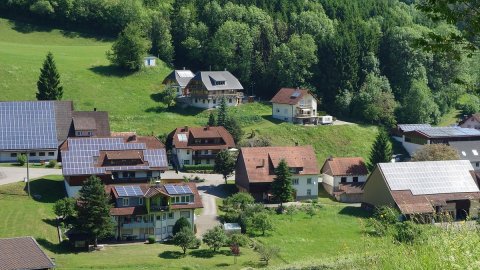
La clean energy sharing represents a transformation of the traditional model of kilowatt-hour production and consumption. With the arrival in Italy of the regulation of renewable energy communities, ERC, the concept of distributed generation and the development of zero km energy are perfected. The CERs are established in a simple legal form with the association of natural persons, commercial activities, non-energy SMEs and local administrations who join forces to acquire a plant for the production and sharing of kilowatt hours from renewable sources. Until now it was legal, for example, for condominiums to associate to finance the installation of panels on the roof of the building, however the energy produced could only be used to power the common areas; while now with the legal recognition of thecollective self-consumption the plant is expected to supply more users.
From an economic point of view it earns a persistent reduction of the bill in the order of 20-30%. An incentive of 110 euros is provided for each self-produced and self-consumed MWh. Any excess energy is purchased by the GSE (€50/MWh approximately 3 times the wholesale energy price). It is recognized aexemption from network and system charges due to the coincidence between production and consumption with a refreshment quantified by the Energy Authority of 8-10€/MWh. In terms of investment for the plant and storage systems, one benefits from tax deductions 50% on RES plants and for a part of the installed capacity (up to 20kWp) also the concessions provided for by Super bonus 110%. The technical limits for setting up a CER are that all participants must be served by the same LV transformer cabin and that the installed power does not exceed 200kWp.
The participation of non-energy entities in renewable energy projects represents a structural discontinuity ideally comparable to that experienced by the audiovisual market when the physical Blockbuster stores were canceled by streaming services such as Netflix.
It is smart grid technology that brings about the changes but it is politics that implements them. The concept of putting citizens at the center of the green supply chain recognizing and encouraging the figure of the prosumer, the one who self-produces, self-consumes, stores and shares energy, takes shape with the European directive REDII of 2018, the transposition of which was anticipated in Italy with an amendment to the Milleproroghe 2020 decree thanks to the initiative of the senator Gianni Girotto. In order to adopt transitional rules, recourse was made to the instrument of experimentation by way of derogation and during the pandemic year some energy community projects. The first to come into operation is that of Magliano Alpi in the Cunese area with the mixed participation of citizens and the municipality.
The European delegation law is currently being examined by Parliament to align the national regulatory framework with the new European directives inintroducing elements of simplification and improvements in the valorisation of the contribution of distributed generation on the basis of objective, transparent and non-discriminatory criteria. We are in the right direction although in the opinion of some there is still room for improvement to broaden participation. The non-recognition of Third Sector entities and public entities other than municipalities among the subjects authorized to form a CER is contested. Another critical point: reasons of confidentiality and security make it difficult to identify a priori the territorial perimeter served from the transformation cabin itself; or the request to unbundle the shared energy from the electricity bill.
At the level of energy transition, collective self-consumption represents an interesting lever to give new impetus to energy modern renewables. The installed power in 2020 collapsed -15% solar and -79% moving away from the decarbonization objective assumed at European and national level - 55% of CO2 emissions by 2030. Finally, another fallout from the participation of citizens in RES projects allows to depower Nimby syndrome that does not spare green energy.