A plane experiences severe turbulence, and a woman's hand grabs the armrest of her seat. The view through the window reveals the eye of a cyclone, then the blind is closed. Cut. The woman has landed: she gets out of a taxi in the pouring rain and suddenly shows up at her daughter's house because she's in a hurry to reveal a secret to her. family secretSo far the prologue, which introduces a flashback narrative and already shows tangible signs of the spiral that envelops the story: the whirlpool in the clouds, the nervously discarded licorice wheels, the spiral staircase that wraps around the water tower at Termini station.
Paolo Strippoli's fourth feature film – “The Spiral” is the international title – was presented in competition at the last Cinema exhibition of Venice and chosen in recent weeks to represent Italy at the next Oscars. The genre is the one that has returned to be popular at the box office: thehorror It's at the top of the box office and Strippoli is one of the few Italian authors to try his hand at it.
The first chapter is set in Bari, in 1999: the protagonist is a mother, Anna Colonna (Jasmine Trinca), owner of a famous local clothing store and married to Walter (Adriano Giannini). They have two children and a dog; they are beautiful, (new) rich and enviedThe family portrait is so impeccable that son Tobia is a promising footballer, daughter Alice has been offered the chance to shoot a Barilla commercial and the parents host elegant receptions in the large garden of their villa.
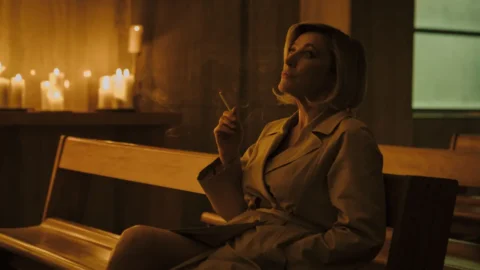
During the preparations for a party – a white party, which seems a bit parvenus when reproduced in the province – the little girl notices hundreds of ants on the lawn forming a crazy spiral, a harbinger of the crack that is about to open up in theapparent perfectionShortly after, Alice is bitten by the family pitbull and risks losing a leg. This is the trigger for the spiral, which will see Anna, terrified by thecrack of the family picture—who would want her, disabled? Certainly not advertising—literally forced to make a deal with the devil, who here wears a beautiful trench coat and is played by Valeria Bruni Tedeschi in one of the best roles ever.
Fire-red nails and lips, a cigarette in her mouth, a perfectly blonde bob. It's the stranger who bursts in and shakes the family to its foundations: the little girl's leg can heal, as long as someone pays...
Paolo Strippoli directs a cast of first-rate actors (besides Jasmine Trinca and Adriano Giannini, Romana Maggiora Vergano is an absolute confirmation and Valeria Bruni Tedeschi steals the scene) in a psychological thriller from the horror codes: 'folk' – that is, rooted in the territory, legitimate heir of Avati's Po Valley Gothic moved further south – and auteur – 'elevated', according to the international nomenclature.
Even in “The Stranger”, as in his previous works, the director explores the family relationships – here the mother is at the center – and the fragilities of a society whose Catholic roots appear only superficial. To the extent that religion is used as a compensatory mechanism in times of pain, Strippoli seems to observe, it is emptied of spiritual meaning, to the point that a Faustian pact can be made within the walls of a chapel.
In “The Stranger”, the sacred is profaned both by a “coin-pay” faith in times of need and by the fanaticism lavished on new pagan rites, like football fandom rising to a new level: the celebration of the World Cup victory visually evokes a hellish Sabbath, and the thronging crowd is yet another manifestation of the spiral. Until the whirlwind finale, which, under the torrential, cathartic rain, frees us from the family trauma.
At Cinema
Production: Italy/France/Belgium 2026, Director: Paolo Strippoli, Screenplay: Salvatore de Chirico, Paolo Strippoli, Editing: Federico Palmerini, Photography: Cristiano Di Nicola, Main cast: Jasmine Trinca, Adriano Giannini, Romana Maggiora Vergano, Valeria Bruni Tedeschi, Running time: 115', Distribution: 01 Distribution.