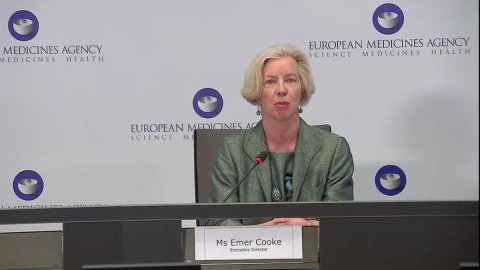
"IThe AstraZeneca vaccine is safe and effective in protecting citizens and preventing the disease from Covid-19”. This is the clear and unequivocal answer given by Emer Cooke, director general of the European Medicines Agency, during the press conference convened this afternoon, to illustrate the results of the analyzes conducted by the Authority's safety committee. The Member States of the European Union will therefore have to resume administering the vaccine and accelerate vaccination campaigns, the only way to counter the spread of the pandemic. France resumed administration on Thursday afternoon, Italy resumed on Friday.
The green light from the EMA had been awaited since Monday, Germany, Italy, France and Spain, preceded by other European countries, they decided to temporarily suspend the administration of the Anglo-Swedish vaccine as a precaution following the reporting of some adverse events, in order to verify if there was a causal link between the vaccine and the cases of thrombosis that occurred in various countries. In light of the results, Italy will resume vaccinations on Friday afternoon
The EMA safety committee (Prac) excluded "relationships with cases of thrombosis", establishing that "the benefits of the vaccine outweigh the risks. The EMA safety commission found no evidence of quality or batch problems. Sabien Straus, number one of the Prac, also highlighted that the cases of thrombosis that have occurred in the last few weeks after the administration of the AstraZeneca vaccine "are lower" than those recorded among the unvaccinated population. However, a link with the rare thromboembolic cases cannot be excluded and therefore it is necessary to warn of these possibilities, explained the director of the EMA, Emer Cooke. Precisely because of these "very rare cases", "the AstraZeneca vaccine package leaflet needs to be updated: It is important that it is communicated to the public and healthcare professionals to better understand this information, allowing them to mitigate these side effects,” added Straus. Responding to journalists' questions, the president of the Prac specified that she was right suspected events of thrombosis are 25 out of 20 million vaccinated: “seven in Germany, three in Italy, two in Norway, one in Spain, as well as three in the United Kingdom and two in India”.
The agency also reassured citizens that it will continue to investigate: “We will launch further insights to understand more”, said the director of the agency.
THE AIFA VERSION
“The current version of the Assessment report, or summary of the data, clearly states in the conclusions that no link between these rare events and the vaccine has been established in question. That is, they are events reported but in which a causal link is not established. In any case, analyzing the complex of phenomena that have occurred, this can lead to some recommendations for use that are currently being evaluated”. This was what was stated in the morning by Nicola Magrini, general manager of Aifa, in a hearing in the Social Affairs Commission regarding rare thrombosis in some people vaccinated with Astrazeneca. Such events, he said, ”they had a known baseline risk".
THE UNITED KINGDOM'S OPINION
The British Medicines Agency (Mhra) also intervened on the matter, which formally excluded that there is any evidence of a link between the use of the AstraZeneca anti-Covid vaccine and the individual cases of blood clots diagnosed in some people after administration. The authority therefore has recommended to continue inoculating this vaccine, which by the way the United Kingdom has never suspended and with which it has vaccinated millions of citizens.