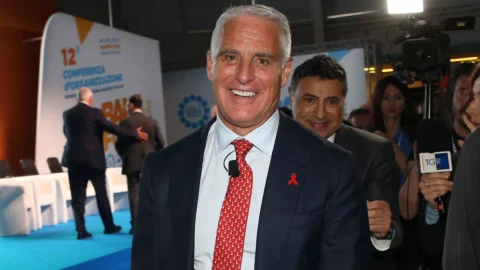
The tenant of Piazza Gae Aulenti, while preparing for theshareholders' meeting in two weeks, exposes the different aspects of theoperation on Commerzbank and reaffirms the benefits of the integration between the two banks, rejecting criticism. While the German bank opposes its advances, Unicredit CEO Andrea Orcel, as a significant shareholder, stressed this morning in a video conference, how the German bank in its current form is unable to cope the future challenges of the banking sector and specified what the changes should bring to increase their profits.
Unicredit, which owns nearly 30 percent of Commerzbank, last month submitted an all-share takeover bid for its rival, worth $1.5 billion. almost 35 billion euros. The Unicredit title this morning at mid-session it is down by almost 2%, in a FtseMib that is losing 1,40%. German bank is up 1,50%
The two plans compared: Commerzbank's Momentum and Unicredit's "Commerzbank Unlocked"
The CEO of Unicredit thus wants to put the market before a choice, contrasting two trajectories for Commerzbank: on the one hand, Momentum plan presented by Commerz, on the other hand the Unlocked strategy proposed by Unicredit. "Unlocked clearly surpasses Momentum," not only quantitatively but also qualitatively, he said.
Unicredit believes that Commerzbank, with the Momentum plan, isoverly concentrated on achieving results short term, while he would have significant growth and risk reduction potential capable of generating further value. As part of Unicredit's plan "Commerzbank Unlocked“, the German bank would reach in 2028 a net profit of approximately 5,1 billion euros or 600 million euros more compared to the current market consensus of 4,5 billion euros. Any upward revision of Commerzbank's profit target would add to this difference, as the measures proposed by Unicredit are of a structural nature, Orcel told analysts: “Commerzbank risks becoming increasingly less suited to a rapidly changing banking environment.” “Our assessments are based on publicly available information and arise from the application of the proven experience of UniCredit Unlocked, which has produced excellent results and a highly convincing long-term sustainable model, both at Group level and in Germany, implemented with low execution risk.”
Unlocked aims for a clean break based on three pillars. The first pillar is the refocusing: "bring Germany, the Mittelstand, families and Poland back to the centre", reducing non-core activities to "lower risk and free up resources". The second is optimization: a “disciplined and structural approach to productivity”. The third pillar is theupgrade: a transformation that “structurally reduces earnings risk” and builds “solid operational and financial safeguards,” with the aim of “more resilient and sustainable returns through 2030.”
Unicredit's participation should not go much beyond 30%
UniCredit added that, given the low premium offered, his participation it shouldn't exceed 30% by much, a hypothesis that, according to Orcel, is confirmed by current indications. “One possible scenario is that we expect a low adhesion, and we're happy about it. Financially, we win, we relax, and people will probably thank us in two years because we could have made a better deal,” Orcel said.
Commerzbank's troubles revealed by Orcel
Commerzbank, Orcel continued, has a “q“disproportionate amount” of non-personnel costs that Unicredit can address, based on the reorganization it has already implemented in its HVB local branch. He also said that the “bureaucracy” at Commerzbank is “rampant”, offering margins for cost cuts, most of which would have affected the bank's international network rather than Germany.
La growth appears disharmonious: "Non-core international expansion is proceeding at a rate approximately 25 times faster than that of Germany," with "limited ties to domestic business and Poland." The result is a development that does not strengthen the bank's industrial core.
Then there is also a lack of strategy"ambition and concrete measures are lacking for sustainable growth and for the transformation of the German franchise”. In the absence of structural interventions, “there are no safeguards capable of supporting future performance”, nor of avoiding “further restructuring”. The Momentum plan thus remains exposed to favourable macro conditions and temporary levers.
Moreover, it is evident how the Loans in Germany "remain essentially flat", while growth is concentrated elsewhere. Estimates indicate "a cost-income ratio of 51% in 2028", compared to "around 32% for HypoVereinsbank". Even the cost management It is criticized: “the base continues to expand and no restructuring costs are foreseen for the period 2026-2028”.
On the front revenues, performance remains "heavily dependent on favorable macroeconomic conditions and financial factors", leaving the model "insufficiently transformed to compete in the future". Even the stock market dynamics It is emphasized: "after Unicredit's entry, Commerzbank appreciated by more than 20% compared to the sector, despite still weak fundamentals."
With the potential merger, Unicredit expects a net profit of 21 billion by 2030.
The objectives indicated can be achieved standalone, but Orcel also relaunches the option of the fusion: “the combination between Unicredit and Commerzbank would create the leader in Germany” and “a federal pan-European group”, more competitive on a global scale. The estimated synergies are “around €1,1 billion in pre-tax value by 2030,” against “€1,6 billion in investments,” with benefits in scale, funding, and products. “One plus one can be worth much more than two,” said Orcel. On the other hand Unicredit foresees un Net income di approximately 21 billion euros in 2030 following the merger with Commerzbank and estimate Net revenues for approximately 45 billion euros and costs of less than 14,5 billion euros in 2030.
The German government remains firm: a hostile takeover would be "unacceptable."
La position of the German government The agreement on UniCredit and Commerzbank is well known and unchanged, a Finance Ministry spokesperson responded this morning, adding that Berlin supports Commerzbank's independence strategy. "A hostile takeover would be 'unacceptable,' especially considering a systemically important bank like Commerzbank," the spokesperson said in a statement.
The next deadlines
An extraordinary meeting of UniCredit shareholders will be held on May 4th to authorize the capital increase to service the offer. The offer is expected to formally launch immediately thereafter, with a four-week acceptance period. Meanwhile, UniCredit is awaiting the ECB's approval of its capital increase program. buyback of own shares 2025, worth €4,75 billion. The buyback will begin only after the closing of the offer subscription period and will depend on the final level of subscriptions. Piazza Gae Aulenti specified that the dividend policy will have no impact.