In 1992, Italy and France explored the feasibility of a new link across the Alps between their two countries. The company tasked with carrying out the preliminary geological surveys and initial feasibility studies was GEIE Alpetunnel, the result of an agreement between Ferrovie dello Stato and SNCF (French National Railways). In 1996, France and Italy signed the four main international treaties for the project's construction. In 2015, the parliaments of their respective countries ratified the agreement, which paved the way for final construction.
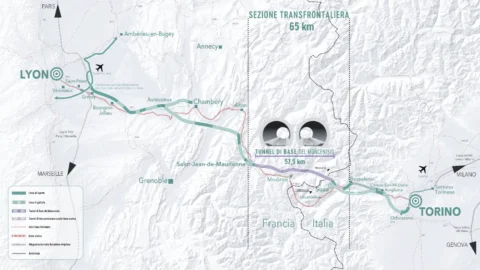
The heart of the Turin-Lyon project is the cross-border section, a 65-kilometer route that extends from the Susa Valley to Maurienne, in France. The most impressive work is the Mont Cenis Base Tunnel, two parallel tunnels 57,5 kilometers long (it will become the longest railway tunnel in the world) which, at the base of the mountain, will accommodate the tracks intended for passenger and freight traffic.
Adding to the complexity of the system are the 204 connecting branches, one every 333 meters, which will connect the two tubes, as well as four descents: three on the French side and one on the Italian side. These vertical tunnels have had—and will have—three key functions: first, to investigate the mountain's geology, then as operational access points during excavation work, and finally as essential corridors for maintenance and to ensure emergency access once the line is operational.
What stage are the works at?
The cross-border section of the work has now reached the 27% progress, with a total of 164 kilometers of tunnels to be constructed, of which 18,5 kilometers have already been excavated. Over a quarter of the southern tunnel is complete.
Sul French sideOn the Saint-Jean-de-Maurienne plain, the first railway installations have begun: long welded rails and switches between the Longefan and Arvan viaducts. In Saint-Julien-Montdenis, the final lining of the base tunnel's entrance tunnel began in August, with the pouring of the first 10-meter segment. Traditional excavation is continuing in parallel on both sides.
In Saint-Martin-la-Porte, the TBM Viviana (the gigantic fresh excavator), after rotating on its main axis, has begun its march towards Modane. At the same time, in the La Praz section, conventional excavations, tunnels, and technical caverns to support underground logistics are progressing. In the Avrieux area, work is underway on the ventilation shafts: the support for the last of the three already excavated has been completed, and waterproofing and lining work on the second is in the final stages, while the Raise Boring Machine Drilling of the fourth well is underway. Also underground, in Villarodin-Bourget/Modane, work is underway on extending the access shaft, the eastern logistics cavern, and the connection to one of the main tunnels. Outside, conveyor belts for excavated material disposal are being installed.
Sul Italian sideIn Chiomonte, construction of the new A32 construction site junction has been completed, scheduled to open in December. Meanwhile, demolition work continues on the forecourt, a prelude to the construction of the Berlinese and the start of excavation of the Maddalena 2 tunnel, from which the Italian TBM will depart.
In Susa, the third phase of archaeological investigations is underway in the San Giacomo area, while in Salbertrand, the war reclamation and the laying of foundation piles for the abutment of the new bridge over the Dora are underway. Finally, in San Didero, in the area designated for the new trucking terminal, the final two spans of the ramps connecting to the A32 motorway have been completed.
The deadline is set for 2033
The Turin-Lyon project can count on significant support from the European Union, which can finance up to 50% of the work – and up to 55% for the base tunnel – within their seven-year budgets. Brussels has already allocated €700 million for the 2021-2027 cycle, while discussions are underway for the subsequent 2028-2035 period.
Traditionally the Union has never exceeded 1 billion in funding in a single seven-year period, but the Commission itself has underlined that the Turin-Lyon is a long-term project, which requires investments spread across multiple budget phases at both the EU and national levels. This means that the funds can be distributed across multiple cycles, ensuring continuity and economic sustainability.
In addition to the European contribution, the possibility remains open that Italy and France could increase their share direct investment, further strengthening the strategic role of the project for both countries.