

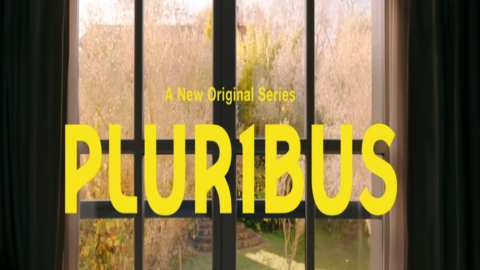
The first season of “ has just endedPluribus”, the new Apple TV series from Vince Gilligan, the author who, together with Peter Gould, created “Breaking Bad."and "B”, for a total of 126 awards and 440 nominations.
At the heart of the new series is Rhea Seehorn - the kim wexler di B, a feisty lawyer and partner of Saul Goodman – called in “Pluribus” to hold up the whole emotional architecture of the story.
Pluribus in unum
Interprets Carol Sturka, Writer frustrated of feuilleton successful and irreducible survived the Joining: a sudden and catastrophic event that took her partner Helen away from her. It happened that an alien virus, the nature of which is unknown, struck all humanity, transforming it into a single collective mind with the promise of eliminating lie, evil, violence e establish la happiness collective.
“Pluribus” derives its name from one of national mottos of United States of America, "E[x] pluribus unum"- from many, one – which stands out on the coat of arms of the nation in a golden scroll held in the eagle's beak.
Il sense of a series of it is though opposite to to that of the motto and can be rendered as “Pluribus in unum”: no more from many, one, to indicate pluralism in the union, but many in one, concrete mixing of plurality in a unique collective amalgam.
This is precisely the joining in Gilligan's narrative universe: "the others", the approved ones, they move and think in unison, sharing a total knowledge. personal identity si dissolves the name of the common good.
We and I
They don't say anymore "I", but "we". Carol, not approved, it's a'living anomaly, a non-joined one that can destabilize the system. No it can however be eliminated: the public moral code of the new order forbids it.
It must instead be persuaded to enter it voluntarily. strategy It's twofold: to show her the magnanimity of the system, capable of satisfy every whim and also seduce her, or confine her in a golden and alienating solitude.
More often, combining cunningly both modeIt is in this liminal space, Between promise of happiness e threat of isolation, which “Pluribus” places its own fundamental conflict.
The narrative universe of Pluribus It transforms the meaning of Christmas—peace, harmony, communion of spirits—into a stable normative precept for humanity. Every day is Christmas: imposed serenity, forced sharing, absence of conflict.
But this collective Eden is also artificial and shatters against the resistance of Carol Sturka, who remains the only authentically human presence in a silent New Mexico, the theatre of her existential conflict.
The landscape
One of Vince Gilligan's many merits is his ability to integrate the climatic, geological, faunal and anthropogenic elements of New Mexico into the narrative fabric, elevating them to true narrative devices.
The landscape, in its intense, saturated, and arid colors, ceases to be a backdrop and becomes meaning: it gives meaning and is the semantic engine of the story, articulating central themes such as solitude, fragility, persistence, harshness, and moral vastness.
It is the same landscape that colonized the pictorial imagination of Georgia O'Keeffe: having arrived in New Mexico from New York, she made it the center of her research and the iconography of the last forty years of her activity.
Carol's Theft
Let's go back to Carol. We are in episode 7"The Void." Loneliness begins to take its toll: "the others" have chosen to distance themselves, leaving her alone with her stubborn resistance. Around her remain only things and animals.
Now that the city is all his, he makes a symbolic gesture. He gets into a stolen Rolls-Royce, still emblazoned with the “Just Married” sign, and drives to Santa Fe, 90 miles north of Albuquerque.
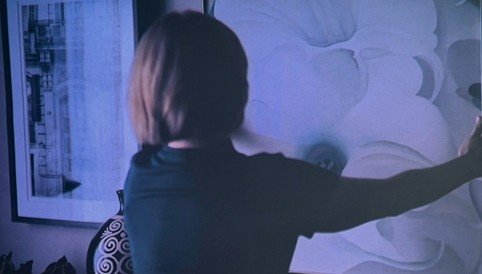
In Santa Fe enters the Georgia O'Keeffe Museum, bright and deserted. From one wall it detaches Bella donna by Georgia O'Keeffe and, once she returned home, replaced the reproduction of the painting in the living room with the original.
She sits and contemplates it, seeking in that aura of authenticity the comfort that people can no longer offer her. But it's a fleeting relief: things, even the most precious, cannot replace human beings.
If everything is possible
Carol isn't committing this theft for money. There's no longer an art market, nor collecting: there's no exchange, no economic value. The virus has made necessity, need, disappear. Technology has taken over everything.
Carol's gesture is more desperate and profound, more existential: it arises from her being radically and irremediably alone while "the others" live fulfilled and connected in the hive-Commune.
In theory, Carol can do anything. Play golf with bison, dine at the most luxurious restaurants in Las Vegas, bathe naked in the caldarium. It's absolute, luxurious, dizzying freedom: the kind we all claim to desire.
Who among us would not want to enter the Louvre, disconnect La Gioconda by Leonardo da Vinci and hang it in your living room? Or dine as a guest at the world's most exclusive restaurants? Or travel in a Rolls-Royce?
This boundless freedom, however, is destroying Carol. She gives no meaning to anything, and even the much-admired painting ends up creating a perfect short circuit between the consoling power of art and the impossibility of sharing it.

Bella Donna
The painting that Carol steals from the Santa Fe museum and hangs in her living room is perhaps not chosen at random by Gilligan. It is Bella donna by Georgia O'Keeffe, a 1939 poster-sized oil painting.
It depicts two large corollas of belladonna, a lush and poisonous flower. One is open, revealing intimacy; the other, tilted, hides the pistil. Fleshy petals, swirling folds. An intense, ambiguous sensuality.
O'Keeffe thus paints a perfect metaphor: something that fatally attracts while intoxicating and annihilating. This is what Zosia represents, the avatar charged with caring for Carol and leading her into the Commune's fold.
Carol begins to feel her allure, to feel attracted to her, even though she knows that Zosia is a charming, sweet, caring presence but devoid of her own will: a programmed simulacrum, a doppelgänger. A double, indeed.
The painting that Carol contemplates in her absolute solitude thus becomes the mirror of an impossible desire that begins to consume her: desiring what promises comfort, but leads to the annihilation of her own identity.
Original and copy
There is a further level of reading. I O'Keeffe's monumental flowers They were interpreted by critics—predominantly men—as symbols of female sexuality. This interpretation persists to this day. O'Keeffe always forcefully rejected this reading as reductive and sexist. She claimed she painted flowers, enlarged to force people to truly look at them, to observe them intimately.
Yet the erotic ambiguity of the forms remains undeniable, inscribed in the matter and in the very openings of the painted flowers by the painter, who created over two hundred of them during her life.
Gilligan may have chosen Bella donna for this stratification: Carol contemplates the flower as a paradigm of the female body, while she begins to feel a terrifying desire for Zosia.
The painting condenses these existential and instinctual tensions. Thus, after episode 7, a new chapter opens in Carol's life, perhaps irreversible, certainly dramatic.
The lands of Georgia
The link between the remains fascinating and unambiguous New Mexico landscape and the pictorial work of Georgia O'Keeffe, who transformed those lands into a heritage of the universal imagination.
In December 2025, New Mexico announced a plan to protect 2.400 acres at Ghost Ranch, where O'Keeffe lived and worked. The views that inspired paintings such as My Front Yard, Summer, 1941 they will be preserved in this way.
A public-private conservation plan, promoted by the Democratic governor of New Mexico, legally preserves this landscape, consigned to art history by one of the greatest artists of the twentieth century.
even the Cerro Pedernal, The flat-topped mesa, painted several times by O'Keeffe, is now protected. Development threatened the areas around Lake Abiquiu, which will be preserved in this way.
Preserving places of art means safeguarding the roots of the creative act. How impossible it would be to understand Perugino without the Umbrian landscape, similarly O'Keeffe's work remains inseparable from the lands that inspired it.
Without these New Mexico locations, visible in their original state, O'Keeffe's paintings would risk being reduced to mere abstractions, severed from the physical and spiritual reality from which they were born. And no one wants that, not even real estate developers.


![E[x] pluribus unum](https://it.wikipedia.org/wiki/E_pluribus_unum#/media/File:Great_Seal_of_the_United_States_(obverse).svg)

