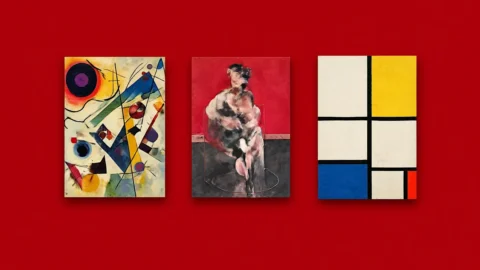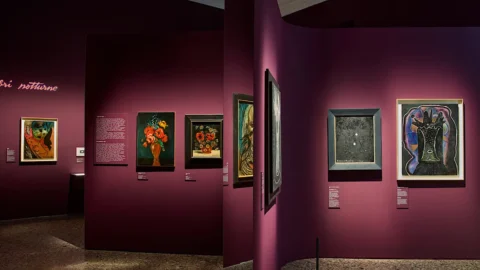
The exhibition brings together over 170 works, including paintings, drawings, photographs, and archival materials from international museums and collections. The exhibition is curated by Anne Berest Picabia, the artist's great-granddaughter. Picabia was one of the most unconventional protagonists of 20th-century art. He explored Impressionism, Fauvism, Cubism, and Dadaism, even approaching abstraction, without definitively identifying with any one movement. His relationships with Marcel Duchamp, Pablo Picasso, and Gertrude Stein reflect the cultural ferment of an era in which art was questioning its own rules and the very way of representing reality. His constant transformation is not merely a stylistic affair. It is a declaration of independence: the artist rejects the obligation of formal coherence when it risks becoming a prison. Changing language means continuing to question the world, escaping established formulas, and keeping open the possibility of research.
The night as a space of freedom
The exhibition's title identifies night as a metaphor for life, desire, and reinvention. The exhibition does not simply follow a chronology, but constructs an immersive journey, conceived as a night spent in the artist's company, from dusk to dawn. Love, music, dance, family origins, war, and collective creation become keys to understanding a complex universe. Night is here the time when identities transform and certainties weaken. It is a space in which contradictions, desires, and unexpected possibilities can emerge. In this sense, Picabia's work continues to speak to the present: it invites us to distrust definitive classifications and to recognize freedom of thought as an essential condition of creativity.
Beyond the avant-garde
The exhibition invites us to reread Picabia not only as a protagonist of the artistic revolutions of the twentieth century, but as an interpreter of a more general condition: the need to continually question one's own certainties. In a world that tends to classify, define, and make people and cultural productions immediately recognizable, his experience suggests a different perspective. Creativity does not always proceed through accumulation and refinement; it can require ruptures, deviations, and even abandonment. Not every change represents a loss of identity: sometimes it is a way to prevent identity from becoming a prison. This is the lesson that makes Picabia still relevant today. His work reminds us that culture thrives on the possibility of experimentation, of navigating contradictions, and of opening unexpected paths. Art is not only a testimony to what an era has produced, but also a space in which to imagine what does not yet exist. At Palazzo Reale, the exhibition dedicated to Picabia thus paints a portrait of an artist who made transformation a choice of freedom. Reinventing oneself, from this perspective, does not mean denying the past, but preventing it from becoming a limit to the future.
UNTIL JANUARY 24, 2027 – Royal Palace of Milan
EDITED BY ANNE BEREST PICABIA
Credits:
Edited by Anne Berest Picabia
Produced by Palazzo Reale and MADEINART
Promoted by the Municipality of Milan
Patronage of the Consulate General of France and the Institut Français
Catalog published by Skira
Urban Vision Partner
Images by Andrea Veggian x GC Agency