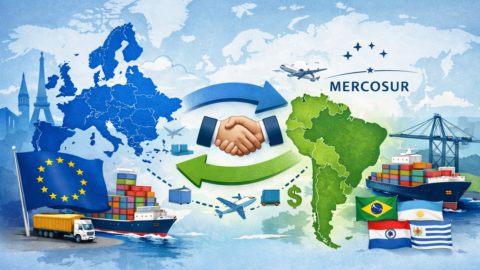
Gray smoke for the EU-Mercosur agreement. After voting against it in last week's EU Council, French President Emmanuel Macron warned: "The issue will not end with the signing of the treaty." Indeed, after Ursula von der Leyen's signature, last Saturday in Paraguay with the leaders of the participating South American economies, Parliament's ratification still had to be awaited, expected in spring. But it will not arrive: today a motion presented by the Left, the Greens and the Patriots (the latter group also includes Matteo Salvini's League, a member of the Italian government who had just voted Yes) passed by 10 votes and has the decision was referred to the judges of the European Court, which could take up to two years.
A setback for von der Leyen. Merz: "The agreement should apply provisionally."
A blow therefore for the President of the Commission Von der Leyen, who had claimed victory for an agreement awaited for over 25 years and which from a certain point of view was like bread to consolidate the trade axis with South America and protect yourself from Donald Trump's hostility, but which on the other hand worries some productive sectors, particularly the agricultural sector. In fact, in addition to France, Poland, Ireland, and Austria, for example, had voted against it, while the main supporters of free trade with Brazil, Argentina, Uruguay, Paraguay, and in the future Bolivia, were primarily Germany and Spain. It's no coincidence that Chancellor Friedrich Merz was not pleased: "The agreement should be applied immediately on a provisional basis," he said immediately after the event. "Parliament's decision is absolutely irresponsible, it's an own goal."Bernd Lange, MEP and president of the International Trade Committee, went down hard.
The world's largest free trade area is at risk.
It should be remembered that what should be born between Europe and South America will be the world's largest free trade area, involving over 700 million people and economies that together exceed 22.000 billion dollars of GDP. We are talking about a quarter of global GDP and the agreement provides for the abolition of almost all duties progressively over the next 12-15 years, having increased the safeguard clauses and the "emergency brakes", that is, the possibility that Brussels has reserved to reintroduce tariffs if the import quota were to exceed certain strictly established thresholds. Yet not even this was enough to reassure the opponents of the Empa (European Union and Mercosur Partnership Agreement), worried about unfair competition from South American agriculture and the disparity in health and environmental regulationsNo comment from South America so far, but there is widespread irritation over an agreement that, especially from their point of view, is deemed indispensable and urgent.