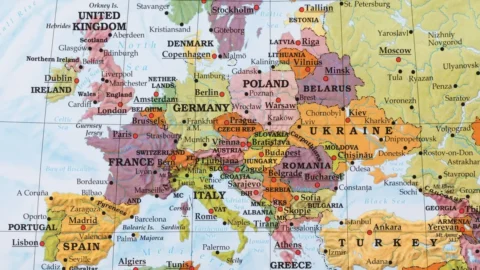
“The list of structural problems of Europe is very long. Some of these problems are common to other regions of the world." Which ones? The demographic issue and aging of the population, visible throughout the West, in China and in Japan. fiscal crisis what follows and the increasing recourse to debt they are also an issue that involves the entire developed world. “What Europe has of its own is the low growth, productivity increasing little, the difficulty in catching up with the trains of technological innovation, the most expensive energy in the world, a confusing and costly energy transition. And then, again, high taxation, a tendency towards hyperregulation, a political fragility that often produces minority national governments." To these already serious problems are added a weakening of geopolitical status and growing international isolation. Europe's image in the rest of the world is tarnished, to say the least.
It is from these considerations that the December 2025 edition of the podcast “On the 4th floor"With Alessandro Fugnoli.
Trump's criticism of Europe
The strategist of Kairos Partners Sgr recalls the accusations against the Old Continent that are raining down from Russia and the cooling of relations with China, underlining however that "those that are most striking, coming from a historic ally, However, there are criticisms from the Americans”. First theand allegations contained in the annual National Security Report Then came a new attack during an interview with Politico, in which he called European leaders "weak," denouncing their handling of immigration and the Ukrainian conflict. "I think they want to be so politically correct. They don't know what to do. Europe doesn't know what to do," the US president said.
According to Fugnoli, the White House's two criticisms of Europe can be read "as part of the domestic American debate, within which there are obviously points of view much more favorable to a continuation of close Atlantic relations."
Europe's strengths
These tensions could lead some investors to assume a particularly cautious attitude towards Europe. "It would be a shame – observes the strategist – because Europe is showing, in addition to its weaknesses, undoubted strengths".
And the list isn't even that short. The renunciation of theRussian energy It had costs, but it did not lead to a recession. There was deindustrialization in energy-intensive sectors, but the rest of theindustrial apparatus has held and even the automotive sector, the sector in the most difficulty, is starting to send some positive signals again. Trump's tariffs and the devaluation of the dollar were absorbed without traumaThe current account surplus narrowed slightly, a sign that competitiveness was not compromised.
And again: the public accounts, for their part, are not as out of control as one might imagine, including those of France and Germany, the two economies that have caused the most concern in recent months. "The fiscal deficit at the European Union level was 3.1% in 2024, 3.3% in 2025, and 3.4% in 2026. As can be seen, it is much lower than the 6.2% forecast for America next year. In exchange for a few decimal points of additional public deficit, Europe will see a doubling of its growth rate towards the end of 2026, which is historically 1% per year and will gradually increase to 2% in the fourth quarter of next year," the strategist notes.
The outlook for European equities
“The outlook is so favorable that Isabel Schnabel, the authoritative German representative at the ECB, says that there will no longer be any need for cut rates and that the next adjustment will be upwards, probably in 2027. profits of European companies, which have remained stable this year, will grow by ten percent in 2026, in line with those of American companies but without the uncertainty linked to developments in artificial intelligence”; observes the economist.
“Without triumphalism, we can therefore say that European stocks will be able to rightfully sit alongside America and Asia in investors' portfolios next year,” concludes Fugnoli.