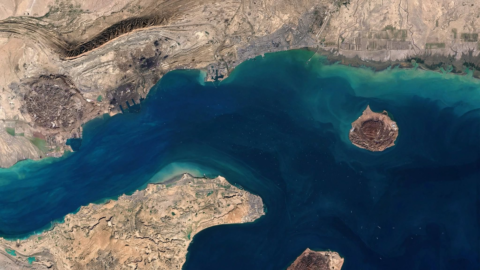
The clash between the United States and Iran has once again inflamed the Middle East after weeks in which a new diplomatic opening seemed possibleOver the night from Sunday to Monday and again on Monday, August 31, Washington struck Iranian targets again, specifically rocket launchers on Larak Island in the Strait of Hormuz. According to the United States, the operation was conducted after identifying Iranian preparations to plant mines in the strategic stretch of sea.
Tehran's response was not long in coming: Iran launched missiles at U.S. bases in Jordan and threatened to strike American interests in the region. The United Arab Emirates also reported intercepting a drone from Iran, but denied reports that the Al Minhad base had been attacked.
Trump threatens: "We'll hit hard." He posts a fake attack on social media.
Donald Trump reacted with a new verbal escalation. The American president has promised that the United States will respond “strongly” to Iranian attacks He called Iran a country now in dire straits, including economically. Trump spoke of Iranian inflation reaching 300% and claimed that Tehran's military capabilities had been severely scaled back.
In the last few hours, Trump also stated that Kharg Island, one of Iran's main oil hubs, had been subjected to heavy bombardment. This statement has not been accompanied, at least so far, by sufficient details to precisely determine the extent of the attack. The White House's language therefore remains extremely harshIn recent days, Trump had also declared that the United States controls the Strait of Hormuz and that the passage of ships would be subject to American control.
Making the escalation even more disturbing was a video posted by Donald Trump on social media. The footage shows massive explosions on Kharg Island, one of Iran's main oil hubs, accompanied by the US president's message that the island had been "torn to pieces." But the footage does not document an actual attack: Reuters has verified that the video was generated or manipulated with artificial intelligence, and in the hours that followed, no evidence emerged of a US bombing of Kharg.
The Strait of Hormuz at the center of the conflict
Hormuz itself is one of the main points of tension. A key portion of global oil traffic passes through this strait, and any prolonged blockage risks immediate consequences for the international economy. Tensions have already driven up oil prices: Brent crude exceeded $90 a barrel yesterday, while maritime traffic remains well below pre-war levels. Reuters reports that oil shipments have partially recovered from their March lows, but remain heavily impacted by regional instability.
Washington accuses Tehran of using control of the Strait as an economic and strategic weapon, but truth be told, the opposite could also be said. And in fact, Iran, for its part, considers the American military presence in the region a direct and direct threat. continues to challenge sanctions imposed by the United States.
From war to diplomacy, and back again
The current escalation comes after a series of diplomatic attempts that had raised hopes of a truce. In early August, Trump announced the suspension of a new massive attack against Iran, claiming he wanted to give space to a possible agreement on Iran's nuclear program and on the reopening of the Strait of Hormuz.
Ma the negotiations did not produce a definitive solutionTrump later clarified that he was "in no rush" to reach an agreement, while Tehran disputed several American accounts of the talks. The conflict, which began with the first US and Israeli attacks on February 28, is now in its seventh month.
Despite the attacks, Tehran opens a glimmer of hope
Despite the renewed fighting, apparently conciliatory signals are also coming from Iran. President Masoud Pezeshkian He declared that the continuation of the war is not in the interests of Iran or the region and expressed his willingness to return to the path of diplomacy.
This is only an apparent contradiction: while attacks continue on the ground, both sides appear to be using military and economic pressure to reach a possible negotiation from a stronger position. Washington is focusing primarily on sanctions and pressure on the Iranian economy; Tehran instead seeks to maintain the ability to threaten American forces and influence traffic through Hormuz.