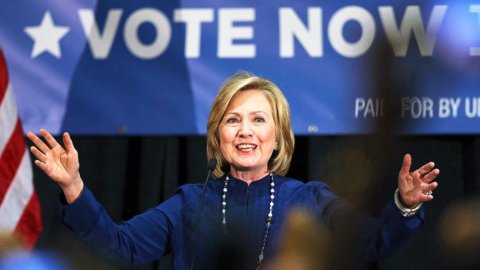
The outcome now seems obvious, and the game could virtually close as early as today: the American primaries, both on the Democratic and Republican fronts, face the vote of five East Coast states (Connecticut, Delaware, Rhode Island but above all Maryland and Pennsylvania), which are giving away an overall number of delegates which, if successful, would compromise the nominations of Hillary Clinton e Donald Trump in the presidential elections in November.
Both are very, very close to presenting themselves at their respective conventions with an unassailable majority: the former first lady, supported by the Democratic establishment, is missing just over 400 delegates out of the remaining 1.668 (of which 462 are up for grabs in today's five ); while to the entrepreneur, who received yesterday Matteo Salvini and that – on the contrary – he is disliked to say the least by the leaders of the Grand Old Party, less than 400 delegates are still needed, but there are “only” 674 up for grabs and the rules of the Republican convention could still put a spanner in his works ( the delegates can change their vote from the second ballot onwards, if the quota of 1.237 is not reached in the first).
On the other hand, the other two candidates for the Republican throne will not be able to put a spoke in his works: Ted Cruz is now an established flop, while the governor of Ohio John Kasich, moreover highly accredited in the polls in the event of a presidential challenge with Clinton or Sanders, is in a good moment but will hardly be able to recover the gap or - as in the real intentions of the party establishment - manage to remove some decisive delegates from Trump . The two also announced a clumsy alliance to stem Trump, but the press has already defined it as a failure: the goal was to divide the states according to where the two felt stronger, without hindering the other.
Il Washington Post however, he is also recognizing the merits of the 70-year-old tycoon, who after having reached the peak of trash in March, with gaffes beyond the limits of the unacceptable, he gave a "presentable" turn to his electoral campaign in April. First by hiring the new campaign manager Paul Manafort, much more pleasing to the historical leaders of the Republican party (in particular to the former mayor of New York Rudi Giuliani, a personal friend of Trump), and then, according to the WP, "by cutting his rallies: much more concise and incisive than to Cruz's prolix dialectic". And also by persistently insisting on the daily battle: after the vote in New York, which, moreover, saw yet another embarrassing triumph for the entrepreneur from intentions often misogynistic and xenophobic, “Cruz took two days off while Trump left for Indiana at dawn.” But above all, his campaign is increasingly supported by the ranks: “Trump sends his supporters a list of talking points every day, thanks to the answers to which he always knows what to say in debates. His campaign has begun to ensure that his voters are more involved and more cohesive ”, sanctioned the US newspaper.
The same press, on the other hand, continues not to be entirely convinced by the now imminent success of Hillary Clinton. After the clear victory in New York, the Washington Post always headlined "Hillary wins, but her reputation is at its lowest". As if to say: she wins, but she doesn't convince. The reasons, according to the newspaper owned by Jeff Bezos, are basically three: first of all, she is not a great "campaigner". “Her supporters – writes the WP – define her as a funny girl, but what she appears in public is one woody and fake candidate. The countryside is not her forte, unlike her husband Bill who was a master at this ”.
Then there is the question of e-mail. Too many, according to some commentators: "Hillary uses e-mail too much and she did it even when she was Secretary of State (at the time of Obama's first term, ed), which has damaged the perception - even among Democratic voters themselves - that she is really honest and trustworthy.” The third point according to the WP is the media overexposure: "The American people have known about it for decades, and overexposure is often a politician's worst enemy."
For his part, to the challenger Bernie Sanders it would take a miracle now to win. However, his electoral campaign was brilliant, at times compelling, and certainly sends a clear message to the top Democrats, as admitted by the vice president himself Joe Biden: “I like the idea of saying 'We can do much more', because that's actually the case, we can do it. We are the Democratic Party, we must think like this,” Deputy Obama told the New York Times. Why was this not enough to convince the democratic electorate? For a simple reason: according to Sanders himself, who has made the fight against economic and social inequalities his forte, it is because "The poor, in America, don't go to vote". Statement that has aroused some controversy but which is in reality absolutely supported by the facts: reading the data of the US Census Bureau, it is in fact very true that those with a higher level of education and greater wealth go out to vote more often.
Indeed, by far those who vote the most are citizens with advanced degree and with an income greater than or equal to $150.000. It is also true, however, that the "poor" who voted often preferred Clinton to Sanders: plus the Gini coefficient on inequality was high, the wider Hillary's margin of victory was. Not only that: in the vast majority of states in which there has already been a vote, the former first lady has won the vote of the segment of the population under $50.000 in income. For an equally simple reason, again explained by the Census Bureau data taken from the Washington Post: the poorest population is largely African-American, with whom Clinton has the greatest appeal. Appeal that is the legacy of her closeness to Obama, the first black president and darling of minorities: in reality, apparently, Hillary is not liked, but she could become the first female president of the United States.