The Guggenheim Museum Bilbao presents the installation of a spectacular work by Lucio Fontana in its Atrium, which visitors to the Museum will be able to admire for the next three years. La Neon structure for the IX Triennale di Milano, conceived by the great Italian-Argentine artist in 1951, it is a work that can be considered at the same time a drawing, a sculpture, a work of luminous design and an expressive trait frozen in the air, and the privilege of exhibiting it is the result of the exceptional collaboration between the Lucio Fontana Foundation in Milan and the Guggenheim Museum Bilbao.
The complexity of this work, which was part of the exhibition in 2019 Lucius Fontana. In the umbral, finds an exceptional interlocutor in the building designed by Frank Gehry, whose sketches scrawled on paper are reminiscent of Fontana's spatial arabesques. Due to its luminosity and size, the imposing neon deceives perspective and distance, giving the observer an intensified experience of the architecture, perceivable both from inside and outside the Museum.
Throughout his career, Lucio Fontana (Rosario, Argentina, 1899 – Varese, Italy, 1968) made space a theme of constant research and meditation, which he tackled in various contexts and using very different materials. After laying the foundations of the movement spatialist and his return to Italy in 1947, Fontana progressively embarked on the path of radical abstraction and experimentation. A pioneer in the use of the void as a generator of the work of art and its distinctive component, Fontana was a key figure in the development of numerous avant-garde groups - among them, the international group Zero -, as well as a point of reference for notable artists of later generations, such as Yves Klein, Jorge Oteiza and Jesús Rafael Soto. Despite being known throughout the world for his dazzling monochrome canvases, cut and pierced, Fontana always considered himself a sculptor and approached each work as a complete experience of color and gesture, time, depth, volume, material and light.
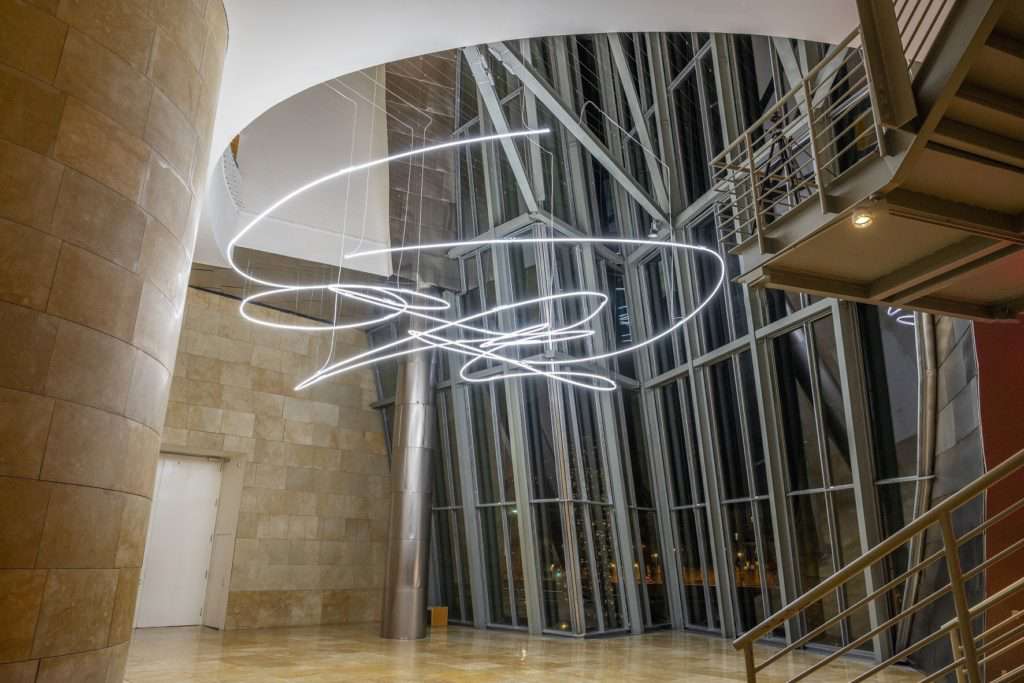
In the words of the president of the Lucio Fontana Foundation, Paolo Laurini, "the neon created for the 1951th Milan Triennale in XNUMX can certainly be considered one of the most representative and iconic works by Lucio Fontana, an absolute example of his disruptive creativity". For Laurini, the presentation of this work in the Atrium of the Guggenheim Museum Bilbao is exceptional because “the artist has always had a special relationship with architects, whom he felt were particularly close to his spatial sensitivity. The great naturalness with which the installation in Bilbao dialogues with the fascinating structure of the architect Gehry — offering suggestive and unprecedented visions and perspectives — makes us think of an ideal continuation of this relationship”.
La Neon structure for the IX Triennale di Milano it is one of the most resolute expressions of the concomitance between art and technology in the 1951th century. Executed with a surprising material for the aesthetic criteria of the period, the work is the result of a specific commission for the Scalone of the Milan Triennale in 1950. It is probable that Fontana responded, with his spatial neon design, to the famous lights" executed by Pablo Picasso in collaboration with the photographer Gjon Mili in XNUMX. To the use of electric light as an "exotic" material of the traditional arts, Fontana proposed, with his one hundred meters of contorted and chaotic neon tubes, a tour de force to the capabilities of the industry of the time, thus making effective one of the principles of the 1948 spatialist manifesto: "With the resources of modern technology, we will make artificial shapes appear in the sky, rainbows of wonder, luminous writings". At the same time, his structure unexpectedly combined the aesthetics of the Baroque, which he had so admired since his youth, with the technological program of the space age.