The exhibition itinerary – open until June 28th – unfolds as a journey from the geometric structure of snow crystals to the effects of climate change and overtourism in mountainous areas. Alongside contemporary artworks, photographs, videos, and installations, the exhibition features valuable ethnographic and scientific testimonies from around the world. Arctic and Tierra del Fuego populations play a central role, with insights into their adaptation to extreme environments and spiritual practices related to shamanism. Among the most significant pieces are a rare Sami shamanic drum from the Museum of Civilizations in Rome and the first complete reconstruction of a Selk'nam hunter's outfit, including the precious guanaco fur cloak preserved in the Civic Museums of Reggio Emilia. Many of the artifacts on display come from museums belonging to the MIPAM – Italian Museums with World Heritage network, established in 2025 on the initiative of MUDEC to promote dialogue, transparency, and best practices in the management of non-European collections. Several works will be on public display for the first time.
Three sections to tell the story of snow
The experience begins in the museum's Agora with the site-specific installation The Moment the Snow Melts by Japanese artist Chiharu Shiota. A cascade of threads and sheets of paper evokes a symbolic snowfall that reflects on human relationships, destined to emerge, transform, and dissolve like snow in the sun.
Snow between science and the climate crisis
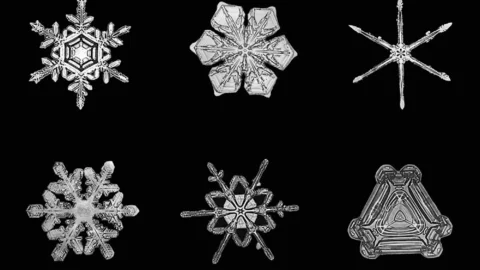
The first section is dedicated to scientific research. From the pioneering photographic studies of Wilson "Snowflake" Bentley, who took the first microphotograph of an ice crystal in 1885, to the classifications developed by Japanese physicist Ukichiro Nakaya, the exhibition explores the fascination with the geometric perfection of snowflakes. But the focus quickly shifts to the Anthropocene and the effects of the climate crisis. The melting of glaciers and perennial snows is altering landscapes once thought to be immutable and raising questions about the future of ecosystems. Contemporary artists such as Shimabuku, Francesco Clerici, Walter Niedermayr, and Philipp Messner address the issue of environmental transformation and the impact of mass tourism on the mountains. Zhang Huan reinterprets the 1956 Cortina Olympics through his work The Warm Snow.
From the Arctic to Tierra del Fuego
The second section takes visitors to the planet's most extreme regions. Here, snow and ice become keys to understanding the cultures, beliefs, and survival methods developed by populations such as the Inuit, Sami, Chukchi, Selk'nam, and Yaghan. Through everyday objects, hunting tools, and ritual artifacts, the role of the shaman as a mediator between the human and spiritual worlds emerges. Great attention is also paid to strategies for adapting to harsh climates: from igloos to sleds, from traditional skis to the clothing that still influences winter sports equipment today. The section also presents the Mario and Andrea Totolo Collection of Inuit objects, recently the subject of new research and currently on loan at the MUDEC.
Snow in art, from the Renaissance to the contemporary era
The final section of the exhibition traces the representation of snow throughout the history of art. Initially appearing as a simple scenic element in fifteenth-century works, snow became a central theme between the seventeenth century and Romanticism, especially in Northern European landscapes. Paintings by artists such as Gysbrecht Leytens interact with the famous Japanese ukiyo-e prints of Hiroshige, Kuniyoshi, and Kunisada, in which snow takes on symbolic meanings linked to purity and the passing of the seasons. Between the nineteenth and twentieth centuries, the theme was enriched with emotional and symbolist connotations in the works of Angelo Morbelli and Emilio Longoni, while artists such as Antonio Ligabue and Alighiero Boetti offered profoundly different interpretations, between figuration and conceptual metaphor. Photography, video, and installations further expand the contemporary narrative. Among the works on display, the historic performance Dry Ice Environment by Judy Chicago and the works of Pia Arke, which address issues related to the colonization of the Arctic regions and the identity of indigenous populations. The journey concludes with When Fox is a Thousand, a new installation by artist Summer Mei-Ling Lee: 85 rolls of cotton gauze transform the first-floor windows into a snowy landscape populated by mythological figures inspired by the sumi-e painting tradition. An exhibition that, through the universal language of snow, invites reflection on the relationship between humanity and nature, memory and change, tradition and future.
Cover image: Wilson Bentley
Snowflakes
beginning of the 20th century
microphotographs
Buffalo Museum of Science