The turnover of all the leading sectors of Made in Italy collapsed, from fashion to cars to furnishings. But the only one that resists is the agri-food sector. An analysis by Coldiretti based on a Mediobanca survey conducted among 2.800 family manufacturing businesses estimates an average drop in turnover of 11,1% for Italian industry.
Contrary to the other symbolic sectors of Made in Italy, such as fashion and automotive, which record drops in turnover of more than 20%, companies in the food sector score an increase in revenues, becoming the first wealth of the country with a supply chain value which exceeds 538 billion.
The agri-food sector is a reality extended from the fields to the shelves which guarantees - Coldiretti highlights - 3,6 million jobs and is worth 25% of the GDP thanks to the activity, among others, of 740 thousand farms, 70 thousand food industries, over 330 restaurants and 230 retail outlets.
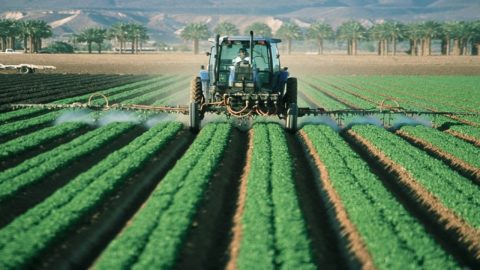
A widespread network throughout the territory that is supplied daily by the Italian countryside where stables, greenhouses and companies continue to produce despite the difficulties associated with the pandemic.
A supply chain that despite the difficulties has recorded continuous growth in exports, reaching the record figure of 44,6 billion euros in 2019 which shows a positive sign of +3% also in the first seven months of 2020.
"The global emergency caused by the coronavirus has brought out a widespread awareness of the strategic value represented by food and the necessary guarantees of quality and safety" says the President of Coldiretti Ettore Prandini in underlining that Italy can count on a world-leading resource but it must invest to overcome the present weaknesses, defend food sovereignty and reduce dependence on foreign supplies at a time of great international tensions”.
A national security objective for which important support - Prandini specifies - can come from the 209 billion made available by the Recovery Fund.
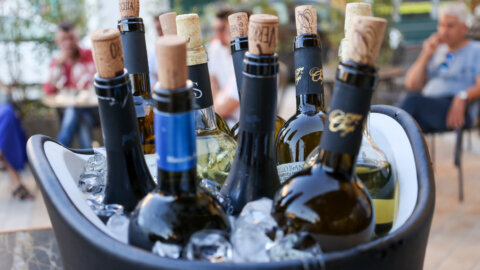
In fact, Italy can count on the undisputed leadership in the EU for food quality with 310 Dop/Igp/Stg specialties, including great cheeses, cured meats and hams, recognized at community level and 415 Doc/Docg wines, 5155 traditional regional products surveyed along the Peninsula.
Not only does Italy also have the leadership in the organic sector with over 60 organic farms and the primacy of world food safety with the least number of agri-food products with irregular chemical residues.
And Italy is also a leader in biodiversity. On the national territory - explains Coldiretti - there are 504 varieties registered in the vine register against the 278 of the French cousins and 533 varieties of olives against the 70 Spanish ones.
The Belpaese is the first EU producer of rice, durum wheat and wine and of many vegetables and greens typical of the Mediterranean diet such as tomatoes, aubergines, artichokes, fresh chicory, endives, celery and fennel. And also as regards fruit, it excels in many important productions: from fresh apples and pears, from cherries to table grapes, from kiwis to hazelnuts and chestnuts.
«This annus horribilis - underlined Francesco Sottile, of Slow Food Italy - is giving us back an extremely fragile vision of agricultural production, especially in the local food supply chains. From here we need to start to understand how to strengthen a production system that cannot remain on the margins of political interest, but must conquer ever greater space and give value to its contribution in favor of a real ecological transition. We need policies that look at the world of the small scale which is not so called because it represents a minority but only because it is made up of thousands and thousands of small farms which together represent pieces of a mosaic of inestimable value for the very important role which play from an economic, agronomic, ecological and cultural point of view. We cannot agree with any policy that gives greater strength to the industrial agricultural world by creating a fertile substrate for a production model that fails to take into consideration the value of biodiversity and the use of natural resources. If the agri-food sector in Italy and in Europe traveled with the same rules and opportunities for everyone, then we would begin to speak of a truly free market conditioned only by skills and know-how».